


History of Kyushu J7W Shinden (Magnificent Lightning)
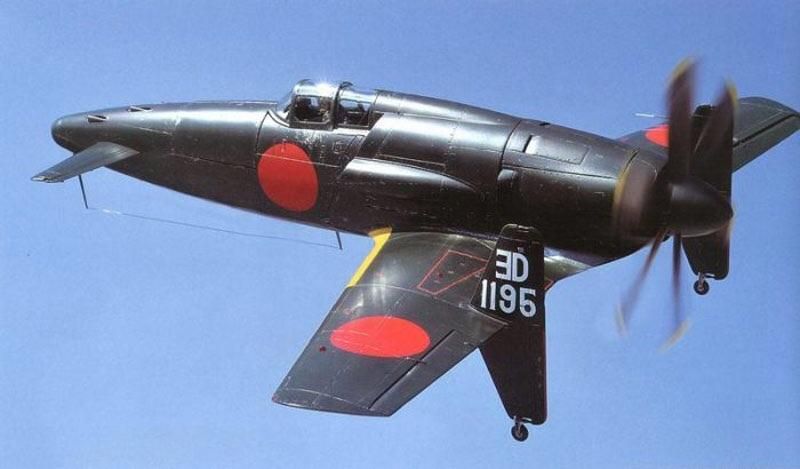
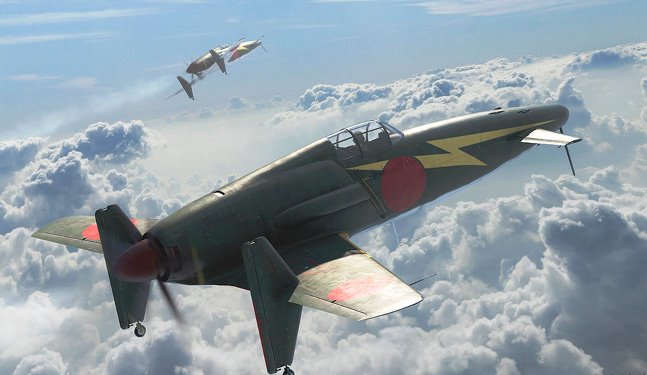
The unorthodox Kyushu J7W Shinden ("Magnificent Lightning") was the "silver bullet" of the Japanese Empire in the final months of World War II. It is in a "canard configuration" and is intended to be used as a high-speed aircraft, a highly agile interceptor specifically designed to counter the destruction of Japanese infrastructure and manufacturing capabilities by the B-29 Superfortress.
Although flown, only two were built before the war ended, marking the end of Shinden's legacy. Therefore, this small interceptor was never put into service for the Imperial Japanese Navy. However, it was the only aircraft in the canard configuration that was ordered for production during the war.
Canard Concept - Nothing New Under the Sun
The duck concept was tested by various manufacturers around the world during the war. Perhaps most notable was the American Curtiss XP-55 Ascender, which first flew in 1943.
Like the Shinden, the Curtiss design had the engines mounted in the rear of a short, slender fuselage with swept wings, and only a few (3) were built before the project was abandoned. Only one of the three ascenders survived.
Regardless, the two aircraft inherently share many common design principles.
Development
The idea for the J7W was conceived by Captain Zouki Tsuru Noma and was intended from the start as the ultimate jet interceptor fighter. With turbojet technology ubiquitous under the pressure of war, the idea had to wait. Nonetheless, Tsuruno's idea was submitted to the 1st Naval Aviation Technical Arsenal in April 1943 and accepted for development.
Three evaluation glider models were developed and built under the collective name MXY6. These systems proved critical in validating the handling capabilities of the canard design, with one system even featuring a Ha-90 series 4-cylinder 22-horsepower air-cooled engine.
Testing began sometime in 1943 and justified the design. In June 1944, construction of the first JW1 prototype began at the Kyushu Aircraft Company's factory. In just 10 months, the Shinden prototype was completed in April 1945, and its maiden flight took place on August 3, 1945. A second prototype was built but never intended to fly.
The first prototype flew two more times for a total flight time of just 45 minutes. With high expectations, a quantitative production agreement was signed.
However, the deteriorating situation on the Japanese mainland and the US atomic bombing of Japan's two largest cities - Hiroshima and Nagasaki - on August 6-9 dashed all hope for a new telegram. The Empire's war effort ended on August 28 with the Allied occupation of mainland Japan.
Kyushu J7W1 New Electric Walks
The fuselage is relatively conventional, with a longer nose and a cockpit mounted in the center of mass. The forward fuselage has a pair of small canards that act as fuselage stabilizers. The engine is mounted at the very end of the fuselage shell as a "propeller" arrangement, driving a four-bladed propeller system. The engine is drawn in through air intakes at the rear and sides of the cockpit.
Wings are low-mounted components with return features, while incorporating vertical surfaces that act as the rudder of the aircraft. Small wheels were added to the rudder mounts to protect them during ground operations. The weapon is housed in a central battery attached to the proboscis. The weapon will be a set of 4 x 30mm Type 5 series cannons. The landing gear is a bit like a traditional tricycle design, although the landing gear legs are very high.
The front part is supported by a single wheel leg that retracts forward into the fuselage, while the main body is supported by a pair of single wheel landing gear legs that retract inward toward the fuselage centerline. Overall, the Shinden maintains a unique design and offers promising specs to back it up.
Armed
The 4 x 30mm artillery armament would impress the invading B-29 Superfortress crew as Britain, Germany, the Soviet Union and Japan soon discovered the importance of artillery armament in their fighters to kill larger Aircraft. A concentrated explosion of these four Type 5 guns is sure to cause significant damage to the inner workings of the US Army Air Force's four-engine, fully pressurized and technologically advanced bomber.
Performance
Estimated performance specifications place the J7W1 at the highest record for combat performance during the war. Top speed is 469 mph, while the range is 531 miles. The service ceiling is reportedly closer to 39,360 feet. As a fast-reacting interceptor, the J7W1 will use its climb rate of 2,460 feet per minute.
Power will be provided by a Mitsubishi Ha-43 Series 12 engine, delivering approximately 2,130 horsepower to the 8,019-pound frame and driving a unique six-blade drive system. When fully loaded, the J7W1 weighs 11,663 pounds.
Other
By the way, the Imperial Japanese Navy used the letter "J" in its name, while the letter "W" stood for Watanabe Factory. A jet-powered version of the J7W existed as a "paper" airplane, but it never entered service.
The model, which will be named "J7W2 Shinden Kai," will be powered by a Ne-130 series axial turbojet engine that will deliver 1,984 pounds of thrust.
Like the Curtis XP-55 Ascender, one J7W1 prototype was shipped to the Smithsonian National Air and Space Museum in Washington, D.C. for storage, while the second was scrapped. However, Ascender remains on a long-term loan to the Sky Zoo in Kalamazoo, Michigan.
Specification
Basic
Production
Roles
- Fighter
- Intercept
- X-Plane / Development
Dimensions
9.66m
36.45 ft (11.11 m)
3.92m
Weight
3,645 kg
11,658 lb (5,288 kg)
Performance
Performance
466 mph (750 km/h; 405 knots)
39,370 ft (12,000 m; 7.46 mi)
528 miles (850 km; 459 nautical miles)
750 m/min (2,460 ft/min)
Armor
Default, suggested:
4 x 30mm Type 5 Autocannon.
Optional, recommended:
4 x 66lb bombs or 2 x 132lb bombs.
External throwing weapons up to 264 lbs.
Changes
J7W - Base Series Name
J7W1 - Prototype designation; only two built.
J7W2 (Shinden Kai) - Proposed jet-powered variant; never developed or produced.
 Argentina
 Armenia
 Australia
 Austria
 Austria-Hungary
 Belgium
 Brazil
 United Kingdom
 United States
 Brunei
 Bulgaria
 Canada
 Chile
Chile China
China Colonial America
 Colombia
 Confederate States
 Croatia
 Czech
Czech Denmark
 Egypt
Egypt Finland
 France
 Georgia
 Germany
 German Imperial
 Greece
 Holland
 Hungary
 India
India Indonesia
 Iran
Iran Iraq
Iraq Ireland
 Israel
 Italy
Italy Japan
Japan Jordan
 Kingdom of Italy
 Malaysia
 Mexico
 Myanmar
 Nazi Germany
 Netherlands
 New Zealand
 North Korea
 Norway
 Pakistan
 Peru
Peru Philippines
 Poland
 Portugal
 Prussia
 Romania
 Russia
 Saudi Arabia
 Serbia
 Singapore
 Slovakia
 Slovenia
 South Africa
 South Korea
 Soviet Union
 Spain
Spain Sweden
 Switzerland
 Syria
Syria Taiwan
 Thailand
 Turkey
 UAE
UAE Ukraine
 Vietnam
 Yugoslavia