

Polikarpov TIS Story
The name Polikarpov has long been known for the rugged open-air cockpit fighters that served the Soviet Union and other countries during the 1930s and 1940s. In addition to these well-known and recognizable entries, the company managed a number of other products, starting with the I-1 monoplane in 1923 (described in detail elsewhere on this site). In the fall of 1938, as World War II loomed, Soviet authorities created new requirements for a "heavy escort fighter", requiring a two-person crew, excellent armament, and strong performance figures.
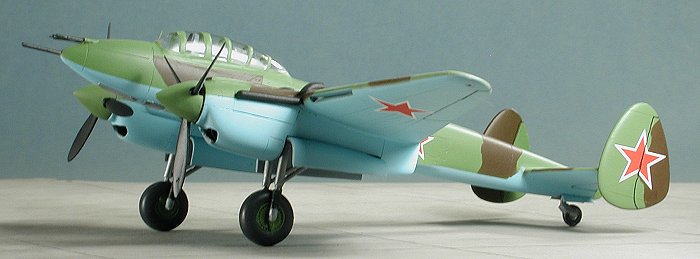
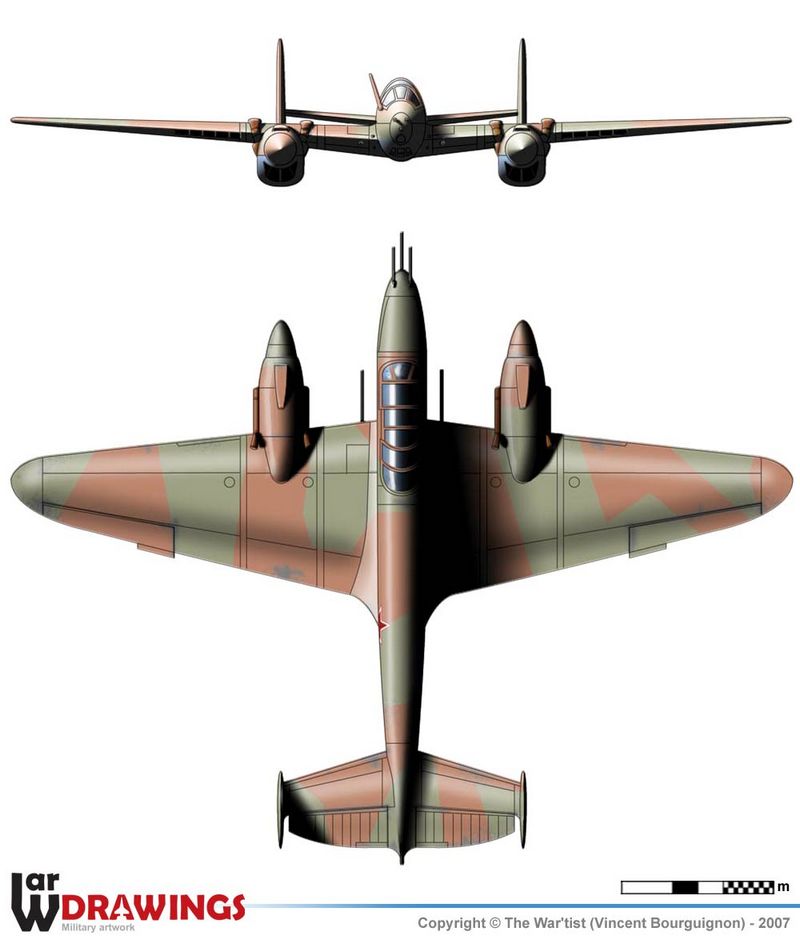
Polikarpov OKB responded with the company's rare twin-engine product - the Polikarpov "TIS" ("Tyazhely Istrebitel Soprovozhdeniya").
Engineers opted for a modern monoplane wing configuration with all-metal construction, powered by 2 Mikulin AM-37 series engines, each producing 1,400 hp. The two crew members will sit back to back in the forward cockpit amidships.
Each wing has an engine nacelle, and each engine drives a three-bladed propeller mounted on a large spinner. The tail adopts a split rudder configuration, and the landing gear adopts a "trailer" arrangement.
In terms of armament, 2 x 20mm cannons are attached to 4 x 7.62mm machine guns (the former is mounted on the root of the wing, the latter is mounted on the nose). The rear of the aircraft will be defended by a back-mounted 7.62mm trainable machine gun and a belly-mounted 7.62mm trainable machine gun.
The latter two guns will be managed by the second crew member to protect the vital "six" of the aircraft from intercepting enemy aircraft.
"Samolet A" is used to denote the first prototype completed by Polikarpov. The first flight took place in September 1941, but the German invasion of the Soviet Union (through Operation Barbarossa, which began in June 1941) pushed much of the existing Soviet military industry eastward. This meant that the Polikarpov program itself was delayed as the Novosibirsk facility was restored. When the move was complete, it was already June 1944 and the second prototype - the "Samolet MA" - finally flew.
The Mikulin AM-38 1,665 hp engine was installed on this aircraft instead of the expected AM-39 (1,700 hp) engine, as they were not supplied.
The revised prototype is also equipped with brand new weapons to better meet the revised Soviet doctrine of operations, now based on years of battles with the Axis powers. The 2 x 20mm cannons were replaced by 2 x 37mm automatic cannons, and the 4 x 7.62mm machine guns were replaced by 2 x 12.7mm machine guns.
This gave the aircraft an even more terrifying "thump" when attacking German fighter/bombers or shelling columns and enemy positions.
The Salomet MA began flight testing in July 1944, but its founder Nikolai Polikarpov died of stomach cancer and development was terminated after his company was merged into Lavochkin OKB. By this time, aircraft like the competing Ilyushin IL-2 were already available as heavy fighter jets and ground attack platforms, and proved little to no need to fund and advance Polikarpov's still-developing TIS program.
This ended its days of flying, with only two prototypes completed.
Specification
Basic
Production
Roles
- Fighter
- X-Plane / Development
Dimensions
11.7m
50.85 ft (15.5 m)
14.27 ft (4.35 m)
Weight
5,800 kg
7,840 kg
Performance
Performance
345 mph (555 km/h; 300 knots)
33,629 ft (10,250 m; 6.37 mi)
1,069 miles (1,720 km; 929 nautical miles)
686 m/min (2,250 ft/min)
Armor
Original:
2 x 20mm ShVAK cannons at the wing root
4 x 7.62mm ShKAS machine guns in the nose
1 x 7.62mm ShKAS machine gun in rear inverted position.
1 x 7.62mm ShKAS machine gun, back supine.
Revision:
2 x 37mm guns
2 x 12.7mm heavy machine guns
Changes
TIS - Base Series Name
Samolet A - first prototype with 1,400 hp Mikulin Am-37 engine; armed with 2 x 20 mm cannons and 4 7.62 mm machine guns; 2 x 7.62 mm machine guns mounted on trainable bases for local use defense.
Samolet MA - Second prototype with Mikulin AM-38 engine rated at 1,665 hp; modified 2 x 37 mm guns and 2 x 12.7 mm HMG.
 Argentina
 Armenia
 Australia
 Austria
 Austria-Hungary
 Belgium
 Brazil
 United Kingdom
 United States
 Brunei
 Bulgaria
 Canada
 Chile
Chile China
China Colonial America
 Colombia
 Confederate States
 Croatia
 Czech
Czech Denmark
 Egypt
Egypt Finland
 France
 Georgia
 Germany
 German Imperial
 Greece
 Holland
 Hungary
 India
India Indonesia
 Iran
Iran Iraq
Iraq Ireland
 Israel
 Italy
Italy Japan
Japan Japan (1940)
 Jordan
 Kingdom of Italy
 Malaysia
 Mexico
 Myanmar
 Nazi Germany
 Netherlands
 New Zealand
 North Korea
 Norway
 Pakistan
 Peru
Peru Philippines
 Poland
 Portugal
 Prussia
 Romania
 Russia
 Saudi Arabia
 Serbia
 Singapore
 Slovakia
 Slovenia
 South Africa
 South Korea
 Spain
Spain Sweden
 Switzerland
 Syria
Syria Taiwan
 Thailand
 Turkey
 UAE
UAE Ukraine
 Vietnam
 Yugoslavia