
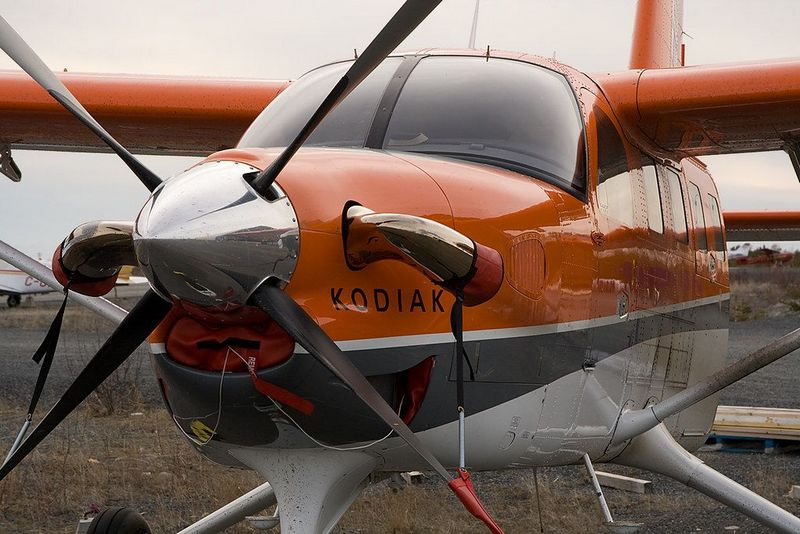

Explore the Kodiak story
Quest Kodiak is a versatile light all-weather aircraft manufactured by Quest Aircraft of the United States for the military and civilian markets. Its versatility allows it to be used in a variety of roles, from reconnaissance and general surveillance to skydiving, cargo transport and passenger travel.
The series was validated in 2007 and has undergone a period of continuous improvement over the past few decades of service.
The Kodiak's design features a strut high-wing monoplane with an excellent lift-to-drag ratio, allowing the aircraft to better serve shorter runways in hard-to-reach areas of the world. The panel sides of the hull are dotted with panoramic windows for viewing, the engine is at the very forward end of the design, and the side-by-side cockpit is directly aft. The passenger compartment forms a large part of the vehicle interior. The tail tapers at its ventral line and has a traditional single-fin configuration. The reinforced landing gear in the traditional tricycle configuration drives on all three legs and is fixed during flight, allowing take-off and landing even on unprepared surfaces.
This arrangement can be replaced by twin seaplanes for water landing and takeoff. Only one pilot is required to fly the plane. Ice protection is optional, as well as a "big tire upgrade" that increases landing weight.
In its seaplane configuration, there were no major changes to the aircraft's existing structure, other than the loss of the tricycle landing gear. The seaplane itself is wheeled, enabling the aircraft to function as a true "amphibious aircraft", capable of landing and taking off on water sources, while also being able to take off and land on runways.
Each seaplane is made of carbon fiber and is designed for saltwater operation. In fact, the Kodiak was designed from the outset to provide this seaplane capability while retaining its land-based capability.
Since its launch, the Kodiak range has been used in recreational activities, humanitarian aid, VIP tours, product transport, wildlife conservation (Botswana) and tourism (Panama).
Original production model is Kodiak 100. May 2018 update is Kodiak 100 Series II.
This model features the Garmin G1000NXi avionics suite, along with tablet integration, an angle of attack (AoA) display, and a digital backup four-instrument cluster. "Air Claw" is defense contractor Northrop Grumman's modified Kodiak platform for use as an airborne surveillance system using forward-looking infrared (FLIR) and persistent surveillance system Hawkeye long-range sensors.
Production through 2018 has resulted in around 250 aircraft being built in the Kodiak series. The official series was released in January 2008.
Specification
Basic
Production
Roles
- Commercial Market
- VIP traffic
- Medical Evacuation (MEDEVAC)
- Search and Rescue (SAR)
- Reconnaissance (RECCE)
Dimensions
10.42m
13.7m
15.26 ft (4.65 m)
Weight
1,710 kg
3,300 kg
Performance
Performance
211 mph (340 km/h; 184 knots)
25,000 ft (7,620 m; 4.73 mi)
1,305 miles (2,100 km; 1,134 nautical miles)
1,370 ft/min (418 m/min)
Armor
No.
Changes
Kodiak - The name of the base series.
Kodiak 100 - Original production form 2007.
Kodiak 100 (Series II) - May 2018 model; Garmin G1000NXi Avionics Kit; Angle of Attack (AoA) display.
Kodiak "Air Claw" - Military variant modified by Northrop Grumman for surveillance roles.
 Argentina
 Armenia
 Australia
 Austria
 Austria-Hungary
 Belgium
 Brazil
 United Kingdom
 Brunei
 Bulgaria
 Canada
 Chile
Chile China
China Colonial America
 Colombia
 Confederate States
 Croatia
 Czech
Czech Denmark
 Egypt
Egypt Finland
 France
 Georgia
 Germany
 German Imperial
 Greece
 Holland
 Hungary
 India
India Indonesia
 Iran
Iran Iraq
Iraq Ireland
 Israel
 Italy
Italy Japan
Japan Japan (1940)
 Jordan
 Kingdom of Italy
 Malaysia
 Mexico
 Myanmar
 Nazi Germany
 Netherlands
 New Zealand
 North Korea
 Norway
 Pakistan
 Peru
Peru Philippines
 Poland
 Portugal
 Prussia
 Romania
 Russia
 Saudi Arabia
 Serbia
 Singapore
 Slovakia
 Slovenia
 South Africa
 South Korea
 Soviet Union
 Spain
Spain Sweden
 Switzerland
 Syria
Syria Taiwan
 Thailand
 Turkey
 UAE
UAE Ukraine
 Vietnam
 Yugoslavia