
History
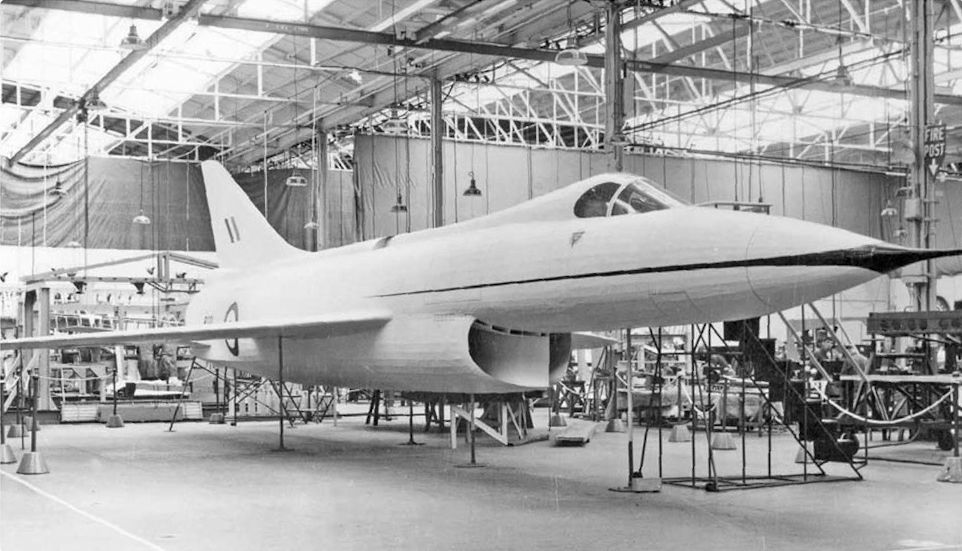
In the late 1950s, the Royal Air Force (RAF) sought a new high-speed, high-altitude interceptor aircraft equipped with missiles and radar guidance. One of the promising projects in consideration was the "P. 1121." Unfortunately, the project was shelved in 1957 due to the British government's "Defense White Paper," which recommended prioritizing missile technology over costly manned aircraft. As a result, the P. 1121 remained in the conceptual stage, with design plans, models, and incomplete prototypes.
The P. 1121 had its roots in the earlier "P. 1103" project, initiated in 1954. This aircraft went through several design iterations, featuring different air intake placements, wing configurations, and armament options. It initially carried rockets, a cannon, and "Gyron" turbojets, with its primary armament being two "Red Dean" air-to-air missiles. Later modifications included the incorporation of an Airborne Intercept 18 (AI.18) radar system.
Despite being abandoned by British officials in 1956, the P. 1121 concept continued to evolve. It eventually transformed into an "air superiority attack aircraft" with a nose-mounted radar and a rear cockpit. The design featured a single-engine configuration with an air intake positioned beneath the aircraft, resembling the General Dynamics F-16. The aircraft's fuselage was tubular, equipped with missile hardpoints, and had a conventional tail arrangement, along with tricycle landing gear and an air brake on the rear fuselage.
Specification
Basics
Year of Service: 1956
Origins: UK
Crew: 1
Manufacturer: Hawker Aircraft UK
Operators: UK (removed)
Roles
Air-to-air combat, fighter
The general ability to actively attack other aircraft of similar form and function, usually using guns, missiles and/or airborne missiles.
Intercept
The ability to intercept incoming airborne threats with high performance, usually speed and rate of climb.
Ground attack (bombing, strafing)
The ability to conduct air strikes against ground targets using (but not limited to) artillery, bombs, rockets, rockets, etc.
Intelligence Surveillance Reconnaissance (ISR), reconnaissance
Monitor ground targets/target areas to assess surrounding threat levels, enemy strength, or enemy movement.
X-Plane (development, prototyping, tech demos)
Aircraft designed for prototyping, technology demonstration, or research/data collection.
Dimensions and Weight
Length: 69.1 ft (21.05m)
Width/span: 37. 0 feet (11.28m)
MTOW: 41,998 lbs (19,050 kg)
Performance
Installed: 1 x de Havilland-Gyron PS. 26-6 or PS. The 26-3 afterburner turbojet produces 17,400 lbs to 20,000 lbs (each) of thrust (dry) and 23,800 lbs to 27,000 lbs (each) of reheated thrust.
Maximum speed: 1,920 km/h(3,090 km/h | 1,668 knots)
Maximum: 58,071 feet(17,700 m | 11 km)
Area: 1,553 km (2,500 km | 4,630 nautical miles)
Rate of climb: 40,000 ft/min (12,192 m/min)
Weapons
2 x 30mm ADEN automatic cannons, mounted internally.
2 x "Red Top" Air-to-Air Missiles (AAM) at the underwing hardpoints (one missile per wing).
Also supports 50 x 2" RP air missiles, nuclear-tipped bombs, and underwing fuel tanks.
 Argentina
 Armenia
 Australia
 Austria
 Austria-Hungary
 Belgium
 Brazil
 United States
 Brunei
 Bulgaria
 Canada
 Chile
Chile China
China Colonial America
 Colombia
 Confederate States
 Croatia
 Czech
Czech Denmark
 Egypt
Egypt Finland
 France
 Georgia
 Germany
 German Imperial
 Greece
 Holland
 Hungary
 India
India Indonesia
 Iran
Iran Iraq
Iraq Ireland
 Israel
 Italy
Italy Japan
Japan Japan (1940)
 Jordan
 Kingdom of Italy
 Malaysia
 Mexico
 Myanmar
 Nazi Germany
 Netherlands
 New Zealand
 North Korea
 Norway
 Pakistan
 Peru
Peru Philippines
 Poland
 Portugal
 Prussia
 Romania
 Russia
 Saudi Arabia
 Serbia
 Singapore
 Slovakia
 Slovenia
 South Africa
 South Korea
 Soviet Union
 Spain
Spain Sweden
 Switzerland
 Syria
Syria Taiwan
 Thailand
 Turkey
 UAE
UAE Ukraine
 Vietnam
 Yugoslavia