
History
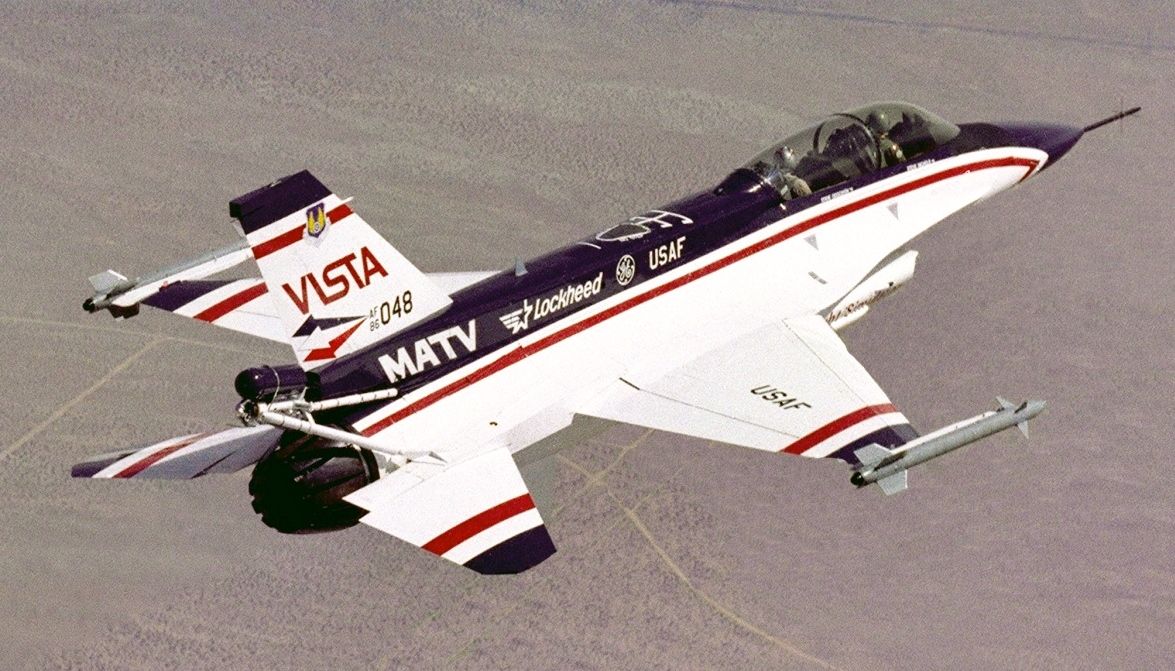
The General Dynamics X-62A Variable In-Flight Simulation Test Aircraft, commonly known as VISTA, is a highly modified two-seat F-16D Block 30. The United States Air Force uses the aircraft for test-pilot training, flight-control research, and the evaluation of artificial intelligence and autonomous systems.
VISTA can reproduce the handling characteristics of other aircraft and accept control commands from experimental software. Its reconfigurable systems allow researchers to test new control laws and autonomy agents while safety pilots remain aboard.
In April 2026, the X-62A completed a series of tests in which an AI agent processed live infrared sensor data, tracked a crewed target aircraft, and flew the test aircraft into tactical intercept positions.
The aircraft was originally designated NF-16D VISTA. It was developed through cooperation between General Dynamics, later incorporated into Lockheed Martin, and Calspan for the United States Air Force Test Pilot School. The aircraft made its first flight in April 1992.
VISTA initially supported the Multi-Axis Thrust-Vectoring program. Flight testing began in July 1993 and examined control at high angles of attack using an Axisymmetric Vectoring Exhaust Nozzle. The program completed 95 test flights before ending in 1994.
The aircraft subsequently became a regular test and training platform at Edwards Air Force Base. It supported instruction for test pilots and flight-test engineers, research involving unstable or unusual aircraft behavior, and development of integrated collision-avoidance technology.
A major modernization replaced the original VISTA Simulation System and introduced the System for Autonomous Control of Simulation and a Model Following Algorithm. The aircraft was formally redesignated X-62A in June 2021. The United States Air Force recognized it as a national test asset intended to support autonomy research, including work associated with the Skyborg program.
In December 2022, the X-62A began a series of flights under AI control. Testing progressed to air-combat experiments during 2023. In 2024, the United States Air Force and the Defense Advanced Research Projects Agency disclosed trials involving the X-62A and a conventionally piloted F-16.
HAVE HEAT
During the HAVE HEAT campaign at Edwards Air Force Base in April 2026, an infrared search-and-track Legion pod detected a Northrop T-38 used as the airborne target. An autonomy agent processed the classified sensor feed and controlled the X-62A to reach an intercept position in real time. The aircraft conducted 27 AI-controlled intercepts during eight flights.
Lockheed Martin used an AI integration capability called Supermassive to connect autonomy agents with the aircraft. Integration and ground testing were completed within three months. The campaign demonstrated a complete sensor-to-action process in which software interpreted sensor information and commanded the aircraft without direct pilot control. Human safety personnel remained aboard throughout the flights. Details of the tests were published in the official USAF account.
HAVE HOLIDAYS
The parallel HAVE HOLIDAYS program evaluated modular technologies in the aircraft's Enterprise Open Mission System Architecture computer. The work included a third-party autonomy agent, additional processing hardware, and safety rules intended to keep autonomous vehicles within limits established by users.
The Mission Systems Upgrade program is planned to add greater computing and sensor capacity, modern network communications, and Raytheon's PhantomStrike active electronically scanned array radar. These additions are intended to support more complex autonomy and human-machine teaming experiments.
Design
Airframe
The X-62A uses an F-16D Block 30 airframe configured for two crew members. An enlarged dorsal fairing behind the cockpit accommodates simulation equipment and flight-test instrumentation. Heavyweight landing gear permits the aircraft to reproduce the higher landing sink rates associated with heavier aircraft. A braking parachute is fitted at the rear of the airframe.
The aircraft previously carried a multi-axis thrust-vectoring nozzle during the MATV trials. This equipment allowed researchers to study pitch and yaw control beyond the normal effective range of conventional aerodynamic control surfaces.
Simulation and control systems
The VISTA Simulation System changes the aircraft's control response so that it can reproduce the flight characteristics of other aircraft. A second control stick and dedicated cockpit equipment support test and safety functions.
The Model Following Algorithm commands the X-62A to reproduce selected handling qualities. The System for Autonomous Control of Simulation allows control by autonomy software or from the ground. Its open architecture supports the integration of third-party applications without permanently tying the aircraft to one software supplier. An AIAA technical paper also identifies cockpit modifications, external-store capability, and DAS, CMDL, and TTNT data links as parts of the modernized architecture.
Sensors and mission systems
For HAVE HEAT, the aircraft carried a Lockheed Martin Legion infrared search-and-track pod. The sensor detected and tracked the target without relying on radar emissions. Its data was supplied directly to the autonomy agent, which converted the track information into aircraft-control commands.
The continuing upgrade program is intended to integrate the PhantomStrike multifunction AESA radar and additional sensor-processing capacity. These capabilities remain part of the planned modernization described after the 2026 flight campaigns.
Program status
The United States Air Force Test Pilot School operates the sole X-62A at Edwards Air Force Base, California, with contractor support from Calspan and technical participation by Lockheed Martin. It remains an active research and training aircraft. Its roles include test-pilot education, autonomous-flight research, rapid software evaluation, AI safety testing, and development of human-machine teaming methods.
The aircraft retains onboard human safety observers during autonomous flights. Lockheed Martin also presents the platform as a means of evaluating pilot-assistance systems, in which AI handles demanding sensor or control tasks while the pilot concentrates on tactical decisions. Additional information about its current configuration is available from the Lockheed Martin X-62A page.
Variants
- NF-16D VISTA: Original designation for the modified F-16D variable-stability test aircraft. It supported simulation, test-pilot training, and the earlier thrust-vectoring program.
- X-62A VISTA: Designation adopted in 2021 after modernization for advanced simulation, AI, and autonomous-flight testing.
Operators
- United States Air Force: One aircraft operated by the United States Air Force Test Pilot School at Edwards Air Force Base, with research involving the Air Force Research Laboratory and other government and industry partners.
Specifications (X-62A VISTA)
General characteristics
- Crew: Two
- Length: Approximately 15.0 m (49.3 ft)
- Wingspan: Approximately 10.0 m (32.8 ft)
- Height: Approximately 5.1 m (16.7 ft)
- Wing area: 28 m² (300 sq ft)
- Maximum takeoff weight: 19,187 kg (42,300 lb)
- Powerplant: One afterburning turbofan engine
- Production: One aircraft
Performance
- Maximum speed: More than Mach 2 at altitude
- Ferry range: Approximately 5,200 km (3,200 mi) with three external fuel tanks
- Service ceiling: More than 15,000 m (50,000 ft)
 Argentina
 Armenia
 Australia
 Austria
 Austria-Hungary
 Belgium
 Brazil
 United Kingdom
 Brunei
 Bulgaria
 Canada
 Chile
Chile China
China Colonial America
 Colombia
 Confederate States
 Croatia
 Czech
Czech Denmark
 Egypt
Egypt Finland
 France
 Georgia
 Germany
 German Imperial
 Greece
 Holland
 Hungary
 India
India Indonesia
 Iran
Iran Iraq
Iraq Ireland
 Israel
 Italy
Italy Japan
Japan Japan (1940)
 Jordan
 Kingdom of Italy
 Malaysia
 Mexico
 Myanmar
 Nazi Germany
 Netherlands
 New Zealand
 North Korea
 Norway
 Pakistan
 Peru
Peru Philippines
 Poland
 Portugal
 Prussia
 Romania
 Russia
 Saudi Arabia
 Serbia
 Singapore
 Slovakia
 Slovenia
 South Africa
 South Korea
 Soviet Union
 Spain
Spain Sweden
 Switzerland
 Syria
Syria Taiwan
 Thailand
 Turkey
 UAE
UAE Ukraine
 Vietnam
 Yugoslavia