
History
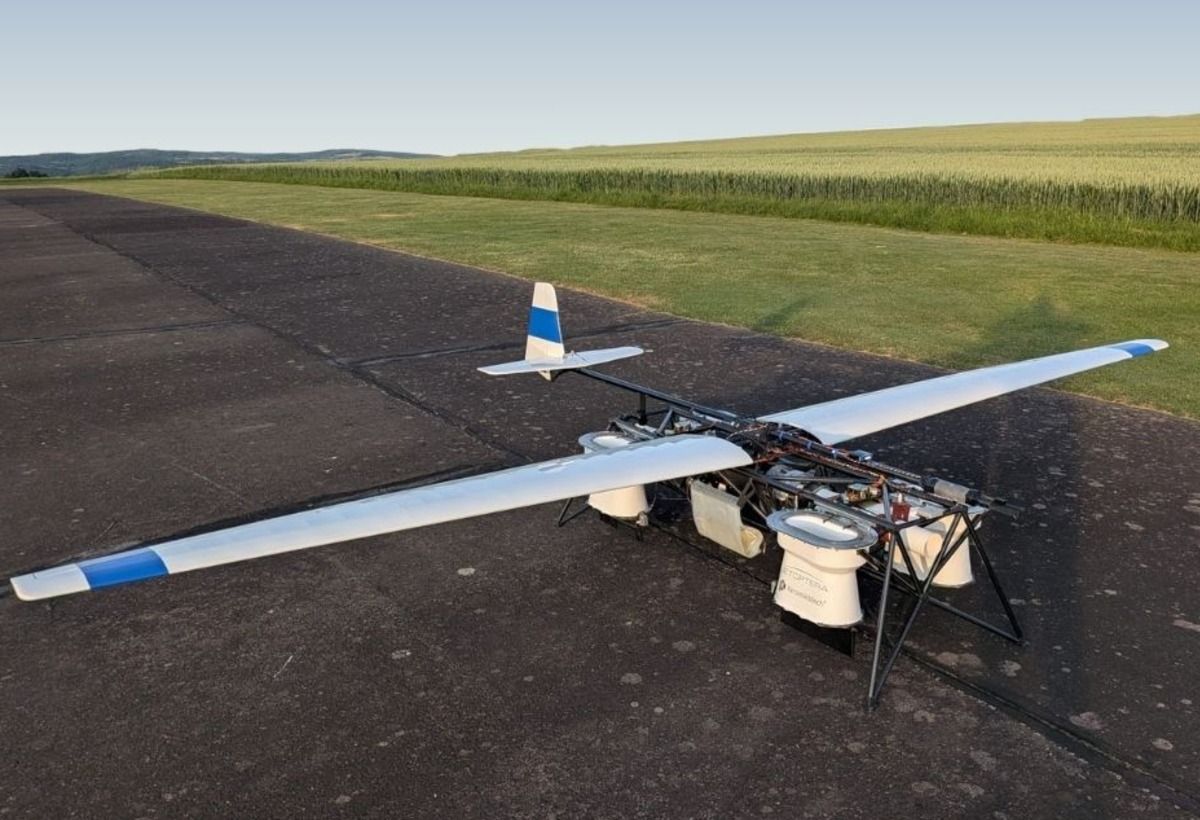
Jetoptera Project Pegasus is a United States heavy-lift unmanned aircraft technology demonstrator. Jetoptera developed it for the Defense Advanced Research Projects Agency Lift Challenge.
The aircraft uses Jetoptera's Fluidic Propulsive System instead of conventional exposed propellers. The Lift Challenge supported the development of an advanced Pegasus configuration, but Jetoptera withdrew the aircraft before the final trials in August 2026.
DARPA organized the Lift Challenge to encourage lightweight unmanned aircraft capable of carrying payloads substantially heavier than the aircraft themselves. The original competition requirements limited an aircraft, including its fuel or batteries, to 25 kg (55 lb). It had to carry at least 50 kg (110 lb) over a 9.3 km (5 nmi) circuit.
Development for the Lift Challenge
Jetoptera spent approximately six months preparing Pegasus for the competition. The company reported that the aircraft's thrusters and turbines had been completed and assembled, with the components gathered for installation as Pegasus approached its final configuration. This development status was documented in a Jetoptera project update.
Jetoptera had previously developed its propulsion technology through several United States Air Force research contracts. The company also conducted wind-tunnel work with Pratt & Whitney's GATORWORKS division and a joint hover demonstration with GE Aviation. Pegasus applied this propulsion work to the heavy-lift requirements of the DARPA competition.
Withdrawal from final testing
As preparations for the live trials progressed, the event format changed. The revised rules imposed an altitude limit of 46 m (150 ft) and required repeated laps inside a lane approximately 335 m (1,100 ft) long. Competitors were also permitted to release spent batteries during flight to reduce aircraft weight.
Jetoptera stated that these conditions were less representative of the commercial aviation missions for which it intended to validate Pegasus. The company also cited safety and liability concerns associated with the low-altitude course and the release of batteries from aircraft carrying heavy payloads.
In August 2026, Jetoptera announced that it would withdraw Pegasus before the Lift Challenge finals in Dayton, Ohio. The company therefore gave up the opportunity to compete for part of the DARPA prize pool, reported as $6.5 million. A contemporary report on the withdrawal described the revised rules and Jetoptera's stated reasons.
Design
Fluidic propulsion
Project Pegasus uses Jetoptera's Fluidic Propulsive System. The system sends compressed air through specially shaped ducts to generate thrust without conventional exposed propeller blades. Jetoptera presents this arrangement as a means of reducing noise, improving safety around the aircraft, and simplifying its propulsion hardware. The available evidence does not provide complete performance measurements for the Pegasus installation.
The demonstrator incorporated dedicated fluidic thrusters and turbines. These components had been assembled before the planned Lift Challenge flights, but the published material does not identify their number, output, arrangement, or power source.
Heavy-lift configuration
Pegasus was designed around the Lift Challenge's strict aircraft-mass and payload requirements. Its intended configuration had to remain within the competition's 25 kg aircraft limit while carrying a payload of at least 50 kg. Published information does not confirm the aircraft's final dimensions, construction materials, battery capacity, flight-control system, or achieved payload performance.
Program status
Project Pegasus had reached the hardware assembly and integration stage in 2026 and was approaching its final competition configuration. Jetoptera withdrew it before the DARPA finals, so the aircraft did not complete the planned Lift Challenge course under the revised rules.
Jetoptera said that it intended to validate Pegasus through a flight-test program conducted under conditions aligned with its commercial aviation objectives. The available sources do not confirm a subsequent first flight, production plan, operator, or service-entry schedule.
Specifications (Project Pegasus Lift Challenge demonstrator)
Competition design requirements
- Aircraft mass limit: 25 kg (55 lb), including fuel or batteries
- Minimum payload: 50 kg (110 lb)
- Original required course distance: 9.3 km (5 nmi)
- Revised altitude limit: 46 m (150 ft)
- Revised course-lane length: approximately 335 m (1,100 ft), flown in repeated laps
- Propulsion: Jetoptera Fluidic Propulsive System with fluidic thrusters and turbines
These values describe the competition limits and intended Pegasus configuration. They are not confirmed results from completed flight testing.
 Argentina
 Armenia
 Australia
 Austria
 Austria-Hungary
 Belgium
 Brazil
 United Kingdom
 Brunei
 Bulgaria
 Canada
 Chile
Chile China
China Colonial America
 Colombia
 Confederate States
 Croatia
 Czech
Czech Denmark
 Egypt
Egypt Finland
 France
 Georgia
 Germany
 German Imperial
 Greece
 Holland
 Hungary
 India
India Indonesia
 Iran
Iran Iraq
Iraq Ireland
 Israel
 Italy
Italy Japan
Japan Japan (1940)
 Jordan
 Kingdom of Italy
 Malaysia
 Mexico
 Myanmar
 Nazi Germany
 Netherlands
 New Zealand
 North Korea
 Norway
 Pakistan
 Peru
Peru Philippines
 Poland
 Portugal
 Prussia
 Romania
 Russia
 Saudi Arabia
 Serbia
 Singapore
 Slovakia
 Slovenia
 South Africa
 South Korea
 Soviet Union
 Spain
Spain Sweden
 Switzerland
 Syria
Syria Taiwan
 Thailand
 Turkey
 UAE
UAE Ukraine
 Vietnam
 Yugoslavia