
History
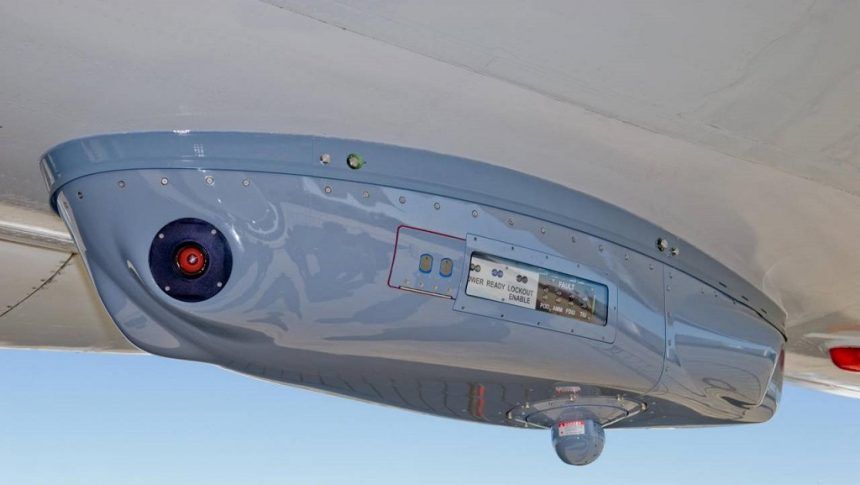
The Large Aircraft Survivability System (LASS) is a U.S. Air Force program intended to improve the protection of tankers, transport aircraft, and other high-value airborne assets against long-range missile threats. The planned system combines onboard sensing, processing, and defensive effectors so that a protected aircraft can detect, assess, and respond to threats without relying entirely on external support. Pasted text
LASS is being developed as a modular and scalable survivability architecture rather than as a single conventional countermeasure. Its planned functions include detection, tracking, identification, threat assessment, and selection of an appropriate defensive response.
The program reflects the increasing vulnerability of large, non-stealthy support aircraft to long-range air-to-air and surface-to-air weapons. It is intended to extend protection beyond the shorter-range infrared threats addressed by existing large-aircraft infrared countermeasure systems.
Development
In 2026, U.S. Air Force planning for LASS described an onboard architecture using multiple sensors, processors, and defensive weapons or effectors. Requirements for the related Platform Agnostic Kinetic Self-Defense system attributes were validated on March 18, 2026. The Air Force's fiscal year 2027 budget request included $68 million for LASS development, divided into $50 million for sensor work and $18 million for the effector system.
The sensor element is planned to observe areas above and below the host aircraft, identify threats, and contribute to a common operating picture for the aircrew. Processing equipment is intended to determine the nature of an inbound threat, identify which aircraft is being targeted, and select an appropriate defensive effector.
The Air Force projected approximately $508 million in LASS-related investment across five budgets through fiscal year 2031. Planned spending included $264 million for the effector system during fiscal years 2028 and 2029 and $176.2 million for sensor development from fiscal years 2028 through 2031. The acquisition approach was expected to use flexible agreements supporting rapid design and prototyping.
In October 2026, SRC received a $37 million U.S. Air Force contract supporting development of LASS sensing capabilities. The work includes potential integration of SRC's Ghost Mantis Gen 3 Multi-Function Aperture technology into LASS prototypes. Ghost Mantis Gen 3 is designed as a scalable multi-mission sensing and electronic-warfare payload suitable for integration on crewed and uncrewed aircraft.
Design
LASS is planned as an onboard, modular survivability system for large aircraft. Its architecture is intended to connect sensors with processors and defensive effectors, allowing the aircraft to perform a detect-decide-defeat sequence against incoming threats.
Sensors and processing
The planned sensor package is intended to detect and track long-range threats while providing coverage above and below the host aircraft. The processing element is intended to correlate sensor information, determine the nature and direction of an incoming threat, identify the threatened aircraft, and determine which defensive response should be used.
SRC's Ghost Mantis Gen 3 Multi-Function Aperture is a candidate technology for LASS prototypes. Its proposed role within the program is to provide sensing and electronic-warfare functions in a scalable package. Its integration into LASS remains part of the development effort rather than a confirmed production configuration.
Defensive effectors
The broader LASS concept includes both kinetic and non-kinetic effectors. These are intended to allow a protected aircraft to engage or otherwise defeat long-range threats using equipment carried onboard. The final effector configuration and production arrangement have not been established in the supplied program information.
Program status
LASS remained under development in 2026 and had not been described as an operationally fielded system. Fiscal year 2027 funding was planned to advance sensor and effector development, with rapid prototyping forming part of the intended acquisition approach. The program is associated with protection of aircraft including the KC-135 Stratotanker, KC-46 Pegasus, C-5 Galaxy, and C-17 Globemaster III.
The program is intended to address threats at greater ranges than traditional infrared countermeasure systems. Its emphasis on integrated detection, processing, and onboard effectors is intended to give large aircraft a greater degree of organic self-defense in contested airspace.
Specifications (Large Aircraft Survivability System)
General characteristics
- Type: Modular large-aircraft survivability and active-defense system.
- Developer: U.S. Air Force program with SRC contracted for development of LASS sensing capability.
- Primary role: Detection, tracking, identification, assessment, and defeat of long-range threats to large aircraft.
- Architecture: Planned onboard combination of sensors, processors, and defensive effectors.
- Intended host aircraft: Large tanker and transport aircraft, including the KC-135, KC-46, C-5, and C-17.
Sensors and processing
- Sensor coverage: Planned upward- and downward-looking threat detection.
- Processing functions: Threat identification, determination of the targeted aircraft, and selection of an appropriate defensive effector.
- Candidate sensor technology: SRC Ghost Mantis Gen 3 Multi-Function Aperture for potential integration into LASS prototypes.
Defensive capability
- Threat focus: Long-range missile threats and other airborne threats to high-value support aircraft.
- Effector concept: Planned kinetic and non-kinetic defensive effectors integrated with onboard processing.
- Operating concept: Organic onboard detection, decision, and defensive response without requiring external assistance for every engagement.
 Argentina
 Armenia
 Australia
 Austria
 Austria-Hungary
 Belgium
 Brazil
 United Kingdom
 Brunei
 Bulgaria
 Canada
 Chile
Chile China
China Colonial America
 Colombia
 Confederate States
 Croatia
 Czech
Czech Denmark
 Egypt
Egypt Finland
 France
 Georgia
 Germany
 German Imperial
 Greece
 Holland
 Hungary
 India
India Indonesia
 Iran
Iran Iraq
Iraq Ireland
 Israel
 Italy
Italy Japan
Japan Japan (1940)
 Jordan
 Kingdom of Italy
 Malaysia
 Mexico
 Myanmar
 Nazi Germany
 Netherlands
 New Zealand
 North Korea
 Norway
 Pakistan
 Peru
Peru Philippines
 Poland
 Portugal
 Prussia
 Romania
 Russia
 Saudi Arabia
 Serbia
 Singapore
 Slovakia
 Slovenia
 South Africa
 South Korea
 Soviet Union
 Spain
Spain Sweden
 Switzerland
 Syria
Syria Taiwan
 Thailand
 Turkey
 UAE
UAE Ukraine
 Vietnam
 Yugoslavia