
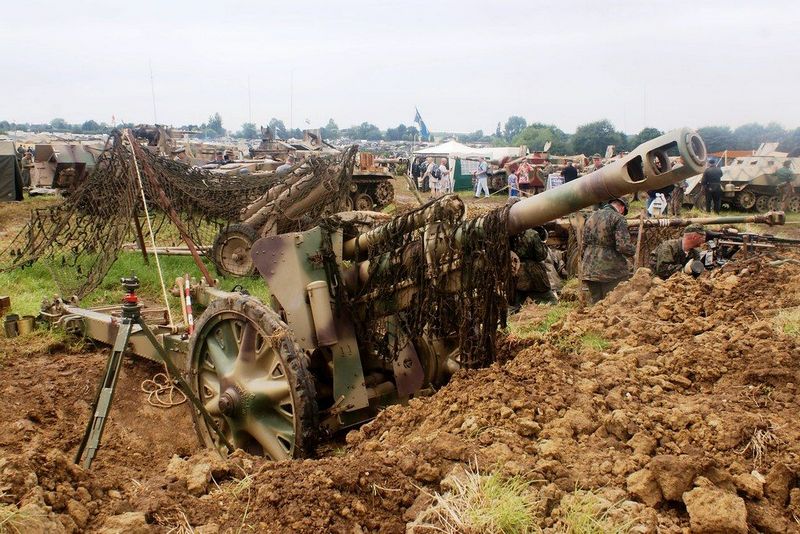
10.5 cm leFH 18/40 story
During World War II, the 10.5cm leFH 18/40 light howitzer appeared alongside the German Army's existing leFH 18 and leFH 18M series of 105mm field howitzers. This model first entered service in 1942 and remained in service until the end of the war in 1945. Some of them were exported from Nazi German factories to Allied Finland before the end of the war under the local number 105 H 33-40.
Production continued until 1945.
The leFH 18/40 was originally developed to retrofit the existing German 105mm field gun. Specifically, the Wehrmacht needed a lighter field weapon to make it easier to carry.
Also, since Germany was in a full-scale war on multiple fronts at this time, the new weapon had to be easier to produce in German factories. As such, the new weapon will consist of several proven components of existing systems.
The barrel of the leFH 18M was chosen as the main weapon, and the mount for the 7.5 cm (75 mm) anti-tank gun PaK 40 was chosen as the standard mount. The gun is equipped with a double ring muzzle brake to deal with recoil.
The PaK 40s frame has been slightly revised for the new design, with modifications including a torsion bar suspension and a pair of rubber tire-pressed steel-spoke wheels. The final product received the Bundeswehr designation 10.5 cm leFH 18/40 (10.5 cm stands for the caliber of the weapon, leFH stands for "leiche Feldhaubitze" in German).
The leFH 18/40 follows the traditional form of contemporary field guns. The barrel is placed on a gun mount, which is further connected to a two-wheeled trailer system with split rear legs that serve as a recoil mechanism (when firing) and towing legs (when transporting). The crew was only sparsely protected by a contoured armored shield at the front. All major working parts (lift/fire control) are mounted on the rear of the gun near the breech.
The breech consisted of a manually-operated horizontal slide, and each shell was loaded with the appropriate charge. The gun is fired via a strike system and levers along the left side of the rack. The gun measures 105 mm (4.13 in) and the recoil is hydropneumatically reactive.
Elevation angles ranged from -6 to +40 degrees, with a lateral limit of 56 degrees within the gun mount. Of course, the crew can manually steer the entire weapon toward the target area for full 360-degree rotation capability. A trained crew can fire 6 to 8 rounds per minute.
The laying was carried out by standard Bundeswehr artillery field sights. Muzzle velocity is rated at 1,772 feet per second. Effective range is 13,479 yards. A standard company staff consists of four to six employees. The leFH 18/40 has an operating weight of 1,955 kg (4,311 lb).
The system has a length of 9.64 feet and a barrel length of 9 feet. The leFH 18/40 can be towed by a variety of Wehrmacht vehicles properly equipped to transport artillery-like systems.
Ammo types available for the Rifle Set include Standard Range High Explosive (HE), High Explosive Incendiary (HEI), Standard Smoke Grenade, Luminous "Star" Grenades, Propaganda Leaflet Grenades, Shaped Charges and Tracer Grenades.
Although some systems were in limited numbers by the end of 1942, the system did not become widely used until after February 1943 - and subsequent combat operations. After full service by 1944, the leFH 18/40 system was used by the German Army Artillery Battalion and proved to be a reliable addition to the inventory, matching the ballistic capabilities of the original leFH 18(M) series, and proved to be lighter.
They would remain in use until the last days of the European War in May 1945.
10.5 cm leFH 18/40 size
Basic
Roles
- fire support/attack/damage
Dimensions
2.94m
2 tons (1,955 kg; 4,310 lbs)
Armor
1 x 105mm howitzer
Depends on the ammunition carrier.
Changes
10. 5-cm leFH 18/40 - Basic series name
105 H 33-40 - Finnish designation for export German models.
 Argentina
 Armenia
 Australia
 Austria
 Austria-Hungary
 Belgium
 Brazil
 United Kingdom
 United States
 Brunei
 Bulgaria
 Canada
 Chile
Chile China
China Colonial America
 Colombia
 Confederate States
 Croatia
 Czech
Czech Denmark
 Egypt
Egypt Finland
 France
 Georgia
 Germany
 German Imperial
 Greece
 Holland
 Hungary
 India
India Indonesia
 Iran
Iran Iraq
Iraq Ireland
 Israel
 Italy
Italy Japan
Japan Japan (1940)
 Jordan
 Kingdom of Italy
 Malaysia
 Mexico
 Myanmar
 Netherlands
 New Zealand
 North Korea
 Norway
 Pakistan
 Peru
Peru Philippines
 Poland
 Portugal
 Prussia
 Romania
 Russia
 Saudi Arabia
 Serbia
 Singapore
 Slovakia
 Slovenia
 South Africa
 South Korea
 Soviet Union
 Spain
Spain Sweden
 Switzerland
 Syria
Syria Taiwan
 Thailand
 Turkey
 UAE
UAE Ukraine
 Vietnam
 Yugoslavia