
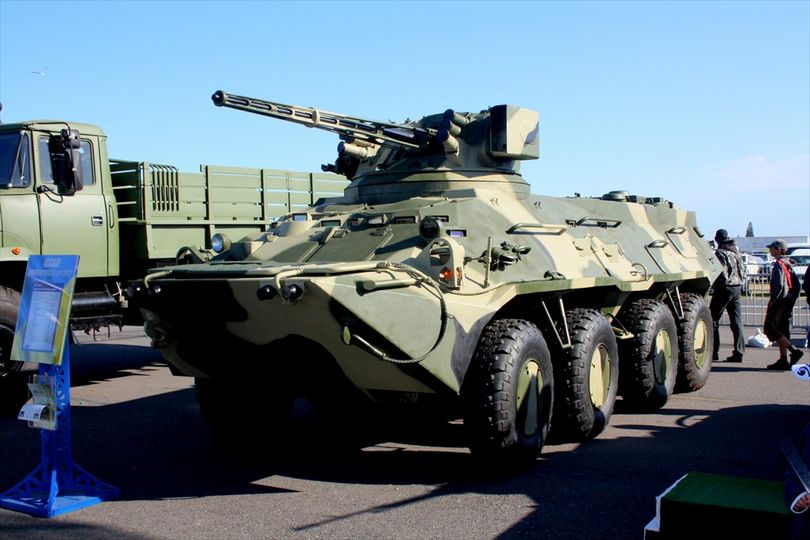
BTR-3 History
The BTR-3 is a modern eight-wheeled armoured fighting vehicle currently in service with a handful of armies around the world - mainly in the United Arab Emirates, Thailand and Myanmar. Design of the BTR-3 began in 2000 as a private company involving ADCOM Mfg in the United Arab Emirates and the Kharkov Morozov Machine Building Design Bureau (KMDB) in Ukraine, using proven power supplies from the United States and Germany group components.
ADCOM is responsible for the overall design of the vehicle, while KMDB has used its manufacturing facilities for series production since 2001. The BTR-3 was originally named "BTR-94K", and despite Ukraine's involvement in the project, the BTR-3 was not an official part of the Ukrainian Army's stockpile at the time.
All in all, the BTR-3 is similar in scope and function to various other global designs, including Russia's BTR-90 and Canada's LAV-25.
The design of the BTR-3 is not dissimilar to previous Soviet-era BTR wheeled transport offerings, although it is widely regarded as an "all-new" due to its upgraded power pack, modern weapons and larger interior space the design of. Ukraine uses a locally produced version of the Soviet BTR-80 as the BTR-94, which features an indigenous weapons arrangement, which explains the influence of the BTR series on the new BTR-3 design. The exterior of the BTR-3 is characterized by its eight large wheels, four on one side of the vehicle. The front hull features a short sloping glacis panel with a steep incline at the bottom. Rectangular front-view ports are available, as well as optional armor plates.
The sides of the fuselage are also heavily sloped to provide basic ballistic protection against small arms fire and artillery jets. A modular one-man turret location - designated KBA-105 "Shkval" (or "Shakval") - mounted on top of the fuselage and managed all available large-caliber weapons. The turret is modular to meet the needs of the operator's mission. Basic weapons include an automatic cannon, a machine gun, a grenade launcher and anti-tank rocket launchers.
The hull roof is flat to promote a slim profile and improve turret rotation. The cabin is in the center of the design, the engine is in the rear, and the sight/muzzle is marked along the side of the vehicle. The standard operator consists of three technicians, including the driver, vehicle commander and gunner. Six combat-ready infantrymen could be transported in the fighting compartment, and vehicle entry and exit for these crews was through two-piece doors mounted between the second and third pairs of wheels on either side of the hull.
The top of the door holds the fire opening, while the bottom pivots to fold down to create a step. Additional hatches are marked above the top of the fuselage.
The BTR-3 is powered by a German Deutz BF6M1015 air-cooled diesel engine producing 326 hp and mated to an American Allison MD3066 automatic transmission system. The clutch has a top speed of 53 mph and a range of 372 miles.
All eight wheels have suspension that provides excellent off-road capability, and the first two pairs of wheels have power steering. Each wheel is also managed by a centralized tire pressure system, allowing the rider to adjust the pressure of each unit according to the environment.
The BTR-3 weighs 18 tons, has a barrel length of 7.6 meters, and a top height of 2.8 meters.
As an armed transport aircraft, the BTR-3 series uses a wealth of weapon attachments. This vehicle is designed to meet a variety of encounters, with an emphasis on supporting Allied infantry units in the role of an infantry fighting vehicle or armored personnel carrier. Therefore, the BTR-3 uses a modular weapon system with the turret at the center of the design. The standard "Shkval" turret is equipped with a powerful 30mm twin-barreled automatic cannon, wrapped in a protective steel "cage" structure for added support. The cannon provides defense against other armored vehicles and enemy buildups with high-explosive (HE) and armor-piercing (AP) projectile types.
A coaxial 7.62mm general-purpose machine gun is mounted next to the cannon and engages enemy infantry by direct action or suppression. The armament is further enhanced by the 30mm AGS-17 automatic grenade launcher capable of delivering high-explosive fragmentation grenades (HE-FRAG) at the target area. There is also a dual launcher system on the right side of the turret for AT-5 "Spandrel" (9M113 Konkurs) anti-tank missiles for attacking enemy vehicles or main battle tanks. The gun has 360 degrees of traverse, while elevation is limited to +75 and -6 degrees.
Although these weapons are the basis of the BTR-3 design, customers can replace them as needed.
For self-defense, BTR-3 crews can rely on 6x81mm smoke grenade launchers mounted as two rows of three launchers. These launchers are mounted on the side panels of the rear turret and can be used to cover tactical operations of an offensive or defensive nature.
The crew is also protected from NBC (nuclear, biological, chemical) attack, and an integrated fire suppression system neutralizes internal fire hazards. Creature Comfort includes a standardized air conditioning system that allows the BTR-3 crew to operate in relative comfort in tropical and desert environments.
Following Soviet-era principles, considering their original BTR series vehicles, the BTR-3 was also fully amphibious, wading through water sources with the slightest preparation of the crew. The operator deploys the trim blades and activates the bilge pump, while lowering and activating the propeller system located under the aft fuselage.
The inherent amphibious nature of the BTR-3 adds another welcome layer of tactical utility to discerning armored vehicle customers.
The BTR-3 only appeared in two main production variants, which were officially called the original "BTR-3U" and the newer "BTR-3E". The BTR-3E differs in being equipped with a different engine option (probably a diesel engine of the UTD-20 series). A sub-variant of the BTR-3E series is the BTR-3E1, which is equipped with the BM-3 "Shturm" turret system.
The BTR-3E variant was further developed as an armored battlefield rescue vehicle, aptly called the "BTR-3E ARV". Like other vehicles in this professional class, the BTR-3E ARV is equipped with a bulldozer-style blade, a heavy-duty crane system and a powered winch - all designed to clear the streets of debris and wrecked vehicles.
In addition to the UAE military, BTR-3 operators are Azerbaijan, Chad, Ecuador, Iraq, Kazakhstan, Myanmar, Nigeria and Thailand. To date, the largest export operator for the vehicle is Myanmar, which has committed to procure about 1,000 BTR-3s by the end of the contract. At least 210 units have been completed, with production taking place at local factories in Myanmar. The UAE Marine Corps uses the original BTR-3U production form with the "Buran-N1" turret system.
The UAE Navy version is known by the name "Guardian".
Specification
Basic
Roles
- anti-tank/anti-tank
- Technology
- Infantry Support
- Reconnaissance (RECCE)
- Troop Transport
Dimensions
25.10 ft (7.65 m)
2.9m
2.8m
20 tons (18,072 kg; 39,842 lb)
Performance
Performance
85 km/h
373 miles (600 km)
Armor
1 x 30mm automatic cannon.
1 x 30mm grenade launcher.
1 x 7.62mm coaxial general purpose machine gun.
2 x AT-5 Spandrel anti-tank missile launchers.
6 x 81mm smoke grenade launcher.
350 x 30mm projectile.
116x30mm shells.
2,500x7.62mm ammo.
4 x AT-5 Spandrel anti-tank missiles.
6 x 81mm smoke grenade.
Changes
BTR-3 - Base series name based on the Soviet APC series BTR-80.
BTR-3U Okhotnik (BTR-94K) - APC base model
"Guardian" - Based on UAE Armed Forces BTR-3U; equipped with Buran N1 series turret system.
BTR-3E - new engine (using UTD-20)
BTR-3E1 - New engine; equipped with BM-3 Shturm turret system.
BTR-3E ARV - Armored rescue vehicle based on the BTR-3 chassis.
 Argentina
 Armenia
 Australia
 Austria
 Austria-Hungary
 Belgium
 Brazil
 United Kingdom
 United States
 Brunei
 Bulgaria
 Canada
 Chile
Chile China
China Colonial America
 Colombia
 Confederate States
 Croatia
 Czech
Czech Denmark
 Egypt
Egypt Finland
 France
 Georgia
 Germany
 German Imperial
 Greece
 Holland
 Hungary
 India
India Indonesia
 Iran
Iran Iraq
Iraq Ireland
 Israel
 Italy
Italy Japan
Japan Japan (1940)
 Jordan
 Kingdom of Italy
 Malaysia
 Mexico
 Myanmar
 Nazi Germany
 Netherlands
 New Zealand
 North Korea
 Norway
 Pakistan
 Peru
Peru Philippines
 Poland
 Portugal
 Prussia
 Romania
 Russia
 Saudi Arabia
 Serbia
 Singapore
 Slovakia
 Slovenia
 South Africa
 South Korea
 Soviet Union
 Spain
Spain Sweden
 Switzerland
 Syria
Syria Taiwan
 Thailand
 Turkey
 UAE
UAE Vietnam
 Yugoslavia