

History
In response to the expected shortage of French Renault FT-17 light tanks during World War I (1914-1918), the Ford Motor Company developed a similar light tracked armored vehicle for American tankers arriving in Europe. By 1917, The United States has successfully avoided a major conflict in Europe, and when it does go to war, it lacks useful war equipment including small arms, vehicles and aircraft.
The Ford 3-ton M1918 (1918 model) became one of the lesser-known domestic players in the country trying to fill one of the anticipated shortages. The FT-17 was eventually delivered to the Americans (and licensed locally to produce the 1917 6-ton).
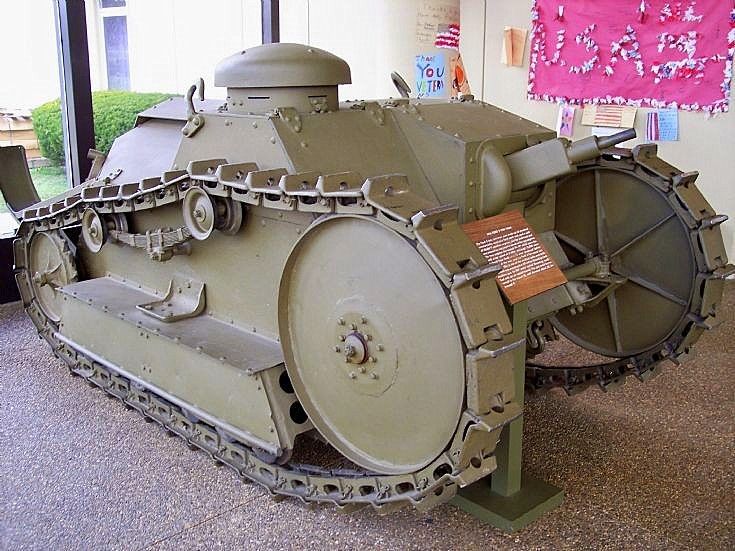
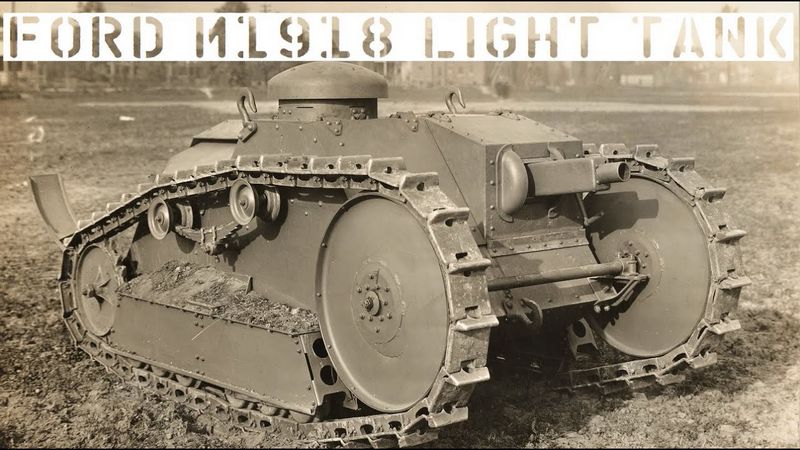
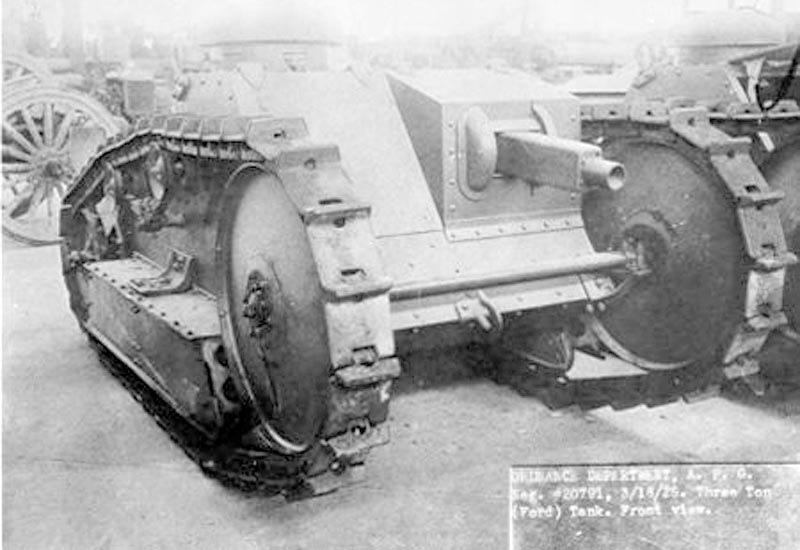
The design of the M1918 was largely based on the Renault FT-17, with a slender chain arrangement. The track system spanned the armoured hull and provided accommodation for the two crew members - the driver and gunner/commander sitting side by side - as well as power packs, ammunition and fuel supplies.
The design features a noticeably larger front idler and rear drive sprocket that works with six small wheels on one side of the track. The fuselage superstructure has some sloping angled surfaces to provide basic ballistic protection and contains a gun emplacement suitable for a single .30 caliber Browning machine gun. Since the weapon mounts were fixed to the front plate of the hull superstructure, it was given limited lateral and height, and therefore had limited tactical value.
The driver sat on the right front of the hull, the gunner sat on his left. As expected, the conditions for these two were cramped, noisy and very smelly - characteristic of all early tanks. Access is through rectangular gullwing doors in front of the driver's position. A dome (with a 360-degree viewing window) was added for the driver at the top right center of the fuselage, and an emergency water boom was added at the rear of the fuselage.
The vehicle weighed 3 tons and completed the expected light combat mission. It is 14 feet long, 6 feet wide and high. Power is provided by two coupled 90 hp (45 hp x 2) Ford Model T 4-cylinder water-cooled automotive engines and a Ford planetary gearbox with variable output as required.
The power/weight arrangement provides a top highway speed of just 8 mph and a range of 34 miles (using 17 gallons of internal fuel).
The U.S. Army eventually took delivery of at least 15 vehicles, which were contracted for a total of 15,000 vehicles, which Ford believed could reach a capacity of 100 tanks per day. However, only two examples made it to France, and their brief testing there proved extremely limited in the expanding war.
In addition, French FT-17s were plentiful, and the locally produced M1917 6-ton version would be readily available after the war. The First World War ended with the armistice in November 1918, and many projects, including the 1918 Ford Model, ended. Of the 15 cars the U.S.
Army claims to own, only two have stood the test of time as protected museum exhibitsall now in the U.S. (one in Ford Benning, Georgia, and the other at Fort Lee, Virginia).
The
Type 1918 was one of the first light tanks in history to be designed and produced by the United States, and undoubtedly provided the U.S. military-industrial complex with the training it needed to design, develop, and manufacture tanks. This proved crucial during the two world wars before World War II.
During the Cold War, U.S. tank expertise would get even better, eventually giving the Army the M1 Abrams main battle tank of today.
Specification
Basic
Roles
- Infantry Support
- Tank vs Tank
- Reconnaissance (RECCE)
Dimensions
13.98 ft (4.26 m)
5.91 ft (1.8 m)
5.91 ft (1.8 m)
3 tons (3,000 kg; 6,614 lb)
Performance
Performance
13 km/h
34 miles (55 km)
for everyone else in our database)
Armor
1 x .30 caliber Browning machine gun
550 x .30 caliber ammo
Changes
Type 1918 - Basic Series Names
 Argentina
 Armenia
 Australia
 Austria
 Austria-Hungary
 Belgium
 Brazil
 United Kingdom
 Brunei
 Bulgaria
 Canada
 Chile
Chile China
China Colonial America
 Colombia
 Confederate States
 Croatia
 Czech
Czech Denmark
 Egypt
Egypt Finland
 France
 Georgia
 Germany
 German Imperial
 Greece
 Holland
 Hungary
 India
India Indonesia
 Iran
Iran Iraq
Iraq Ireland
 Israel
 Italy
Italy Japan
Japan Japan (1940)
 Jordan
 Kingdom of Italy
 Malaysia
 Mexico
 Myanmar
 Nazi Germany
 Netherlands
 New Zealand
 North Korea
 Norway
 Pakistan
 Peru
Peru Philippines
 Poland
 Portugal
 Prussia
 Romania
 Russia
 Saudi Arabia
 Serbia
 Singapore
 Slovakia
 Slovenia
 South Africa
 South Korea
 Soviet Union
 Spain
Spain Sweden
 Switzerland
 Syria
Syria Taiwan
 Thailand
 Turkey
 UAE
UAE Ukraine
 Vietnam
 Yugoslavia