


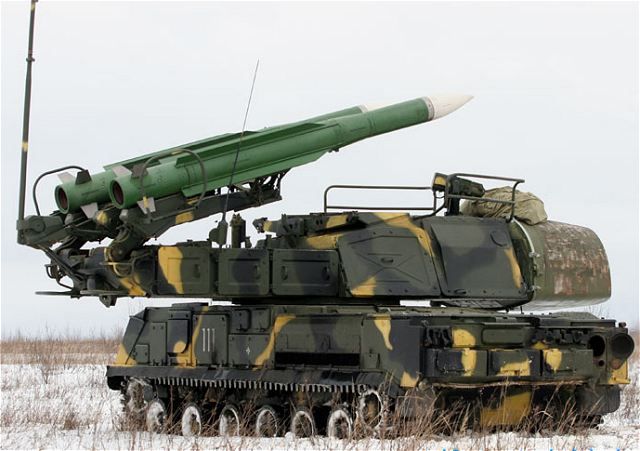
SA-11 (Gadfly) / 9K37 Buk History
The vast airspace over the Russian border and the climate of Cold War readiness required the Soviet Army to maintain a large number of mobile surface-to-air missile platforms. To extend the range, these systems were often sold to allies overseas or to satellite factions within the Soviet sphere of influencewith the aim of causing headaches for Western war planners, especially Americans. In 1970, the Soviet Army introduced the SA-6 "Gain" mobile anti-aircraft missile system to counter low-to-medium-speed threatsmainly low-flying aircraft and helicopters. However, as early as the early 1970s, it was considered to supplement existing systems with a more advanced type capable of countering all types of medium-altitude threats, including cruise missiles.
In 1972, the Soviet government commissioned such a system, which was designed to serve both land-based and sea-based installations - the former in basic track form, the latter only as a launch vehicle.
One of the major design shortcomings of the SA-6 Gainful series was the reliance on multiple transmitters for a single fire control radar. As such, the new missile system will have its own integrated fire control radar for increased tactical value.
The 9M38 "Buk" missile is designed to be mounted on a tracked chassis with six twin tire wheels on one side and a rear drive sprocket. The complete system will feature a 360-degree lateral launch platform (with powered lift) mounted with 4 x 9M38 rockets.
The new missile system was evaluated between 1977 and 1979, and only a limited number of examples entered service with the Soviet Army (designated "9K37-1 Buk-1") before the system officially entered service in 1980. The naval variant became the 3S-90 "Uragan", followed in 1983.
Recognition by Western NATO observers led to the designation of the SA-11 "Gadfly".
The complete system package was designed around the 9M38 rocket (later the 9M317 rocket) powered by a solid rocket motor. It has a range of up to 20 miles and defended airspace up to 46,000 feet. The missile relies on a semi-active radar homing guidance kit and is detonated by a radar-based proximity fuze that uses a high-explosive fragmentation warhead in the nose cone. Stabilizing fins were found along the sides of the missile.
The total weight of each rocket is 700 kg. The barrel length of each rocket is 5.55 meters. The advantage of such a system is that it can be launched from a variety of launch platforms, not just mobile land-based vehicles.
In this way, solid and marine variants can be developed from the basic design.
By 1983, the 9K37 series was modernized, which led to the development, acceptance and improvement of missiles with improved radar and further protection from enemy jamming signals designed to disrupt service. influences. The Soviet Army officially adopted this version in 1983, followed by an export brand. Another modernization effort introduced an improved missile type - the 9M317 - which was accepted in 1998, forcing NATO to create the completely new designation SA-17 "Grizzard" to differentiate the two main production types.
The Grizzly has the ability to track and intercept ballistic missiles in the air, improving range, accuracy and performance. The land-based variant also yielded an equivalent naval form. A new missile with enhanced capabilities was introduced in 2007. Vertical launchers were also developed.
The 9K37 weapon is thought to have shot down at least four Georgian drones in fighting between Russia and Georgia during the 2008 South Ossetia war. Instead, Georgia's 9K37 system shot down four Russian aircraft. During the conflict, the 9K37 performed very well.
Despite their origins in the 1970s, modern forms are still able to keep up with more modern aircraft and their respective countermeasures.
Both Belarus and China produced localized copies of the Soviet-Russian 9K37 anti-missile series. Both have been modernized in their own way to make them usable on the modern battlefield. Global operators that actually use the Soviet-Russian design include Belarus, China, Cyprus, Egypt, Finland, Georgia (via Ukraine), North Korea, Syria, Ukraine and Venezuela.
Russia has about 250 in stock.
Specification
Basic
Roles
- Air Defense/Airspace Denial
Armor
4 x 9M38 or 9M38M1 surface-to-air missiles (Gadfly).
4 x 9M317 SAM (Grizzly)
4 x missiles (without inherent reloads)
Changes
9K37 "Buk" - Official Soviet/Russian base designation; 9M38 missile; released in 1980.
9K37 Buk-1 - Basic production version
9K37M1 Buk-M1 - Modernized improvement; increased resistance to countermeasures; issued in 1983.
9K37M1 Buk-M1 Gang - export version of 9K37M1 Buk-M1
9K37M1-2 - Modernized Buk-M1 form
9K37M1-2 Buk-M1-2 - Improved new advanced missile (9M317); released in 1998
9K37M1-2 Buk-M1-2 "Ural" - The export name of the Buk-M1-2 production brand.
9K37M1-2 Buk-M1-2 "Ezh" - Navy version of Buk-M1-2.
9K37M1-2 Buk-M1-2 "Shtil-1" - The export name of the Buk-M1-2 production brand.
9K37M1-2A Buk-M1-2A
9K37M2 Buk-M2 - Improved/enhanced version with new missiles and new radar control system; released in 2009.
9K37M2E Buk-M2E "Ural" - export variant of the Buk-M2
9K37M3 Buk-M3 - latest version under development; entered service in 2009.
9K317 - 9M317 missile
9M317ME - Vertical firing variant of the 9K317
9M317-M2 - Buk-M2 - Test System
SA-11 "Gadfly" - NATO name
SA-N-7C "Grunk" - NATO-designated Shtil-1 export variant.
SA-17 "Grizzly" - NATO designated production brand 9K37M1-2 Buk-M1-2.
SA-N-7B "Grizzly" - NATO designation Buk-M1-2 "Ezh" system.
3S-90 "Uragan" - Naval Model 9K37; Issued 1983.
3S-90-E "Shtil-1" - export code for 9M317ME
3S-90-M - Russian military designation 9K317ME
 Argentina
 Armenia
 Australia
 Austria
 Austria-Hungary
 Belgium
 Brazil
 United Kingdom
 United States
 Brunei
 Bulgaria
 Canada
 Chile
Chile China
China Colonial America
 Colombia
 Confederate States
 Croatia
 Czech
Czech Denmark
 Egypt
Egypt Finland
 France
 Georgia
 Germany
 German Imperial
 Greece
 Holland
 Hungary
 India
India Indonesia
 Iran
Iran Iraq
Iraq Ireland
 Israel
 Italy
Italy Japan
Japan Japan (1940)
 Jordan
 Kingdom of Italy
 Malaysia
 Mexico
 Myanmar
 Nazi Germany
 Netherlands
 New Zealand
 North Korea
 Norway
 Pakistan
 Peru
Peru Philippines
 Poland
 Portugal
 Prussia
 Romania
 Russia
 Saudi Arabia
 Serbia
 Singapore
 Slovakia
 Slovenia
 South Africa
 South Korea
 Spain
Spain Sweden
 Switzerland
 Syria
Syria Taiwan
 Thailand
 Turkey
 UAE
UAE Ukraine
 Vietnam
 Yugoslavia