
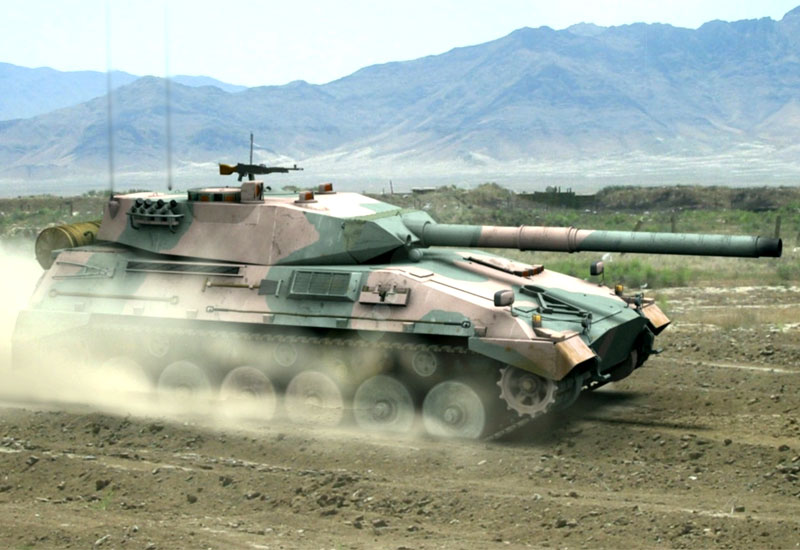
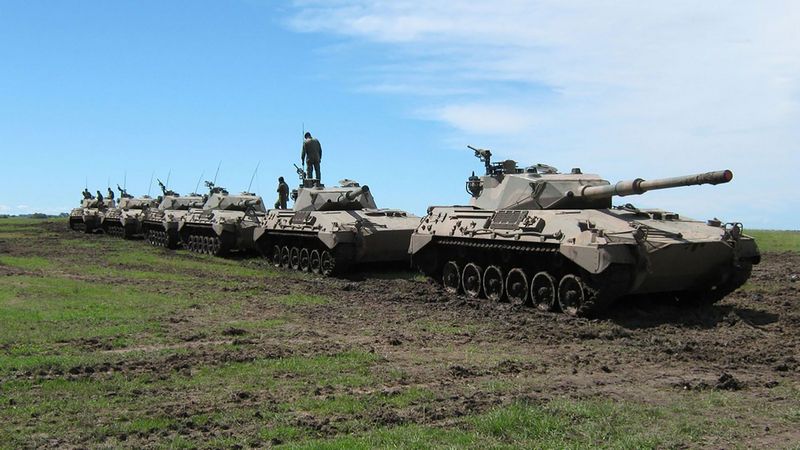
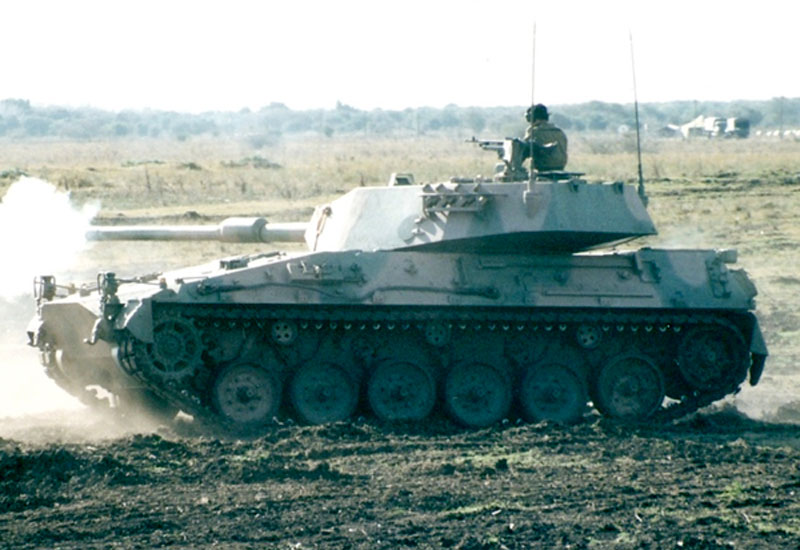
TAMSE TAM (Tanque Argentino Mediano) History
In the 1970s, the Argentine government sought to modernize its outdated armored force, consisting mainly of World War II-era M4 Sherman medium tanks and M3/M9 half-track tanks, and sought new replacements. In 1974, lacking the historical foundation needed to design and develop an expensive tracked vehicle program locally, the country hired the German company Thyssen-Henschel (now Rheinmetall Landsysteme in Kassel, Germany) to undertake the task.
Key to the Argentine Army's requirements is the development of a light/medium frontline fighting vehicle and an infantry fighting vehicle (IFV) using the same chassis and powertrain to keep costs in check.
In response, Thyssen-Henschel equipped the German Army's existing Marder infantry fighting vehicles with these roles - main battle tanks with full-scale rotating turrets and large-caliber weapons, infantry fighting vehicles with more compact turrets and Fighting compartment with automatic cannon and passengers. The Germans developed three prototypes of each car with the help of Argentina, which underwent extensive testing and trials while in Germany.
After successfully completing the tests, the vehicles were then shipped to Argentina for serial production at the TAMSE (Tanque Argentino Mediano Sociedad el Estado) plant in Buenos Aires, Argentina. About 70 percent of the vehicles come from Argentina, with the rest of the components built in Germany and finally assembled in Buenos Aires.
The Argentine Army's initial order was for 512 vehicles (200 TAM tanks and 312 VCTP IFVs) to store their inventory, although budget constraints forced the order to be reduced to 350 vehicles, and even then only 250 vehicles were completed (150 TAM tanks and 100 VCTP IFVs). The Argentines called the new main battle tank "TAM" (Tanque Argentino Medium = "Tank, Argentina, Medium"), while the IFV became the VCI with 12 seats and armed Rheinmetall (Vehiculo Combate Infanterie = "Infantry fighting vehicle" ) RH-202 20mm automatic cannon (the VCI name eventually evolved into VCTP (Vehiculo de CombateTransporte de Personal = "Personal Transport Vehicle")).
Several major variants emerged from these developments, each of which played its intended combat role in the Argentine Army and utilized the chassis of the TAM tank, although all were produced in very limited totals. These include the 155 mm armed VCA 155 (Vehiculo de Combate de Artilleria de 155 mm = "155 mm Artillery Combat Vehicle"), which uses the chassis of the TAM tank and the turret and gun (SPG) of the Italian OTO-Melara Palmaria self-propelled artillery attached. Platform, VCRT Armored Rescue Vehicle (ARV) (without turret) and VCL (Vehiculo de Combate Lanzacohetes = "Rocket Launcher Combat Vehicle") TAM-based rocket launcher with Israeli-designed launchers and missiles.
Command Vehicle - VCPC (Vehicle de Combate Puesto de Mando = "Command Combat Vehicle") is also identified and based on VCTP.
The TAM is a very traditional combat system, and its Marder IFV origins are evident in the chassis and fuselage sections. The hull sports a well-sloped ramp that leads to the roof of the hull. The sides are almost vertical with a slight slope, while the rear wall also slopes inward. The turret is located at the rear of the design and protrudes significantly.
Unlike other frontline main battle tanks, the TAM has an engine in the right front compartment, more similar to modern infantry fighting vehicles. The turret has a flat design and the barrel protrudes from the panel as usual. The front and side walls of the turret are slightly sloped to provide basic ballistic protection.
The undercarriage consists of six twin-tire wheels on one side and three track return rollers (these rollers are sometimes hidden by optional serrated side skirts for added protection). The drive sprocket is at the front of the hull and the chain idler is at the rear. The armor is steel and the NBC (Nuclear, Biological, Chemical) system is standard.
The vehicle consists of four standard operators, including the driver (left forward fuselage), commander, gunner and loader (all in the turret, central part of the fuselage).
The TAM tank is powered by a supercharged 6-cylinder diesel engine of the German MTU brand MB 833 Ka 500, producing 720 hp at 2,400 rpm. This allows for a top road speed of 46 mph and a range of 580 miles.
An optional external fuel barrel can be mounted on the rear wall of the fuselage to increase range. The hull is suspended on a conventional torsion bar suspension system, providing the required onshore handling characteristics.
The main armament is a turret-mounted 105mm FM K.4 Modelo 1L main gun (essentially a Royal Ordnance L7A1 series tank gun) that can be locked with a reverse V-lock during transport. In addition, there is a 7.62mm coaxial machine gun next to the main gun. An optional 7.62mm machine gun is mounted on the commander's cupola as an air defense/infantry deterrent. 2 x 4 electronically operated smoke grenade launchers provide a temporary smoke screen for the vehicle and crew.
It carries 50x105mm projectiles and 6,000x7.62mm bullets.
TAM was in service with the Argentine army in 1983 and is still active in their inventory today (2013). The first batch of models was produced from 1979 to 1991 with an initial batch of 150 TAM tanks and 100 VCTP IFVs, while a second batch was ordered from 1994 to 1995, which according to sources will be 50 Added IFV to TAM tanks and 116 VCTPs.
Since then, in 2010, a modernization program was implemented to bring the tracked vehicle family to modern operational standards. Elbit Systems, of Israeli concern, was handed the responsibility and key to the upgrade, including the installation of the L44 series of 120mm main guns (Rheinmetall 120mm smoothbore guns) to significantly increase the tactical value of the TAM tanks.
Modernization is expected to continue through 2013. The Argentine Army currently deploys 200 TAM tanks and 216 VCTP IFVs (some of which are assault tanks).
The TAM tank combines speed and maneuverability with sufficient firepower and protection to counter the threats posed by its neighbors in a potential war scenario. It's still superior to the latest generation of main battle tanks in the world, but still fills demand at a premium price. Its chassis has proven reliable and modular to a large extent to meet the short- and long-term needs of the Argentine Army, and will continue to serve the country for a decade or more.
Noticing foreign interest in German-Argentine products, despite the lack of a buyer to date, inevitably forced the TAMSE factory to close in 1995.
Specification
Basic
Roles
- Technology
- Infantry Support
- Tank vs Tank
- Front
- Reconnaissance (RECCE)
Dimensions
27.00 ft (8.23 m)
10.79 ft (3.29 m)
2.43m
33 tons (30,000 kg; 66,139 lbs)
Performance
Performance
75 km/h
367 miles (590 km)
for everyone else in our database)
Armor
1 x 105mm rifled main gun in the turret.
1 x 7.62mm coaxial machine gun in the turret.
1 x 7.62mm anti-aircraft (AA) machine gun on top of turret.
2 x 4 smoke grenade launchers near the sides of the rear turret.
50 x 105mm projectile.
6,000 7. 62mm ammunition.
8 x Smoke Grenade.
Changes
TAM - Model designation of the basic intermediate tank; entered service in 1983; 200 cars were produced.
VCA 155 - 155mm SPG variant; TAM tank chassis with Italian OTO-Melara Palmaria 155mm gun and turret; passed in 1995; 19 cars produced.
VCI - original name for infantry fighting vehicle; based on TAM chassis.
VCTP - updated name of armored personnel carrier; based on TAM chassis; entered service in 1983; 216 vehicles produced.
VCRT - Armored rescue vehicle based on TAM chassis.
VCA - battlefield ambulance based on TAM chassis
VC AMUN - Proposed Ammunition Carrier
VCLC - Battlefield Missile System; Israeli launchers and rockets in 160mm and 350mm sizes.
VCPC - Command post vehicle with improved communications; limited production.
R301 - Further development of the basic TAM system with added armor protection.
VCTM - Mortar Delivery Vehicle; 50 copies made.
 Armenia
 Australia
 Austria
 Austria-Hungary
 Belgium
 Brazil
 United Kingdom
 United States
 Brunei
 Bulgaria
 Canada
 Chile
Chile China
China Colonial America
 Colombia
 Confederate States
 Croatia
 Czech
Czech Denmark
 Egypt
Egypt Finland
 France
 Georgia
 Germany
 German Imperial
 Greece
 Holland
 Hungary
 India
India Indonesia
 Iran
Iran Iraq
Iraq Ireland
 Israel
 Italy
Italy Japan
Japan Japan (1940)
 Jordan
 Kingdom of Italy
 Malaysia
 Mexico
 Myanmar
 Nazi Germany
 Netherlands
 New Zealand
 North Korea
 Norway
 Pakistan
 Peru
Peru Philippines
 Poland
 Portugal
 Prussia
 Romania
 Russia
 Saudi Arabia
 Serbia
 Singapore
 Slovakia
 Slovenia
 South Africa
 South Korea
 Soviet Union
 Spain
Spain Sweden
 Switzerland
 Syria
Syria Taiwan
 Thailand
 Turkey
 UAE
UAE Ukraine
 Vietnam
 Yugoslavia