

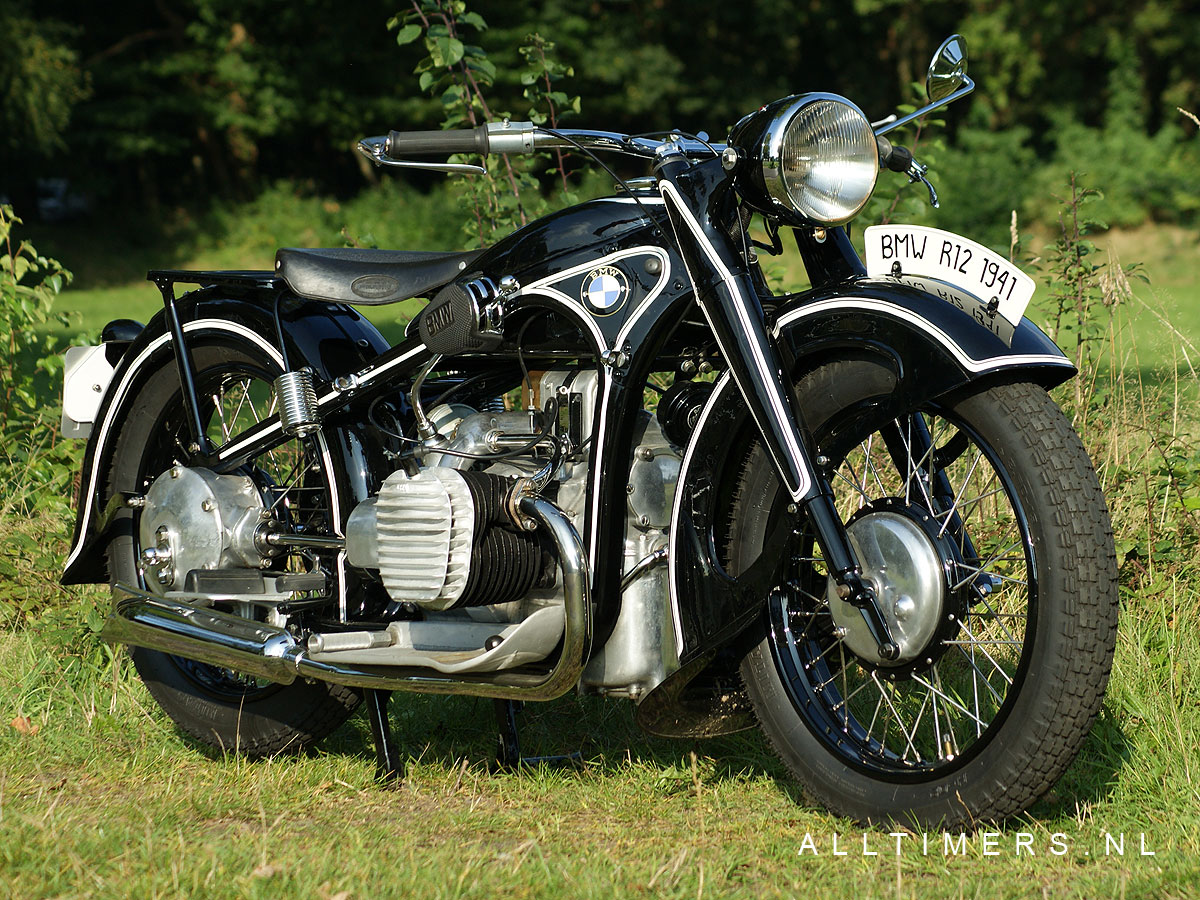

History of the BMW R12
The R12 was used by the German Army for communications and reconnaissance purposes in the late 1930s and 1940s. During this period, such fast vehicles proved increasingly important for the speed required for Hitler's blitz in European countries.
By May 1941, BMW had delivered 36,000 R12s to the German army, making the R12 BMW's most produced motorcycle at the time. Despite its long range, the model was eventually replaced by the military-oriented R75 series in service with the German Army in 1942.
On BMW's line, the R12 itself replaced the 1932 R4 - which was nothing more than a civilian motorcycle purchased for military use.
BMW motorcycle frames from the 1920s, at least those equipped with the popular "Touring" sidecars, proved prone to damage due to their simple joint welding. So, research into a new frame began, which culminated in an entirely new motorcycle design - the R11 series. The revised frame is constructed as two separate channels of stamped sheet metal, with rivets connecting the two halves during assembly.
The new structure helps the frame absorb the weight and dead weight of the carrying sidecar. To power the R11, BMW developed a range of powerful 750cc engines, including a 16hp version and a 28hp Overhead Valve (OHV) version. The R11 "Touring" and R16 "Sport" models were born from these two engines.
New telescopic forks were developed in the early 1930s, contributing to the revision of the 1935 R11 and R16 models. A new 4-speed manual gearbox was also installed, resulting in the corresponding model names R12 and R17.
That same year, the German Army chose to produce the R12 to fill their reconnaissance and security ranks. By 1936, arc welding was gaining momentum, and BMW was using the technology to solve their joint stress problems, resulting in a stronger machine when using sidecars, which helped keep the R12 series (and its R17 siblings) Business success.
Specification
Basics
Year of Service
1935
Origins
Nazi Germany
Crew
1 to 3
Production
30,000
Manufacturer
BMW - Nazi Germany
Operator
Nazi Germany
Role
Scout
Can perform reconnaissance/reconnaissance missions to assess threat levels, enemy strength, etc. - usually due to lightweight construction.
Utilities
Generally user-centered design to perform various battlefield missions, usually in an indirect combat fashion.
Dimensions and Weight
Length
6.9ft
2.1m
width
3. 0 feet
0.9m
Height
3. 1 feet
0.94m
Weight
414 lbs
188 kg
Power and Performance
Engine:
1 x BMW 2-cylinder 745cc engine with 20 hp at 4,000 rpm.
Speed
62. 1 km/h
(100.0km/h)
Area
158. 4 miles
(255.0 km)
Weapon
Optional (sidecar mounted): 1 x 7.92mm MG34 or MG42 general purpose machine gun. All personal weapons are also carried with you.
AMMOTION
100 x 7.92mm ammo (typical)
VARIANTS
R12 - name of the basic production series
 Argentina
 Armenia
 Australia
 Austria
 Austria-Hungary
 Belgium
 Brazil
 United Kingdom
 United States
 Brunei
 Bulgaria
 Canada
 Chile
Chile China
China Colonial America
 Colombia
 Confederate States
 Croatia
 Czech
Czech Denmark
 Egypt
Egypt Finland
 France
 Georgia
 Germany
 German Imperial
 Greece
 Holland
 Hungary
 India
India Indonesia
 Iran
Iran Iraq
Iraq Ireland
 Israel
 Italy
Italy Japan
Japan Japan (1940)
 Jordan
 Kingdom of Italy
 Malaysia
 Mexico
 Myanmar
 Netherlands
 New Zealand
 North Korea
 Norway
 Pakistan
 Peru
Peru Philippines
 Poland
 Portugal
 Prussia
 Romania
 Russia
 Saudi Arabia
 Serbia
 Singapore
 Slovakia
 Slovenia
 South Africa
 South Korea
 Soviet Union
 Spain
Spain Sweden
 Switzerland
 Syria
Syria Taiwan
 Thailand
 Turkey
 UAE
UAE Ukraine
 Vietnam
 Yugoslavia