
History
The Patriot interceptor missile family comprises several generations of American surface-to-air missiles used with the Patriot air and missile defense system. The family evolved from an anti-aircraft weapon into a group of interceptors capable of engaging aircraft, cruise missiles, drones, and tactical ballistic missiles.
Raytheon produces the MIM-104-derived PAC-2 and Guidance Enhanced Missile variants. Lockheed Martin produces the smaller PAC-3 hit-to-kill interceptor and its PAC-3 Missile Segment Enhancement development.
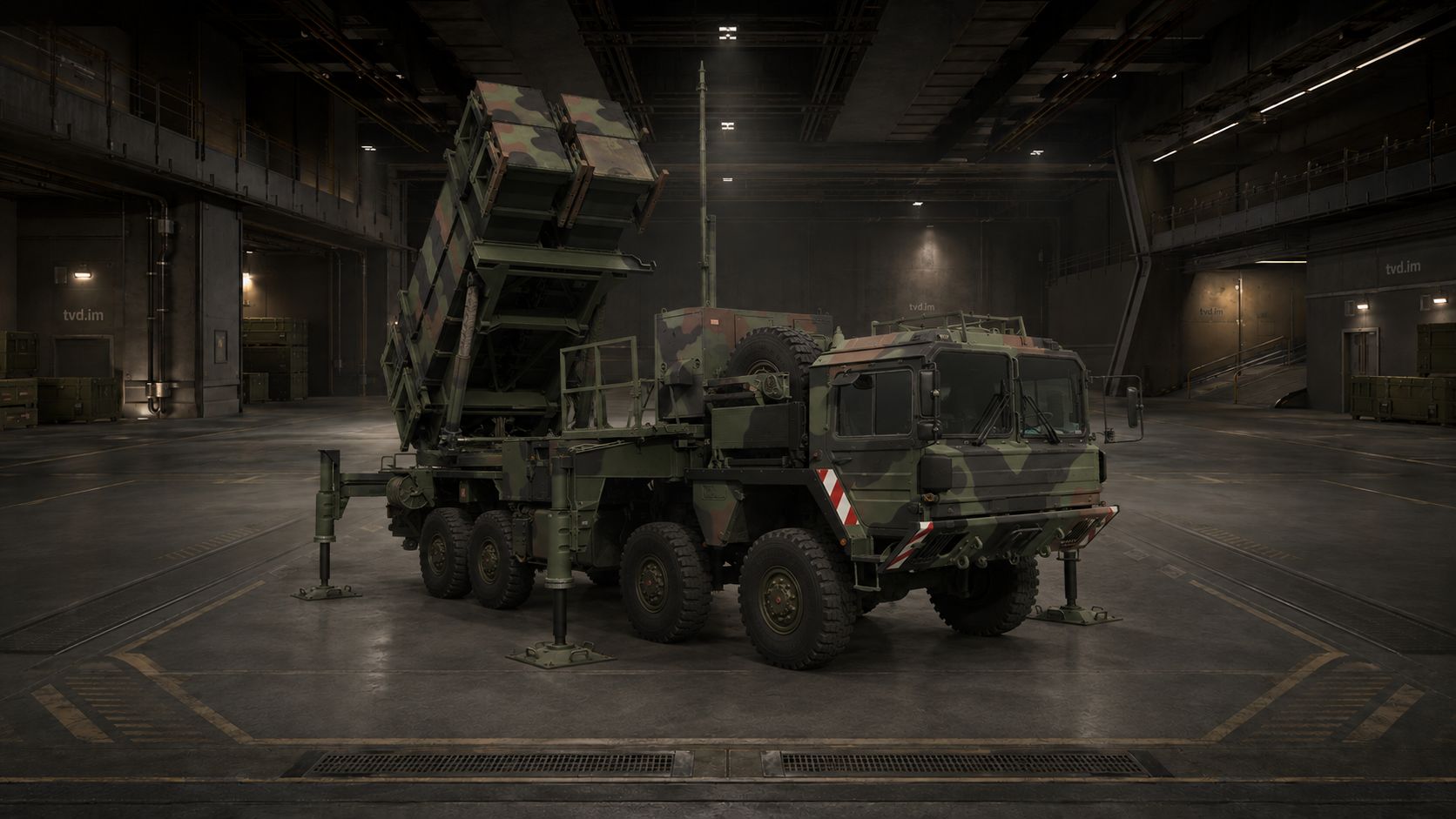
The missiles operate as part of a wider Patriot battery that includes radar, command-and-control equipment, launchers, power-generation equipment, and support vehicles. Different interceptor types can complement each other within the same defensive architecture.
Development of the original missile
The U.S. Army Missile Command began the Army Air Defense System for the 1970s program in 1961. The planned mobile system was intended to replace fixed HAWK and Nike Hercules positions. The program became Surface-to-Air Missile, Development, or SAM-D, in October 1964. A prime contractor was selected in 1967, and the first SAM-D flight test took place in November 1969.
In January 1974, the U.S. Department of Defense revised SAM-D around a Track-Via-Missile guidance method and a simplified operational concept. Engineering development began in February 1976. The program received the Patriot name in May 1976. Full-rate production began in September 1980, and the U.S. Army activated its first Patriot missile battalion in May 1982. A detailed development chronology is available from the CSIS Missile Threat project.
The initial MIM-104A Standard missile was intended primarily for aircraft interception. The PAC-1 program introduced software and radar-search changes during the 1980s to provide an initial capability against tactical ballistic missiles. A successful interception of a Lance missile took place in September 1986, and PAC-1 was deployed in July 1988.
PAC-2 and Guidance Enhanced Missile development
Testing showed that the earlier missile could intercept a ballistic target but might not destroy it reliably. The PAC-2 program therefore changed the missile fuze, guidance, and blast-fragmentation warhead. The fragments were enlarged from approximately 2 g to approximately 45 g, while the pulse-Doppler radar fuze was adjusted for high-speed ballistic targets. PAC-2 testing began in 1987, and the missile reached U.S. Army units in 1990.
Further PAC-2 improvements produced the Guidance Enhanced Missile family. The original GEM received a faster proximity fuze, a low-noise seeker front end, and improved performance against targets with a small radar cross-section. GEM-T was optimized for tactical ballistic missiles, while GEM-C addressed cruise missiles and other low-altitude targets. The GEM+ generation entered service in November 2002. The development and distinctions between the MIM-104 variants are summarized in the MIM-104 Patriot reference.
PAC-3 development
The PAC-3 represented a separate interceptor design based on hit-to-kill technology. Instead of relying mainly on fragments from a nearby detonation, it was designed to destroy a target through direct collision. The U.S. Army began work on a hit-to-kill weapon in 1983. The Flexible Lightweight Agile Guided Experiment intercepted a Lance ballistic missile during a flight test in May 1987.
The follow-on Extended Range Intercept Technology design completed its final design review in December 1989 and underwent flight testing from 1992 to 1994. ERINT became the basis of PAC-3, and the U.S. Defense Acquisition Board selected it for development in May 1994. PAC-3 missile flight testing began in 1997. Limited user testing and low-rate initial production followed in 2000. The missile achieved initial operational capability in 2001 and was declared combat-ready in August 2002.
PAC-3 MSE development
The PAC-3 Missile Segment Enhancement introduced an enlarged rocket motor, larger tail fins, greater speed, and improved maneuverability. Its first guided intercept attempt in March 2009 failed when the motor's second pulse did not ignite. During another test in February 2010, one interceptor failed to launch, but the second destroyed a tactical ballistic missile target.
PAC-3 MSE was approved for low-rate initial production in 2014 and achieved initial operational capability late in 2016. The U.S. Army approved full-rate production in 2018.
Production cooperation with Ukraine
In July 2026, possible licensed production of Patriot interceptors for Ukraine remained under consideration in Washington. Ukrainian representatives held discussions with Lockheed Martin, which produces PAC-3 missiles, and RTX, whose Raytheon business produces PAC-2-family missiles. U.S. President Donald Trump said that no decision had been made and described the technology as equipment whose licensing required caution.
Ukraine also discussed potential joint production, while Poland was reported to be preparing cooperation with Ukraine in PAC-3 production and servicing. These discussions concerned future industrial arrangements and did not establish that licensed production had begun.
Design
System integration
Patriot interceptors are components of a ground-based mobile defense system rather than independent weapons. A battery combines a phased-array radar, an engagement control station, launchers, electrical-power equipment, communications, and interceptor missiles. The radar detects and tracks threats, while the control station evaluates targets and directs an engagement.
A standard launcher has four full-size canister positions. Four PAC-2-size missiles can be carried, while a suitably modified launcher can accommodate as many as sixteen smaller PAC-3 interceptors. A launcher may be positioned separately from the radar and control station. An overview of the battery and its interceptor options is provided by the Missile Defense Advocacy Alliance.
PAC-2 architecture
PAC-2 is a single-stage, ground-launched interceptor derived from the original MIM-104 missile. It uses a high-explosive blast-fragmentation warhead and a proximity fuze. The missile is intended to pass close enough to the target for the warhead's fragments to damage or destroy it.
PAC-2 engagements use radar support from the Patriot battery. The missile transmits information back to the ground system, which tracks the missile and target and contributes to guidance. The PAC-2 ballistic-missile engagement procedure introduced a short delay between two launches so that the second interceptor could distinguish the target warhead after the first detonation.
GEM-T seeker and fuze
GEM-T combines the PAC-2 blast-fragmentation principle with improved electronics. Its modernized digital fuze increases sensitivity against high-speed tactical ballistic missile targets. A low-noise seeker front end improves acquisition and tracking, while a revised oscillator and downlink increase the signal-to-interference ratio against small airborne targets and cruise missiles in clutter. Raytheon describes these features on its GEM-T product page.
PAC-3 architecture
PAC-3 is smaller than PAC-2 and uses hit-to-kill interception. Its direct-impact method concentrates the interceptor's kinetic energy on the target. PAC-3 MSE retains this principle while using a larger motor and larger tail surfaces to extend the engagement envelope and improve maneuverability.
The PAC-2/GEM and PAC-3 branches therefore provide complementary effects. GEM-T can engage aircraft, cruise missiles, and tactical ballistic missiles with a blast-fragmentation warhead. PAC-3 concentrates on direct-impact interception of ballistic and cruise missile threats.
Operational history
PAC-2 was the first Patriot interceptor used for ballistic missile defense in combat during the 1991 Gulf War. Assessments of individual engagements have remained disputed, and the complete official study of PAC-2 effectiveness has not been made public.
PAC-3 and GEM-T were used during Operation Iraqi Freedom in 2003. PAC-3 units conducted their first combat employment during that conflict, while GEM-family missiles also saw extensive operational use.
Patriot interceptors have subsequently been deployed by the United States and partner countries for defense against aircraft and missile threats. RTX states that Patriot had been used by five nations in more than 250 combat engagements. The manufacturer also reported more than 150 ballistic-missile interceptions since January 2015, including more than 90 involving Guidance Enhanced Missiles. These figures are manufacturer-reported totals. Current program information is available on the RTX Global Patriot page.
Published operator totals vary with the date and definition used. A 2023 CSIS account identified 18 operating countries, while RTX later described Patriot as the basis of a 19-nation air and missile defense partnership.
Variants
- MIM-104A Standard: Initial production interceptor intended primarily for anti-aircraft defense.
- MIM-104B: Variant associated with an anti-stand-off-jammer role against electronic warfare aircraft. PAC-1 itself was principally a radar and software upgrade rather than a completely new interceptor.
- MIM-104C PAC-2: Major missile upgrade optimized for ballistic missile engagements through changes to the guidance, fuze, and blast-fragmentation warhead.
- MIM-104D PAC-2 GEM: Guidance Enhanced Missile with an improved proximity fuze and seeker performance against ballistic missiles and targets with a small radar cross-section.
- GEM-C: GEM development optimized for cruise missiles and other low-altitude targets.
- GEM-T: PAC-2-family interceptor optimized for tactical ballistic missiles while retaining capability against cruise missiles and aircraft.
- PAC-3: Smaller direct-impact interceptor developed from ERINT. Modified Patriot launchers can carry more PAC-3 missiles than PAC-2 missiles.
- PAC-3 MSE: Missile Segment Enhancement with a larger motor, larger tail fins, increased maneuverability, and an engagement range described as nearly twice that of the preceding PAC-3.
Specifications (MIM-104C PAC-2)
General characteristics
- Type: Ground-launched surface-to-air interceptor
- Stages: One
- Primary roles: Interception of aircraft and tactical ballistic missiles
- Launch installation: Patriot mobile launching station
- Launcher capacity: Four PAC-2 missiles in individual canisters
Guidance and engagement
- Guidance concept: Radar-supported Track-Via-Missile engagement
- Target detection and tracking: Patriot battery phased-array radar
- Warhead: High-explosive blast-fragmentation
- Fragment mass: Approximately 45 g for the PAC-2 ballistic-missile-optimized warhead
- Detonation: Proximity fuze optimized for high-speed engagements
- Intercept method: Near-target warhead detonation rather than the direct-impact method used by PAC-3
Related equipment
- ERINT: Extended Range Intercept Technology test program that became the basis of the PAC-3 interceptor.
- THAAD: A higher-tier ballistic missile defense system that can operate with Patriot as part of a layered defense architecture.
 Argentina
 Armenia
 Australia
 Austria
 Austria-Hungary
 Belgium
 Brazil
 United Kingdom
 Brunei
 Bulgaria
 Canada
 Chile
Chile China
China Colonial America
 Colombia
 Confederate States
 Croatia
 Czech
Czech Denmark
 Egypt
Egypt Finland
 France
 Georgia
 Germany
 German Imperial
 Greece
 Holland
 Hungary
 India
India Indonesia
 Iran
Iran Iraq
Iraq Ireland
 Israel
 Italy
Italy Japan
Japan Japan (1940)
 Jordan
 Kingdom of Italy
 Malaysia
 Mexico
 Myanmar
 Nazi Germany
 Netherlands
 New Zealand
 North Korea
 Norway
 Pakistan
 Peru
Peru Philippines
 Poland
 Portugal
 Prussia
 Romania
 Russia
 Saudi Arabia
 Serbia
 Singapore
 Slovakia
 Slovenia
 South Africa
 South Korea
 Soviet Union
 Spain
Spain Sweden
 Switzerland
 Syria
Syria Taiwan
 Thailand
 Turkey
 UAE
UAE Ukraine
 Vietnam
 Yugoslavia