
History
The Diehl Defence IRIS-T SLM is a German medium-range ground-based air-defence system derived from the IRIS-T air-to-air missile. It is intended to engage aircraft, helicopters, cruise missiles and unmanned aerial vehicles at greater distances than the short-range IRIS-T SLS system.
IRIS-T SLM combines vertically launched guided missiles with radar, command-and-control equipment and mobile launch vehicles. The standard SLM missile has an engagement range of up to 40 km and an altitude envelope of about 20 km.
The system entered operational service with Ukraine in 2022 and has subsequently been ordered by several European countries. A maritime adaptation has also been developed for integration with German Navy F125 frigates.
Development and qualification
IRIS-T SLM was developed by Diehl Defence as the medium-range member of the surface-launched IRIS-T family. The system was publicly demonstrated in 2014, and the IRIS-T SL missile completed qualification firings in 2015.
Egypt placed the first export order for IRIS-T SLM in December 2021. Ukraine received an IRIS-T SLM fire unit in October 2022 and became the first country to employ the system operationally. Germany ordered six fire units and 216 missiles in 2023 as part of the development of its own ground-based air-defence capability.
Further European procurement followed through national programs and the European Sky Shield Initiative. Estonia and Latvia jointly selected IRIS-T SLM, while Slovenia, Bulgaria, Sweden, Switzerland and Denmark subsequently placed orders or entered procurement arrangements for the system.
Naval adaptation
Germany began examining the integration of IRIS-T SLM with the F125 frigate class in 2024. The work required adaptation of a system originally designed for land-based operation to the ship's sensors, command architecture and deck installation.
A navalized demonstrator was installed aboard the frigate Baden-Württemberg for a German Navy firing exercise off Andøya, Norway, in October 2025. Three live IRIS-T SLM missiles were fired during the exercise. Target information from the ship's radar was supplied to the missile system, demonstrating the basic integration of the frigate's sensors with the naval air-defence module.
In 2026, Diehl Defence and the German procurement authority BAAINBw agreed on further adaptation and development work intended to turn the demonstrator into an operational capability for the four F125 frigates. The planned configuration provides each ship with two launchers carrying 16 missiles each, for a total of 32 IRIS-T SLM missiles.
Design
System architecture
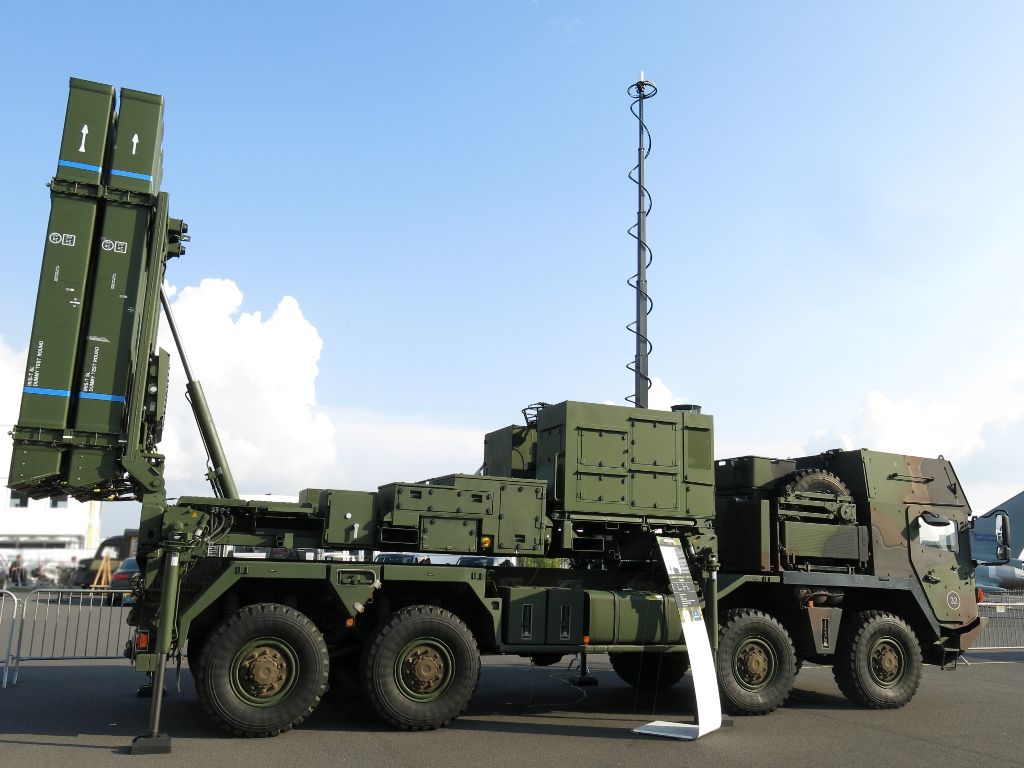
An IRIS-T SLM fire unit combines missile launchers, radar and battle-management equipment. The mobile launcher is based on an 8×8 vehicle and normally carries eight missile canisters arranged in two banks of four. Missiles are launched vertically, allowing engagement in any direction without requiring the launcher to be pointed toward the target.
The system can use the HENSOLDT TRML-4D radar for detection, tracking and target designation. Diehl's integrated battle-management software coordinates sensor information, launchers and engagements within the fire unit.
Missile and guidance
The IRIS-T SLM interceptor is derived from the IRIS-T missile family. During the mid-course phase it uses inertial and satellite navigation together with updates transmitted through a radio-frequency datalink. Terminal guidance is provided by a passive infrared seeker.
The missile is approximately 2.94 m long, has a diameter of 152 mm and weighs about 87.4 kg. It carries an 11.4 kg high-explosive fragmentation warhead. Maximum speed is stated as more than Mach 3.
The SLM configuration provides an engagement range of up to 40 km and an altitude of up to 20 km. Its vertical-launch arrangement provides 360-degree coverage around the launcher.
Operational history
Ukraine became the first operational user of IRIS-T SLM in October 2022. The systems have been used during the Russia-Ukraine war against aerial threats including cruise missiles and unmanned aircraft. By June 2024, more than 240 successful interceptions had been attributed to IRIS-T SLM and IRIS-T SLS systems in Ukrainian service.
Germany formally introduced IRIS-T SLM into Bundeswehr service in 2024 and has continued expanding its planned inventory. Other European customers have ordered the system as part of efforts to rebuild or expand medium-range ground-based air defence.
Variants
- IRIS-T SLM: Medium-range ground-based configuration with a stated range of up to 40 km and engagement altitude of up to 20 km.
- IRIS-T SLM/X launcher: Common launcher configuration unveiled in 2026 that can accommodate both IRIS-T SLM and the longer-range IRIS-T SLX interceptor within the existing ground-based architecture.
- Naval IRIS-T SLM adaptation: Shipboard configuration demonstrated aboard the German frigate Baden-Württemberg in 2025 and subsequently selected for further development for the F125 class.
Operators
- Egypt: First export customer, with an IRIS-T SLM contract placed in December 2021.
- Ukraine: First operational user, receiving its first IRIS-T SLM fire unit in October 2022 and subsequently receiving additional systems.
- Germany: Ordered IRIS-T SLM for the Bundeswehr and introduced the system into service in 2024. Germany is also developing a naval adaptation for the F125 frigates.
- Estonia: Procured IRIS-T SLM jointly with Latvia; systems arrived in Estonia in 2026.
- Latvia: Joint procurement partner with Estonia for IRIS-T SLM.
- Slovenia: Procured IRIS-T SLM and later ordered additional fire units.
- Bulgaria: Approved procurement of IRIS-T SLM with options for additional systems.
- Sweden: Ordered seven IRIS-T SLM fire units in 2025, with deliveries planned from 2028.
- Switzerland: Selected IRIS-T SLM for medium-range ground-based air defence and entered a procurement program in 2025.
- Denmark: Selected IRIS-T SLM for the development of its ground-based air-defence capability.
Specifications (IRIS-T SLM)
Missile
- Length: 2.94 m
- Diameter: 152 mm
- Weight: 87.4 kg
- Warhead: 11.4 kg high-explosive fragmentation
Performance
- Maximum engagement range: up to 40 km
- Maximum engagement altitude: up to 20 km
- Maximum speed: more than Mach 3
Guidance
- Mid-course guidance: Inertial and satellite navigation with radio-frequency datalink updates
- Terminal guidance: Passive infrared seeker
Launcher
- Standard missile load: Eight canister-launched missiles
- Launch method: Vertical launch
- Engagement coverage: 360 degrees
- Mobile launcher chassis: MAN SX45 8×8
Related equipment
- IRIS-T: Air-to-air missile from which the surface-launched family was developed.
- IRIS-T SLS: Short-range member of the ground-based IRIS-T air-defence family.
- IRIS-T SLX: Longer-range member of the family, designed for an engagement range of up to 80 km and altitude of up to 30 km.
 Argentina
 Armenia
 Australia
 Austria
 Austria-Hungary
 Belgium
 Brazil
 United Kingdom
 United States
 Brunei
 Bulgaria
 Canada
 Chile
Chile China
China Colonial America
 Colombia
 Confederate States
 Croatia
 Czech
Czech Denmark
 Egypt
Egypt Finland
 France
 Georgia
 German Imperial
 Greece
 Holland
 Hungary
 India
India Indonesia
 Iran
Iran Iraq
Iraq Ireland
 Israel
 Italy
Italy Japan
Japan Japan (1940)
 Jordan
 Kingdom of Italy
 Malaysia
 Mexico
 Myanmar
 Nazi Germany
 Netherlands
 New Zealand
 North Korea
 Norway
 Pakistan
 Peru
Peru Philippines
 Poland
 Portugal
 Prussia
 Romania
 Russia
 Saudi Arabia
 Serbia
 Singapore
 Slovakia
 Slovenia
 South Africa
 South Korea
 Soviet Union
 Spain
Spain Sweden
 Switzerland
 Syria
Syria Taiwan
 Thailand
 Turkey
 UAE
UAE Ukraine
 Vietnam
 Yugoslavia