
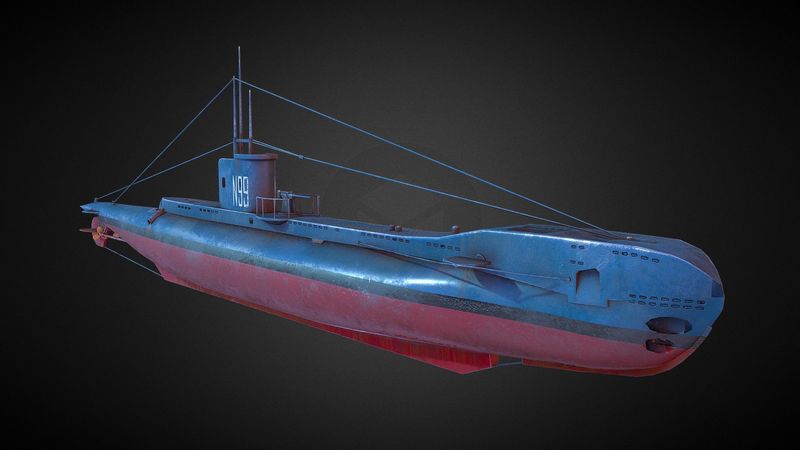
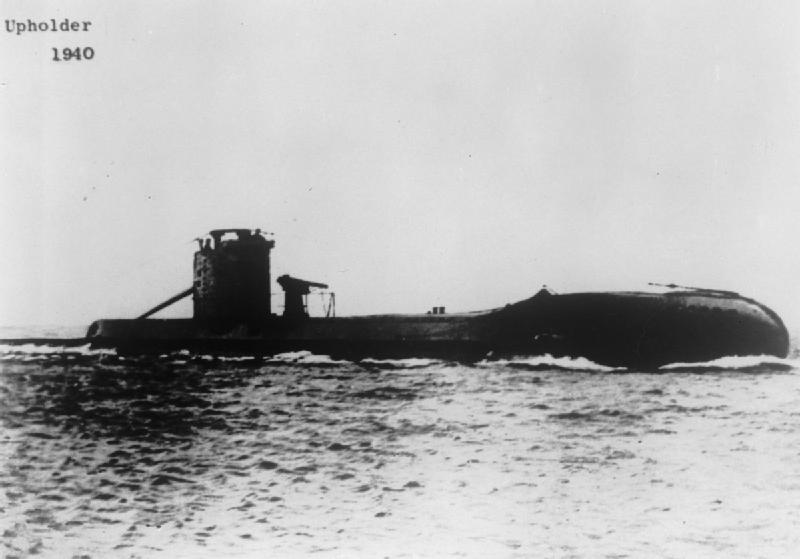
HMS Upholder (P37) History
The HMS Upholder (P37) ordered in 1936 was the seventh U-class submarine built by Vickers Armstrong for the Royal Navy. With a looming war against German submarine submarines, the Royal Navy had to replace its aging WWI H-class submarine fleet. The U-class ship was originally designed as an unarmed training submarine, but this was of course modified for the war across the North Sea. Therefore, in the final stages of her design, it was decided to equip the U-Class series with torpedo tubes - initially 6, then reduced to 4, all mounted on her bow.
A 3-inch anti-aircraft gun was added to the bow in front of the conning tower. Displacement of only 630 tons, the U-class is smaller than the German U-type I submarine, which itself displaces 862 tons. The inherent small size of the U-Class makes them more maneuverable, while also making them much smaller targets for enemies. Faster to build from the keel, cheaper to acquire and reliable at sea, the U-class became the premier ship for British submarine service during World War II.
In total, about 46 U-class submarines were built.
HMS Upholder began sea trials in September 1940, and after completing the required crew training, she made her maiden voyage on 10 December and was assigned to the 10th Submarine Fleet at Malta. The Mediterranean Sea is a complex area for submarine operations, some deep and some shallow. The water, it turns out, is shallow enough for an attack submarine to accidentally hit the bottom while diving. Ships on or in the clear waters of the Mediterranean are also relatively easy to spot from the air. Other issues facing the 10th Submarine Division include mines, small submarine hunters in coastal waters and land-based enemy reconnaissance aircraft.
Freshwater rivers also flow into the Mediterranean. River water often proved to be less buoyant and unsupportive for submarines, causing passing submarines to sink 100 feet or more without warning.
The situation was very dangerous when the 10th U-boat fleet lost 3 U-boats on patrol. HMS Upholder under the command of Lt. However, Commander Malcolm Wanklyn showed hope when she sank an 8,000-ton enemy supply ship on her first patrol.
In early 1941, the Luftwaffe bombed Malta daily in an attempt to break British control of the island. Many British aircraft were destroyed, except for some Wellingtons and Swordfish, which were capable of attacking enemy ships.
British air defenses on the island were a negligible threat to the Luftwaffe.
By September 1941, two more ships had been sunk by the Germans. HMS Upholder launched her 14th patrol with three other U-class ships to locate and sink enemy troop carriers heading for Tunisia. Four submarines took up positions on the route near Sirte. Three Italian transports with the umbrella of six destroyers are approaching the position of the maintainers. She alone attacked nine heavily armed enemy ships.
Wanklyn penetrated the destroyer's screen and fired three torpedoes within five thousand yards.
Wanklyn hits three of the three torpedoes fired at the transport plane. Two torpedoes hit SS Neptunia and one hit SS Oceania. Neptune was badly damaged, and Oceania's propeller was completely blown up. A third transport ship, the SS Vulcania, left the area with the support of a destroyer. The SS Neptunia eventually sank, and the accompanying destroyer collected the survivors and sailed to the aid of the SS Oceania after completing the mission, which was now dead in the water.
Upholder surfaced and fired two torpedoes more than a mile at the destroyer protecting SS Oceania, hitting and sinking one. SS Oceania later sank. On 6 April, HMS Upholder embarked on her 25th and final patrol before returning to the UK.
However, she never returned, and the exact cause of her death remains largely unknown. She was reported missing on April 14, 1942, possibly the victim of an Italian submarine hunter.
HMS Upholder (P37) has the most successful record of any British submarine during WWII. During her 24 patrols against enemy ships in the Mediterranean, she carried out 36 torpedo attacks, sinking a total of 21 ships with a gross tonnage of over 90,000 tons: 15 German and Italian transport and supply ships, 3 German anti-submarine submarines , 2 destroyers and 1 armed trawler.
Lieutenant Colonel Wanklyn was awarded the coveted Victoria Cross for his service.
Specification
Basic
Roles
- Blue Water Operations
- Fleet Support
- Hunter
- direct attack
Dimensions
58.22m
16 feet (4.88 m)
15.1 ft (4.60 m)
Weight
540 tons
730 tons
Performance
Performance
11 kn (13 mph)
10 knots (11.51 miles)
4,706 nautical miles (5,415 mi; 8,715 km)
Armor
4 x 533 mm (21 in) torpedo tubes in bow fitting; 10 torpedoes.
2 x 533 mm (21 in) external torpedo tubes in bow fitting.
1 x 76.2mm dual-purpose deck gun
Wing
No.
 Argentina
 Armenia
 Australia
 Austria
 Austria-Hungary
 Belgium
 Brazil
 United States
 Brunei
 Bulgaria
 Canada
 Chile
Chile China
China Colonial America
 Colombia
 Confederate States
 Croatia
 Czech
Czech Denmark
 Egypt
Egypt Finland
 France
 Georgia
 Germany
 German Imperial
 Greece
 Holland
 Hungary
 India
India Indonesia
 Iran
Iran Iraq
Iraq Ireland
 Israel
 Italy
Italy Japan
Japan Japan (1940)
 Jordan
 Kingdom of Italy
 Malaysia
 Mexico
 Myanmar
 Nazi Germany
 Netherlands
 New Zealand
 North Korea
 Norway
 Pakistan
 Peru
Peru Philippines
 Poland
 Portugal
 Prussia
 Romania
 Russia
 Saudi Arabia
 Serbia
 Singapore
 Slovakia
 Slovenia
 South Africa
 South Korea
 Soviet Union
 Spain
Spain Sweden
 Switzerland
 Syria
Syria Taiwan
 Thailand
 Turkey
 UAE
UAE Ukraine
 Vietnam
 Yugoslavia