
History
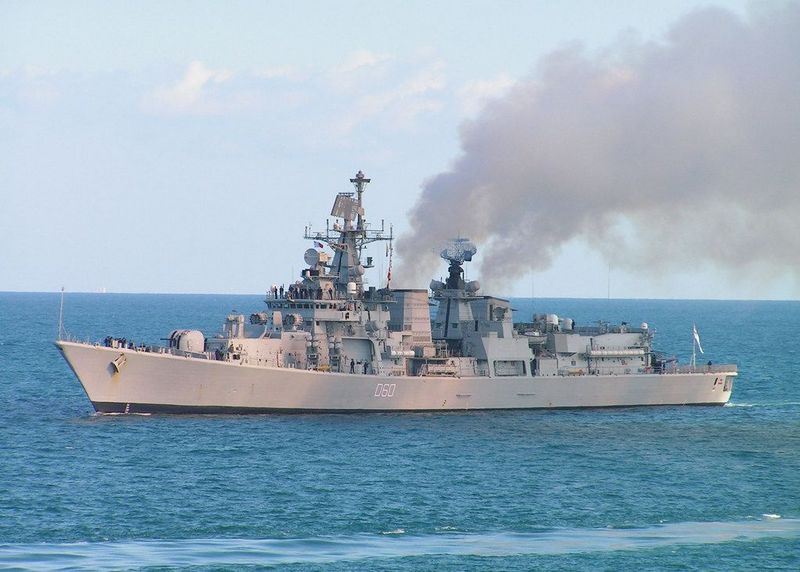
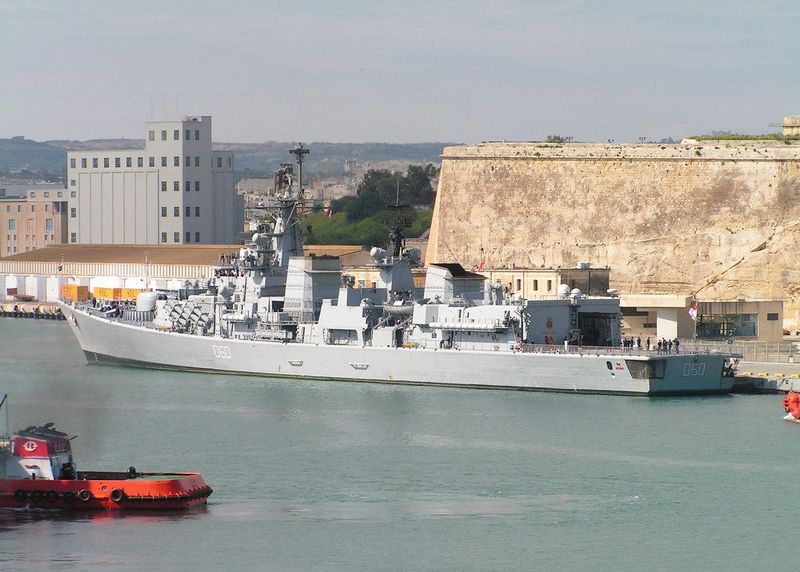
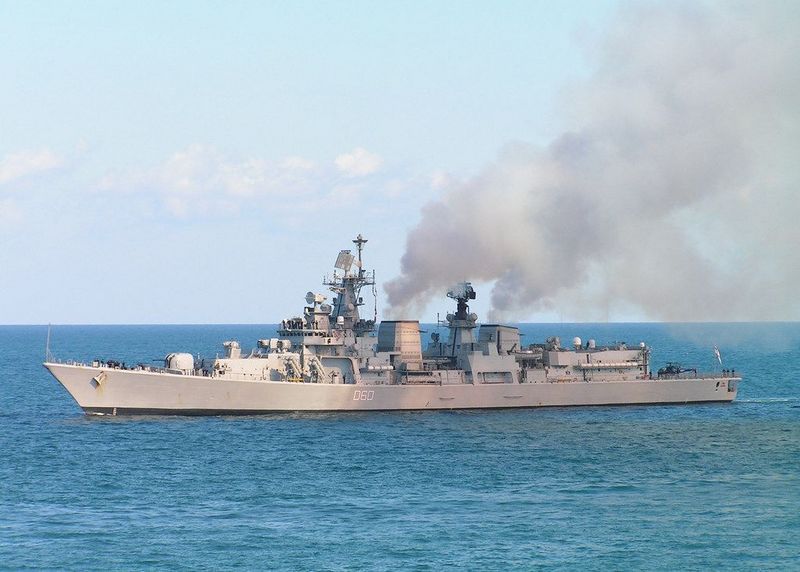
Three warships make up the modern Indian Navy's Delhi-class surface destroyer group - INS Delhi (D61), INS Mysore (D60) and INS Bombay (D62). This class was adopted as the successor to the old Rajput class ships, but was itself superseded by the newer Calcutta class. Nonetheless, the three ships remain in service with the Indian Navy. INS Mysore is the group's second vessel, ordered on 20 March 1992 and laid by Mazagon Dock Limited on 4 June 1993.
She officially entered service on June 2, 1999, with the motto "The Hunter" "Always Fearless".
The constructed warship had a displacement of 6,835 tons, a length of 535 feet, a beam of 56 feet, and a draft of 21 feet. Power consists of 2 x 54,000hp AM-50 gas turbines linked to 2 x 10,000hp marine diesel engines driving 2 x axles. Gas turbines are used to provide the extra thrust, while diesel engines provide the required cruising power.
This combination of power plants maximizes fuel efficiency. It has a speed of 32 knots and a range of 5,000 miles.
360 crew on board. A pair of medium helicopters (and their matching crews) are also supported thanks to the combination of a hangar and helipad in the stern.
The warship is equipped with state-of-the-art radar, communications and sensor equipment, as well as a hull-mounted variable depth sonar system.
The idea behind modern guided missile destroyers is to hunt down enemy ships (including submarines) while providing surface support to the main fleet. As such, INS Mysore is designed to operate independently of or in conjunction with the main fleet and be able to handle a range of attack mission types.
Weapons include a mix of rocket and projectile-guided weapons. Four quadruple launchers service a stockpile of 16 SS-N-25 Surface-to-Surface Missile (SSM) and two SA-N-7 Surface-to-Air Missile (SAM) launchers to counter air threats from afar . There is a conventional 100mm deck gun and 4 x AK-630 series 30mm Close-In Weapon Systems (CIWSs) and turrets.
In addition, the warship is equipped with two RBU-6000 anti-submarine rocket (ASROC) launchers and five 21-inch (533 mm) torpedoes, deployed in quintuple launchers.
The shape of the battleship is the same as the class, with the paste of the main armament facing the bow. The bridge section takes its normal place in the design behind and above the forecastle, with the main mast integrated into its line. The back is the first pipe, which has a flat design. The auxiliary mast is marked midship with a second smoke funnel at the stern. At the very end of the destroyer is the hangar and flight deck area, which provides disabled access for helicopters.
The helipad can display one helicopter at a time, while a second helicopter is placed in the hangar. These aircraft can be equipped with anti-submarine warfare (ASW)/anti-ship equipment and provide ships with the ability to raise their sights to the sky.
Additionally, these systems can help resupply warships at sea.
INS Mysore has been involved in significant operations since 2008 and has held security/deterrence and anti-piracy roles in the Indian government. In 2011, after the civil war began, she was sent to expel Indian nationals from the Libyan theater of operations.
Likewise, the warship was deployed in this manner during an anti-ISIS operation in northern Iraq in 2014 and operated from the Gulf of Aden.
Specification
Basic
Roles
- Blue Water Operations
- Fleet Support
- Hunter
- direct attack
Dimensions
535 feet (163.07 m)
56 feet (17.07 m)
6.40m
Weight
6,835 tons
Performance
Performance
32 kts (37 mph)
4,345 nm (5,000 miles; 8,047 km)
ARMAMENT
1 x 100mm AK-100 turreted deck gun
4 x Quadruple launchers for 16 x SS-N-25 Surface-to-Surface Missiles (SSMs).
2 x SA-N-7 Surface-to-Air Missiles (SAMs)
4 x 30mm AK-630 Close-In Weapon Systems (CIWSs).
2 x RBU-6000 Anti-Submarine ROCket (ASROC) launchers.
5 x 21" (533mm) quintuple torpedo launchers (10 total torpedoes).
AIR WING
2 x Westland Sea King (or equivalent) navy medium-lift helicopters supported off of stern flight deck.
 Argentina
 Armenia
 Australia
 Austria
 Austria-Hungary
 Belgium
 Brazil
 United Kingdom
 United States
 Brunei
 Bulgaria
 Canada
 Chile
Chile China
China Colonial America
 Colombia
 Confederate States
 Croatia
 Czech
Czech Denmark
 Egypt
Egypt Finland
 France
 Georgia
 Germany
 German Imperial
 Greece
 Holland
 Hungary
 Indonesia
 Iran
Iran Iraq
Iraq Ireland
 Israel
 Italy
Italy Japan
Japan Japan (1940)
 Jordan
 Kingdom of Italy
 Malaysia
 Mexico
 Myanmar
 Nazi Germany
 Netherlands
 New Zealand
 North Korea
 Norway
 Pakistan
 Peru
Peru Philippines
 Poland
 Portugal
 Prussia
 Romania
 Russia
 Saudi Arabia
 Serbia
 Singapore
 Slovakia
 Slovenia
 South Africa
 South Korea
 Soviet Union
 Spain
Spain Sweden
 Switzerland
 Syria
Syria Taiwan
 Thailand
 Turkey
 UAE
UAE Ukraine
 Vietnam
 Yugoslavia