


History
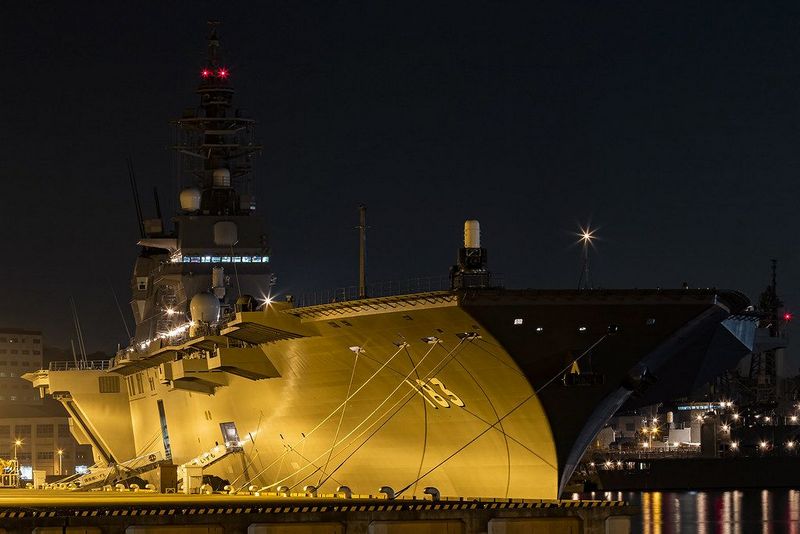
JDS Izumo (DDH-183) leads the new 22DDH-class helicopter destroyer, rebuilding a key component of the Japan Maritime Self-Defense Force (JMSDF), the naval branch of the Japan Self-Defense Force (JSDF) that formed the end of World War II and American postwar occupation. The mission of the Japan Maritime Self-Defense Force is to defend Japan and its territorial waters, including vast waterways that are vital to the overall economy. Due to a prohibition in Japan's postwar national constitution (also to quell fears of its Pacific neighbors), Japanese authorities deliberately did not classify the Izumo as an "aircraft carrier", so the official "helicopter destroyer" was used instead.
Usually, the ship is classified as a "helicopter carrier".
The demand for Izumo stems from the emergence of an arms race between countries bordering the Sea of ??Japan and the East and South China Seas. The territory is dotted with hundreds of islands and reefs, which also often make them vying for territory and the natural resources they possess. This geopolitical location offers abundant fish, gas, and oil reserves, making the South China Sea particularly attractive to developed (and emerging) nations such as Japan, China, Taiwan, the Philippines, North and South Korea, Vietnam, Thailand, and Cambodia. In addition, One-third of global shipping passes through these contested waters, and interest in the region's stability extends beyond Southeast Asia and the Pacific.
In 2013, advanced Chinese destroyers armed with cruise missiles were spotted near gas fields in the East China Sea actions that have not gone unnoticed and have heightened tensions on all sides. In fact, America's center of gravity is shifting from the Middle East to the Pacific.
The 22DDH-class helicopter destroyer was developed in part to patrol disputed sea lanes and protect Japanese merchant ships, with the aim of eventually defeating the aging Shirane (DDH-143) and her sister Kurama (DDH-144) and four other destroyers Decommissioning is planned to begin in fiscal 2014 and no replacement ships will be built. The Japan Maritime Self-Defense Force believes that two 22DDH-class warships can make up for the loss of the six destroyers without adding more ships, thereby reducing military naval spending.
The Izumo was laid on January 27, 2012 and launched from the Yokohama Pier Factory on August 6, 2013. The unveiling date also serves as a reminder of the atomic bombing of Hiroshima in 1945.
The size of the Izumo allows the vessel to adequately respond to emergency rescue operations in its own waters and international peacekeeping requirements. Helicopter destroyers can transport up to 4,000 people or about 50 military trucks. In addition, the class has the ability to fuel other Japanese warships in the fleet as needed.
This continuous replenishment will eliminate the need for ships to berth for refueling, saving steam time. Therefore, it was decided not to build a specific destroyer or support ship type, but to design, develop and build "multi-mission" platforms with other world powers, that is, ships that serve multiple purposes on the high seas. Thus, the "bigger is better" approach allows Izumo to greatly expand its basic mission capabilities.
Compared to previous destroyer helicopter models, the Izumo is 165 feet long and 22 feet wide, and the drop deck is 150 feet long and 20 feet wide all in all, increasing interior volume and deck space by nearly 50 percent.
The 22DDH class is powered by a propulsion unit similar to the Hyuga-class helicopter destroyer. In the Hyuga class, the COGAG (Combined Gas and Gas) turbine propulsion system is configured by 2 GE/IHI Marine LM2500IEC gas turbines driving 1 shaft while producing 75,000 hp (42,000 kW). This configuration is now doubled in the 22DDH class as the two COGAG systems use 4 GE/IHI gas turbines connected to 2 axles for a combined power output of 150,000 hp and a top speed of 30 knots (56 km/h).
The COGAG system was chosen for the fuel efficiency of the gas turbine at its maximum power level and better fuel economy at cruising speed.
Izumo's large flight deck can accommodate up to 9 helicopters operating simultaneously, and the hangar deck can store 14 to 17 helicopters. Different helicopters also require different storage spaces, so more or less can be allocated depending on the type of helicopter and mission requirements. With no launch catapults on the flight deck, conventional Navy jets cannot operate on Izumo's deck. However, the Lockheed F-35B variant under development represents a fifth-generation, single-seat, single-engine, multirole, short takeoff vertical landing (STOVL) fighter designed to operate in limited deck space. Capable of air defense, ground attack and reconnaissance missions, the aircraft will be a core component of Japan's Pacific Rim arsenal - perhaps in the near future via the smaller, combat-ready VSTOL Unmanned Combat Air Vehicle (UCAV) The arrival of the Izumo helps.
Therefore, observers in the region do not believe it is a coincidence that the start of the US F-35B sea test and the launch of the Izumo occurred in the same week. Once the technologically advanced F-35B enters service, the number of capable ships capable of transporting F-35B aircraft in the Pacific will increase, which could change the balance of power in the region to some extent.
Neighboring China, which has no close military ties to the United States, relies on its own in-house fifth-generation fighter jets and UCAV programs.
If the F-35B is procured, it could theoretically be serviced by 22DDH- and Hyuga-class ships. Australia is building two Canberra-class landing helicopter docks, while the United States has eight Wasp-class landing helicopter docking ships and two America-class amphibious assault ships - all of which allow fighter jets to operate from their flight decks. In order to circumvent the problem of the F-35B, the reason why Japan proposed that the 22DDH class is larger than the Hyuga class is that Japan intends to use the V-22 Osprey tilt-rotor transport helicopter as its main aircraft.
Japan is currently negotiating to buy a batch of V-22 Ospreys from the United States. The Chinese, Vietnamese and Philippine governments are of course closely monitoring the situation and will likely take turns responding.
In addition to the presumed air force, the Izumo was equipped to defend against threats from above, underwater and in the air. 2 x 20mm Phalanx Close-In Weapon Systems (CIWS), one port and one starboard, are designed to counter low-flying aircraft and cruise missile threats and are digitally controlled for rapid response and accuracy. Additional defenses are controlled by 2 SeaRAM (RIM-116 Rolling Airframe Missile) launchers against aircraft and submarine threats. SeaRAM connects Phalanx CIWS (Mk-15 Block 1B) radar/electro-optical systems to 11-cell missile launchers on trainable mounts.
The system works directly with the OYQ-12 Combat Control Kit as well as the OPS-50 AESA Radar and OPS-28 Surface Search Radar systems. The missile is a surface-to-air weapon developed by Raytheon/Dair BGT Defense using an explosive fragmentation warhead and a tri-mode guidance system.
The OQQ-23 bow sonar is used for standard submarine "ground tracking" and general anti-submarine (ASW) operations.
JOS Izumo DDH-183 destroyer helicopter officially entered service on March 25, 2015. Its designated home port is Yokosuka. The ship is named after the province of Izumo and is the second Japanese warship to use that name.
The second ship in this class, as yet unnamed (as of 2015), was launched on October 7, 2013, with an expected launch date of mid-to-late 2015 and commissioned later in 2017. As of this writing, its home port has not been designated (2015).
Specification
Basic
ROLES
- Aircraft / Offshore Support
- Blue Water Operations
- Fleet Support
- Hunter
- Direct-Attack
DIMENSIONS
815 ft (248. 41 m)
125 ft (38. 10 m)
25 ft (7. 62 m)
WEIGHTS
20,000 tons
POWER
PERFORMANCE
32 kts (37 mph)
ARMAMENT
2 x SeaRAM Close-In Weapon Systems (CIWSs).
2 x 20mm Phalanx CIWSs.
AIR WING
Up to seven navalized helicopters of various types - transport, Search and Rescue (SAR), Anti-Submarine Warfare (ASW), etc. Up to 28 total aircraft.
 Argentina
 Armenia
 Australia
 Austria
 Austria-Hungary
 Belgium
 Brazil
 United Kingdom
 United States
 Brunei
 Bulgaria
 Canada
 Chile
Chile China
China Colonial America
 Colombia
 Confederate States
 Croatia
 Czech
Czech Denmark
 Egypt
Egypt Finland
 France
 Georgia
 Germany
 German Imperial
 Greece
 Holland
 Hungary
 India
India Indonesia
 Iran
Iran Iraq
Iraq Ireland
 Israel
 Italy
Italy Japan (1940)
 Jordan
 Kingdom of Italy
 Malaysia
 Mexico
 Myanmar
 Nazi Germany
 Netherlands
 New Zealand
 North Korea
 Norway
 Pakistan
 Peru
Peru Philippines
 Poland
 Portugal
 Prussia
 Romania
 Russia
 Saudi Arabia
 Serbia
 Singapore
 Slovakia
 Slovenia
 South Africa
 South Korea
 Soviet Union
 Spain
Spain Sweden
 Switzerland
 Syria
Syria Taiwan
 Thailand
 Turkey
 UAE
UAE Ukraine
 Vietnam
 Yugoslavia