
History
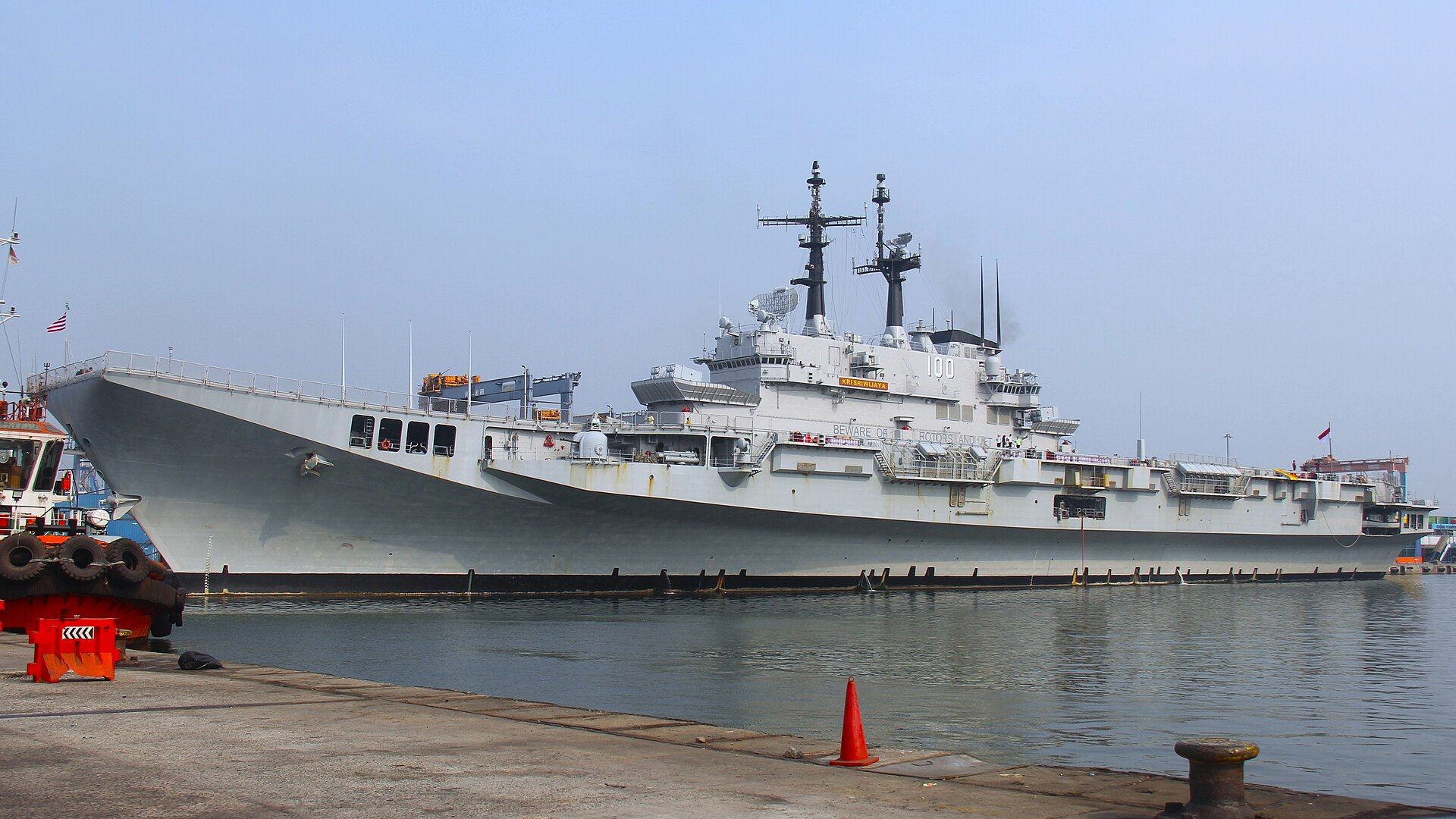
KRI Sriwijaya (100) is the Indonesian Navy's first aircraft carrier. The ship is the former Italian Navy aircraft carrier Giuseppe Garibaldi, transferred to Indonesia in 2026 and commissioned under its new name on 24 September 2026 at Tanjung Priok in North Jakarta.
The carrier gives Indonesia a large aviation-capable command platform intended for maritime security, fleet air defence, power projection, and humanitarian or emergency-response missions. Its 174 m flight deck, ski-jump, hangar, aviation support spaces, and gas-turbine propulsion were inherited from its Italian service.
KRI Sriwijaya entered Indonesian service before completion of a planned modernization programme. Indonesia intends to adapt the ship for long-term national requirements, including tropical operating conditions, updated combat and communications systems, and future shipboard aviation.
Italian construction and service
The ship was laid down at Fincantieri's Monfalcone shipyard on 26 March 1981 and launched on 11 June 1983. It entered Italian Navy service as Giuseppe Garibaldi on 30 September 1985. The vessel was designed as a compact aviation ship with a full-length flight deck and a ski-jump for vertical or short take-off aircraft.
During Italian service the ship operated AV-8B Harrier II aircraft and helicopters. A normal air group could include approximately 8 to 12 Harriers and 4 to 6 helicopters, while larger configurations could reach 16 Harriers or 18 helicopters. Around 12 aircraft could be accommodated in the hangar.
The carrier demonstrated sustained aviation operations during deployments. In an 87-day Afghanistan deployment beginning in November 2001, its Harriers flew 288 missions and accumulated 860 flight hours. During 78 consecutive days at sea for Libya operations in 2011, the ship generated 173 sorties and more than 1,200 flight hours.
A modernization was completed in 2003. A major overhaul followed in 2013, during which more than 30,000 kg of steel and 4,880 m of piping were replaced, tanks were cleaned, hull surfaces were treated, and much of the flight deck was recoated. Giuseppe Garibaldi was decommissioned by Italy on 1 October 2024.
Transfer to Indonesia
Indonesia pursued acquisition of the retired carrier as part of its effort to establish a carrier aviation capability. The ship was transferred without a purchase price for the hull, although the transfer, refurbishment, aviation equipment, infrastructure, training, support, and future maintenance create substantial programme costs.
The vessel departed Taranto on 24 August 2026. It travelled through the Suez Canal, Red Sea, and Indian Ocean before reaching Jakarta on 18 September, escorted in Indonesian waters by KRI Brawijaya-320 and KRI Prabu Siliwangi-321.
The Indonesian Navy commissioned the carrier as KRI Sriwijaya (100) on 24 September 2026. Colonel Mochamad Fuad Hasan commanded 399 personnel at commissioning. The name commemorates Srivijaya, the historic maritime power centred around present-day South Sumatra that controlled important regional trade routes, including areas associated with the Strait of Malacca.
Design
KRI Sriwijaya retains the fundamental hull, machinery, flight-deck arrangement, and aviation facilities of Giuseppe Garibaldi. The ship is 180.2 m long and approximately 33.4 m wide at its maximum beam. Its full-load displacement is approximately 13,850 tonnes, although figures following the 2003 modernization have also been given at about 14,150 tonnes.
Flight deck and aviation facilities
The flight deck is approximately 174 m long and 30 m wide, giving a nominal area of about 5,220 m². A 4-degree ski-jump is fitted at the bow. The arrangement was originally intended to support helicopters and vertical or short take-off and vertical landing aircraft.
Indonesia has considered unmanned aviation as an important part of the wider carrier programme. Planning has included navalized Bayraktar TB3 unmanned aircraft and larger Akinci-class systems, although the wider planned aircraft quantities do not represent an air group permanently assigned to KRI Sriwijaya. The final Indonesian aviation complement has not been confirmed.
Propulsion and electrical power
The ship uses four GE/Avio LM2500 gas turbines driving two shafts. Combined output is approximately 60,400 kW, or 81,000 hp. The propulsion plant provides a speed of about 30 knots. Economical range is approximately 7,000 nautical miles, or 13,000 km, at 20 knots.
Six diesel generators rated at 1,560 kW each provide approximately 9.36 MW of electrical generating capacity. Available electrical power is an important constraint for modernization because new radars, electronic warfare equipment, communications, servers, unmanned-aircraft control stations, and additional cooling systems must be integrated with the existing shipboard power network.
Legacy sensors and weapons
In its Italian configuration, the ship carried several air-surveillance, surface-search, aircraft-approach, and fire-control radars together with the WASS DMS-2000 sonar. The sensor fit included MM/SPS-768 RAN-3L, SPS-774/RAN-10S, AN/SPS-52C, SPS-702, SPN-728, RTN-30X, and RTN-20X equipment.
The former Italian armament included two eight-cell Mk 29 launchers with 16 ready Aspide or Sea Sparrow missiles, three twin 40 mm DARDO mounts, and two triple 324 mm torpedo launchers. Electronic protection included SLQ-732 equipment, SCLAR decoy launchers, and AN/SLQ-25 Nixie. Four Otomat Mk 2 anti-ship missile launchers had been removed in 2003. The final Indonesian combat-system and weapons configuration has not been confirmed and is expected to depend on the modernization programme.
Program status
KRI Sriwijaya entered Indonesian service in September 2026 while modernization planning continued. Fincantieri and Indonesian state shipbuilder PT PAL established a framework to define modernization work, with PT PAL expected to play a leading role in integration, shipbuilding support, and future sustainment.
Planned work includes refurbishment and adaptation of the carrier for Indonesian conditions. Requirements include tropicalization of air-conditioning and support spaces as well as possible replacement or integration of radar, identification, electronic warfare, combat-management, communications, and point-defence systems. Such work requires consideration of antenna foundations, internal equipment space, electrical distribution, cooling, consoles, and cable routes.
Indonesia is also adapting shore infrastructure. Ratai Bay in Lampung has been prepared for carrier operations with channel work, heavy-duty mooring arrangements, and increased shore electrical capacity. Carrier berthing construction was stated to have reached 76 percent in July 2026.
The Indonesian Navy has considered extending the ship's useful life by approximately 15 to 20 years. Achieving this objective depends on structural condition, machinery reliability, availability of replacement components, modernization scope, maintenance periods, and the development of trained aviation and shore-support personnel.
Operators
- Indonesian Navy: KRI Sriwijaya (100) was commissioned on 24 September 2026 as Indonesia's first aircraft carrier.
Specifications (KRI Sriwijaya)
General characteristics
- Type: Aircraft carrier
- Length: 180.2 m
- Beam: approximately 33.4 m
- Draught: approximately 8.2 m
- Full-load displacement: approximately 13,850 tonnes
- Flight deck length: approximately 174 m
- Flight deck width: approximately 30 m
- Flight deck area: approximately 5,220 m²
- Ski-jump angle: 4 degrees
- Commissioning personnel: 399
Propulsion
- Powerplant: four GE/Avio LM2500 gas turbines
- Total output: approximately 60,400 kW (81,000 hp)
- Propulsion: two shafts
- Electrical generation: six 1,560 kW diesel generators, approximately 9.36 MW total
Performance
- Maximum speed: approximately 30 knots
- Range: approximately 7,000 nautical miles (13,000 km) at 20 knots
 Argentina
 Armenia
 Australia
 Austria
 Austria-Hungary
 Belgium
 Brazil
 United Kingdom
 United States
 Brunei
 Bulgaria
 Canada
 Chile
Chile China
China Colonial America
 Colombia
 Confederate States
 Croatia
 Czech
Czech Denmark
 Egypt
Egypt Finland
 France
 Georgia
 Germany
 German Imperial
 Greece
 Holland
 Hungary
 India
India Indonesia
 Iran
Iran Iraq
Iraq Ireland
 Israel
 Japan
Japan Japan (1940)
 Jordan
 Kingdom of Italy
 Malaysia
 Mexico
 Myanmar
 Nazi Germany
 Netherlands
 New Zealand
 North Korea
 Norway
 Pakistan
 Peru
Peru Philippines
 Poland
 Portugal
 Prussia
 Romania
 Russia
 Saudi Arabia
 Serbia
 Singapore
 Slovakia
 Slovenia
 South Africa
 South Korea
 Soviet Union
 Spain
Spain Sweden
 Switzerland
 Syria
Syria Taiwan
 Thailand
 Turkey
 UAE
UAE Ukraine
 Vietnam
 Yugoslavia