
History
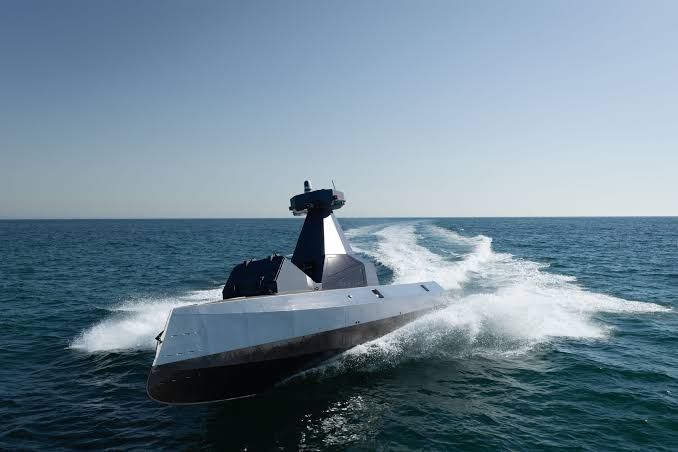
STARK Vanta-12 is a 12 m modular uncrewed surface vessel developed for maritime patrol, surveillance, electronic warfare, anti-submarine tasks and strike missions. The vessel combines long-range unmanned operation with a configurable payload architecture intended to accept sensors, electronic warfare equipment and weapons.
The Vanta-12 extends STARK's Vanta family beyond the smaller Vanta-4 and Vanta-6. Its demonstrated configuration combines an aft installation for MBDA Sea Venom missiles with a forward launcher for STARK Cascade loitering munitions, while the Minerva command-and-control and mission autonomy system provides the platform's software architecture.
The first Vanta-12 was completed in the United Kingdom in mid-2026 and entered sea trials before participating in REPMUS 2026 in Portugal. STARK formally unveiled the vessel on 28 September 2026 following the exercise. Pasted text
Development and testing
The Vanta-12 concept was initiated in October 2025. By mid-2026 the first vessel had been built, launched and entered harbour and sea acceptance trials. Development proceeded rapidly toward integration of weapons and mission systems.
From 31 August to 25 September 2026, the Vanta-12 participated in REPMUS 2026 in Portugal. During the exercise it operated with crewed surface vessels and other uncrewed platforms and took part in simulated combat missions. A Cascade loitering munition was launched digitally through the Minerva system from a Vanta platform during the exercise.
Sea Venom integration was less mature. An emulation model was installed to demonstrate the concept, and initial software integration connected the relevant systems. Full integration of the surface-launched Sea Venom remained under development after REPMUS 2026.
Design
Platform and modular architecture
Vanta-12 is a 12 m uncrewed surface vessel designed around a modular payload concept. STARK developed the platform to accept different sensors and effectors without tying the vessel to a single fixed mission configuration. The design is intended to support relatively rapid production and upgrades, with construction potentially distributed among different shipyards.
The vessel has a stated payload capacity of up to 2 tonnes. Available mission areas include intelligence, surveillance and reconnaissance, maritime patrol, electronic warfare, strike and anti-submarine warfare. Surveillance sensors and electronic warfare jammers can be installed according to mission requirements.
In its current configuration, the Vanta-12 can operate effectively in Sea State 4 and remain on station in conditions up to Sea State 6. Its endurance is stated as several weeks at sea.
Command and autonomy
The Vanta-12 uses STARK's Minerva command-and-control and mission autonomy software. Minerva provides the core architecture for controlling the vessel and integrating sensors and effectors. Additional software drivers can be incorporated for individual payloads and weapons.
The platform incorporates autonomous navigation and AI-enabled software for persistent maritime missions. STARK has also been developing compatibility between the Vanta-12 architecture and wider command-and-control networks so the vessel can operate as part of mixed crewed and uncrewed forces.
Weapons and mission systems
The demonstrated strike configuration provides space for weapons at both ends of the vessel. Up to four MBDA Sea Venom guided missiles can be carried in an aft box-launcher installation. Sea Venom was originally developed as an air-launched weapon, and a surface-launched version is being developed for applications including Vanta-12.
A forward 10-cell launcher can carry STARK Cascade loitering munitions. Cascade provides a separate, lower-cost strike option and has a stated range of up to 100 km. Combining Sea Venom and Cascade gives the vessel two different classes of precision weapon on one uncrewed platform.
The modular architecture also provides for surveillance sensors, electronic warfare equipment and other effectors. Integration work has been conducted to accommodate a laser weapon. Towed sonar arrays and lightweight torpedoes have also been identified as possible future payloads, but these should be regarded as potential integrations rather than confirmed operational equipment.
Program status
As of late September 2026, Vanta-12 had completed initial construction and sea trials and had participated in REPMUS 2026, but several planned weapon integrations remained under development. Cascade had been launched through the Minerva architecture, while Sea Venom integration was still progressing from concept demonstration and software interconnection toward a complete surface-launched weapon capability.
STARK planned further demonstrations and development activities during the remainder of 2026 and into 2027, including participation in Nordic exercises and continued work on autonomy and mission integration. Production is intended to be scalable through multiple shipyards rather than dependent on a single builder.
Specifications (STARK Vanta-12)
General characteristics
- Type: Modular uncrewed surface vessel
- Length: 12 m
- Payload: Up to 2 tonnes
- Endurance: Several weeks at sea
- Operating conditions: Effective operation in Sea State 4; capable of remaining on station up to Sea State 6 in its current configuration
Performance
- Range: 1,200 nautical miles at patrol speed
- Sprint speed: More than 40 knots
Armament and mission payloads
- Sea Venom: Provision for up to four MBDA Sea Venom guided missiles in an aft launcher; surface-launch integration remained under development in 2026
- Cascade: Forward 10-cell launcher for up to ten STARK Cascade loitering munitions
- Electronic warfare: Configurable electronic warfare and jamming equipment
- Surveillance: Modular intelligence, surveillance and reconnaissance sensor fit
Related equipment
- STARK Vanta-4: Smaller 4 m member of the Vanta uncrewed surface vessel family.
- STARK Vanta-6: Smaller 6 m Vanta-family platform developed before Vanta-12.
 Argentina
 Armenia
 Australia
 Austria
 Austria-Hungary
 Belgium
 Brazil
 United States
 Brunei
 Bulgaria
 Canada
 Chile
Chile China
China Colonial America
 Colombia
 Confederate States
 Croatia
 Czech
Czech Denmark
 Egypt
Egypt Finland
 France
 Georgia
 Germany
 German Imperial
 Greece
 Holland
 Hungary
 India
India Indonesia
 Iran
Iran Iraq
Iraq Ireland
 Israel
 Italy
Italy Japan
Japan Japan (1940)
 Jordan
 Kingdom of Italy
 Malaysia
 Mexico
 Myanmar
 Nazi Germany
 Netherlands
 New Zealand
 North Korea
 Norway
 Pakistan
 Peru
Peru Philippines
 Poland
 Portugal
 Prussia
 Romania
 Russia
 Saudi Arabia
 Serbia
 Singapore
 Slovakia
 Slovenia
 South Africa
 South Korea
 Soviet Union
 Spain
Spain Sweden
 Switzerland
 Syria
Syria Taiwan
 Thailand
 Turkey
 UAE
UAE Ukraine
 Vietnam
 Yugoslavia