
History
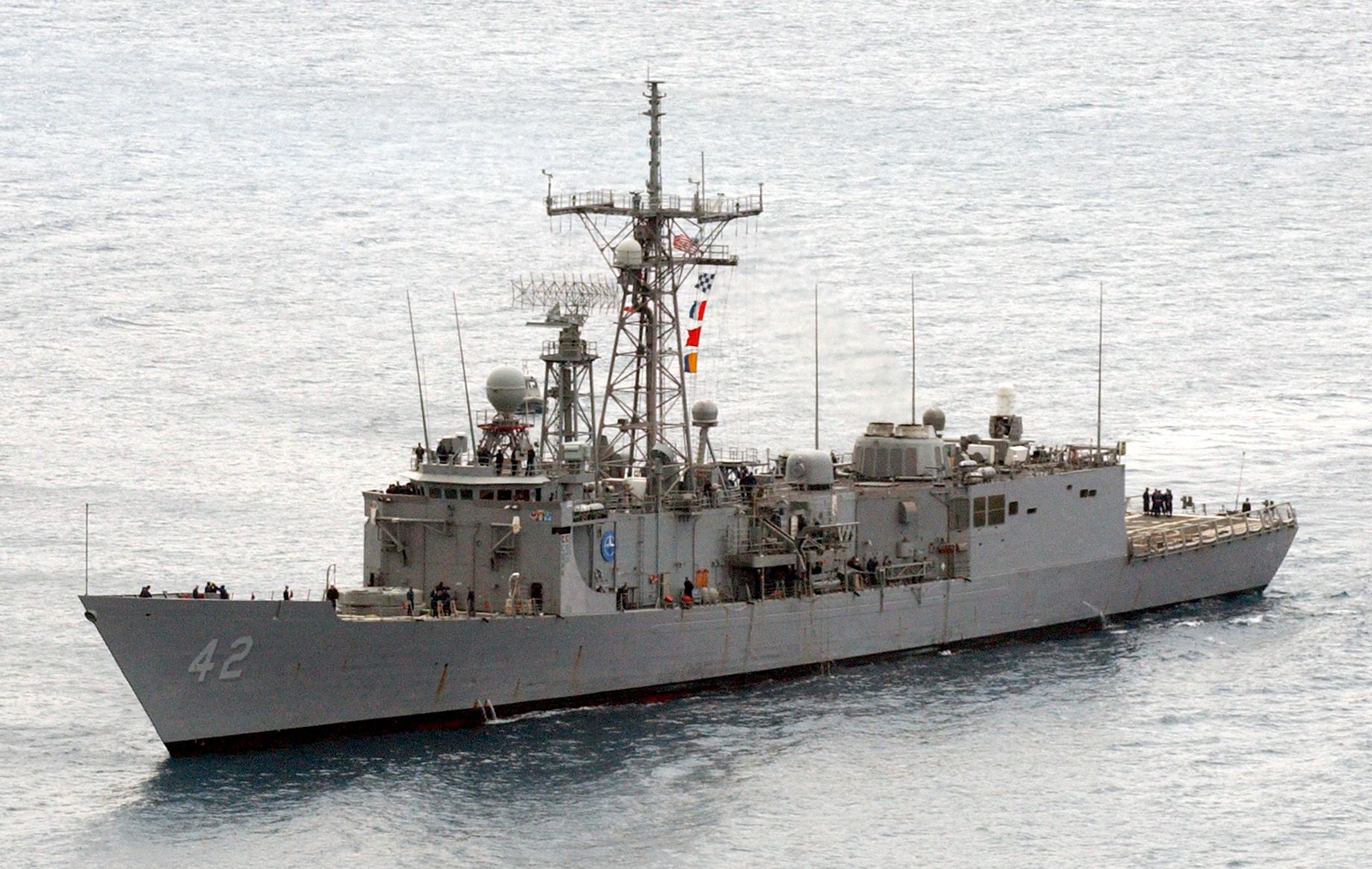
USS Klakring (FFG-42) was an Oliver Hazard Perry-class guided-missile frigate built for the United States Navy by Bath Iron Works at Bath, Maine. The ship was laid down on 19 February 1982, launched on 18 September 1982, and commissioned on 20 August 1983.
Klakring served for nearly three decades in roles that included fleet training, escort operations, anti-submarine warfare, maritime security, Middle East deployments, and multinational exercises. During the Iran-Iraq War, she supported Operation Earnest Will and escorted shipping through the Persian Gulf and Strait of Hormuz.
The frigate was decommissioned on 22 March 2013 and subsequently laid up at the Naval Inactive Ship Maintenance Facility in Philadelphia. On 25 September 2026, the former warship was used as a target during Exercise Atlantic Thunder 2026 and was sunk in the North Atlantic after attacks by U.S. and British forces.
Construction and commissioning
The U.S. Navy awarded the ship on 27 April 1979. Bath Iron Works laid down FFG-42 on 19 February 1982 and launched her on 18 September 1982. Beverly Bohen, a niece of Rear Admiral Thomas B. Klakring, sponsored the ship. USS Klakring entered commission at Bath on 20 August 1983 with Commander Leonard O. Wahlig in command.
The frigate was named for Rear Admiral Thomas B. Klakring, a U.S. submarine officer whose World War II service included command of USS Guardfish. He received three Navy Crosses for his wartime actions.
After commissioning, Klakring completed a Light-Off Examination on 8 September 1983 and Initial Crew Certification on 15 September. She reached Charleston, South Carolina, later that month and subsequently conducted a shakedown cruise in the Caribbean. The ship visited St. Thomas and Guantánamo Bay, carried out a weapons-system accuracy test at Port Everglades, and fired torpedoes at the Atlantic Undersea Test and Evaluation Center in December 1983.
Early service
In 1984, Klakring continued training in the Caribbean before returning to Bath for a post-shakedown availability from April to August. Work during this period included installation of fin stabilizers. The frigate later conducted sea trials and resumed fleet training, including operations with the aircraft carrier USS Nimitz.
During early 1985, Klakring completed refresher training at Guantánamo Bay. Helicopter Antisubmarine Squadron Light 42 Detachment 3 embarked with an SH-60B Seahawk in February, and the ship subsequently participated in Composite Unit Training Exercise 2-85.
First Middle East deployment
Klakring began her first overseas deployment on 7 June 1985 in company with the destroyer USS Comte de Grasse. The ships crossed the Atlantic, entered the Mediterranean, and passed through the Suez Canal before continuing through the Red Sea toward the Persian Gulf.
During the deployment, Klakring operated extensively in the Persian Gulf and supported the U.S. Middle East Force. She escorted the command ship USS La Salle, conducted patrols and multinational training, visited ports in Saudi Arabia, Bahrain, Pakistan, and the United Arab Emirates, and trained with the Indian Ocean Battle Group. The frigate also operated with French naval forces before departing the region in November 1985. She returned to Charleston on 6 December.
Operation Earnest Will
Following further exercises, maintenance, and readiness training, Klakring deployed again for the Middle East on 6 June 1987. After crossing the Mediterranean and transiting the Suez Canal, she entered the Persian Gulf during the Iran-Iraq War.
The frigate supported Operation Earnest Will, the U.S. effort to protect maritime traffic and maintain freedom of navigation as attacks on commercial shipping increased. Klakring patrolled between radar picket stations in the Persian Gulf and repeatedly passed through the Strait of Hormuz for replenishment.
On 10 August 1987, the frigate embarked a detachment of U.S. Army helicopters and helped coordinate British tugs converted for minesweeping. On 30 August, Klakring escorted the reflagged Kuwaiti tanker Bridgeton outbound through the Strait of Hormuz. She subsequently escorted additional cargo ships and tankers in the region before USS Carr relieved her on 26 October. Klakring returned to Charleston on 4 December 1987.
Late 1980s operations
In 1988, Klakring underwent repairs at Jacksonville Shipyards and completed readiness training at Guantánamo Bay. During June and July, she participated in Caribbean law-enforcement operations with U.S. Coast Guard personnel and equipment embarked. Further exercises included Middle East Force Exercise 1-89 with other U.S. surface combatants.
Klakring deployed to the Mediterranean on 31 May 1989 as part of a force centered on the aircraft carrier USS Coral Sea. She operated in the Black Sea region, visited Constanta in Romania and Istanbul in Turkey, underwent maintenance at Haifa, and participated in the U.S.-Israeli naval exercise Noble Dina 3.
After the killing of U.S. Marine Corps Lieutenant Colonel William R. Higgins in Lebanon in August 1989, Klakring operated off the Lebanese coast during contingency operations. The ship later participated in the multinational Display Determination exercise and in Naval On Call Forces Mediterranean activities before returning to Charleston on 10 November 1989.
Decommissioning
Klakring remained in U.S. Navy service until 22 March 2013. Following decommissioning, the frigate was towed to the Naval Inactive Ship Maintenance Facility at Philadelphia, Pennsylvania, where she remained in reserve status as a former warship.
Exercise Atlantic Thunder 2026
On 25 September 2026, ex-USS Klakring served as the surface target for Exercise Atlantic Thunder 2026, a joint U.S.-U.K. sinking exercise in the North Atlantic. Participating forces included U.S. Navy task forces, the Royal Navy, and the U.S. Air Force.
USS Paul Ignatius engaged the target with an anti-surface variant of the Standard Missile 6. Royal Navy forces employed Naval Strike Missile and Sea Venom weapons against the former frigate. Sensors had been installed aboard the target beforehand to collect data for post-exercise battle-damage assessment.
The final attack was made by the Block IV Virginia-class submarine USS Massachusetts using a Mk 48 Advanced Capability heavyweight torpedo. The torpedo strike ultimately sank ex-USS Klakring, ending the physical existence of FFG-42 after more than four decades from her 1982 launch. Pasted text
Design
USS Klakring was a long-hull Oliver Hazard Perry-class frigate. The class was designed as an escort and general-purpose surface combatant capable of anti-air, anti-surface, and anti-submarine operations. Klakring combined guided missiles, a rapid-fire naval gun, lightweight torpedoes, a close-in weapon system, and embarked helicopters.
Weapons
The frigate's principal missile system was the Mk 13 guided-missile launcher, which could employ RGM-84 Harpoon anti-ship missiles and SM-2 Standard surface-to-air missiles. Gun armament consisted of one 76 mm Mk 75 rapid-fire gun. Close-range defense was provided by one Mk 15 Mod 1 Phalanx close-in weapon system.
For anti-submarine warfare, Klakring carried Mk 46 lightweight torpedoes. Her aviation component provided an additional means of detecting and engaging submarines beyond the immediate range of the ship's own sensors and weapons.
Aviation facilities
Klakring could operate two SH-60 LAMPS III helicopters. During her service, embarked SH-60B Seahawk detachments supported surveillance, anti-submarine warfare, and other fleet operations. The helicopters significantly extended the frigate's ability to search areas beyond the ship's own sensor horizon.
Operational history
USS Klakring's documented service included deployments to the Persian Gulf, Mediterranean, Caribbean, Red Sea, and Indian Ocean regions. Her missions ranged from carrier-group support and anti-submarine training to maritime escort, contingency operations, multinational exercises, and law-enforcement support.
Her most significant documented combat-era assignment was Operation Earnest Will in 1987. During that deployment, Klakring helped protect shipping in the Persian Gulf, supported mine-countermeasure coordination, and escorted tankers and cargo vessels through waters threatened by the Iran-Iraq War.
After decommissioning in 2013, Klakring remained inactive until selected as a target ship. The 2026 Atlantic Thunder sinking exercise exposed the hulk to multiple modern anti-surface weapons before the final Mk 48 ADCAP torpedo attack.
Specifications (USS Klakring FFG-42)
General characteristics
- Class: Oliver Hazard Perry-class guided-missile frigate, long-hull configuration
- Displacement: approximately 4,200 t full load (4,100 long tons)
- Length: 138 m (453 ft)
- Beam: 14.3 m (47 ft)
- Draft: 7.9 m (26 ft)
- Complement: 101
Performance
- Maximum speed: more than 29 knots (54 km/h)
- Range: approximately 9,300 km (5,000 nautical miles) at 18 knots
Armament
- Missile launcher: 1 Mk 13 guided-missile launcher for RGM-84 Harpoon anti-ship missiles and SM-2 Standard surface-to-air missiles
- Main gun: 1 76 mm Mk 75 rapid-fire gun
- Torpedoes: 6 Mk 46 lightweight torpedoes
- Close-in defense: 1 Mk 15 Mod 1 Phalanx close-in weapon system
Aviation
- Aircraft: 2 SH-60 LAMPS III helicopters
 Argentina
 Armenia
 Australia
 Austria
 Austria-Hungary
 Belgium
 Brazil
 United Kingdom
 Brunei
 Bulgaria
 Canada
 Chile
Chile China
China Colonial America
 Colombia
 Confederate States
 Croatia
 Czech
Czech Denmark
 Egypt
Egypt Finland
 France
 Georgia
 Germany
 German Imperial
 Greece
 Holland
 Hungary
 India
India Indonesia
 Iran
Iran Iraq
Iraq Ireland
 Israel
 Italy
Italy Japan
Japan Japan (1940)
 Jordan
 Kingdom of Italy
 Malaysia
 Mexico
 Myanmar
 Nazi Germany
 Netherlands
 New Zealand
 North Korea
 Norway
 Pakistan
 Peru
Peru Philippines
 Poland
 Portugal
 Prussia
 Romania
 Russia
 Saudi Arabia
 Serbia
 Singapore
 Slovakia
 Slovenia
 South Africa
 South Korea
 Soviet Union
 Spain
Spain Sweden
 Switzerland
 Syria
Syria Taiwan
 Thailand
 Turkey
 UAE
UAE Ukraine
 Vietnam
 Yugoslavia