
History of Kongsberg M/1914 (Kongsberg Colt)
One of the most iconic firearms in history remains the venerable American Colt M1911. The 45 caliber semi-automatic pistol is widely used and adopted by dozens of national armies, irregular forces, resistance organizations and special forces as a first-line pistol. It has proven popular in both civilian and security markets, proving its reliability and robustness in all types of operating environments and routine use.
Surprisingly, its pre-World War I origins didn't diminish the influence or popularity of good Colt designs.
In 1893, the Norwegian Army used the 7.5mm caliber Russian Nagant Model 1893 service revolver as its standard pistol. Despite its name, the revolver originated from the Nagant Model 1895, a no-frills seven-round service pistol with a solid frame, ribbed grip, and a large, slender trigger ring.
The weapon was chambered for the 7.62x38mmR cartridge and approximately 2,000,000 were produced, making it widely used in countless subsequent conflicts.
Despite the introduction of the Model 1893 into Norwegian service, a committee was formed to evaluate several other pistols on the market. The committee eventually came up with the Colt Military Model 1902 until the U.S. Army adopted the Colt M1911. This high-profile move prompted the Norwegians to test the M1911 at their request, and it was officially accepted in August 1914 - the M1911 directly replacing the outgoing Nagant. With Colt's European connections in Belgium (through the famous Fabrique Nationale = FN), the pistol was given local production rights in Norway, handled by the Kongsberg Vaapenfabrikk factory.
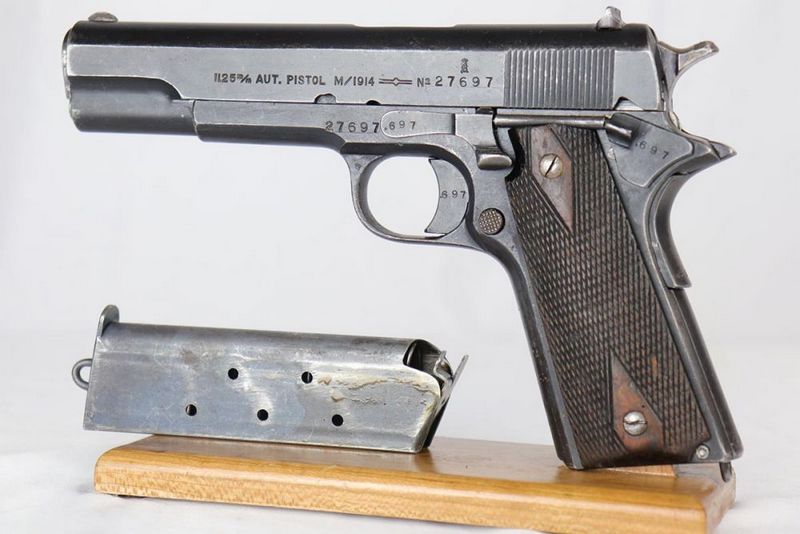
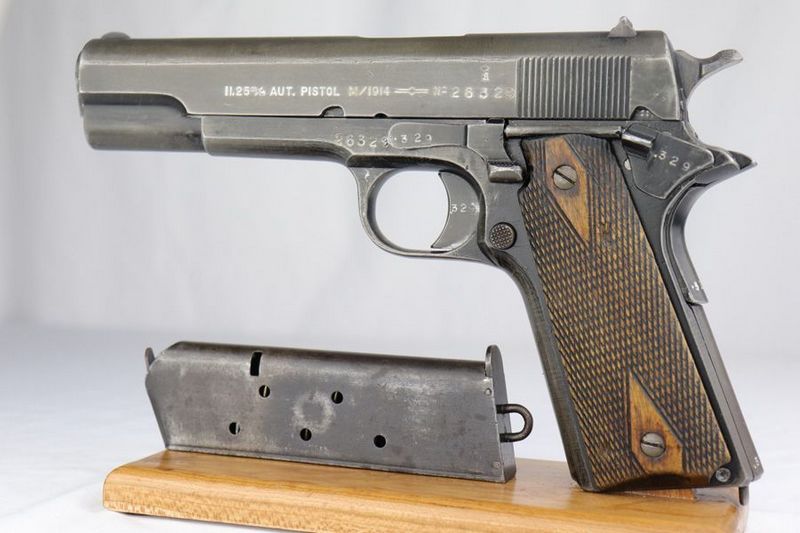
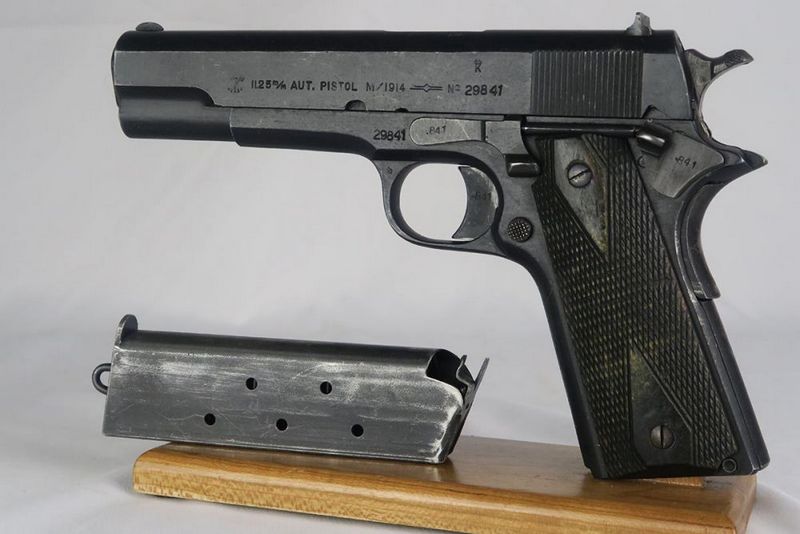
The pistol was officially named "11. 25 m/m AUT. PISTOL M/1914" and was popularly known as "Kongsberg Colten" or "Kongsberg Colt" because of where it was produced.
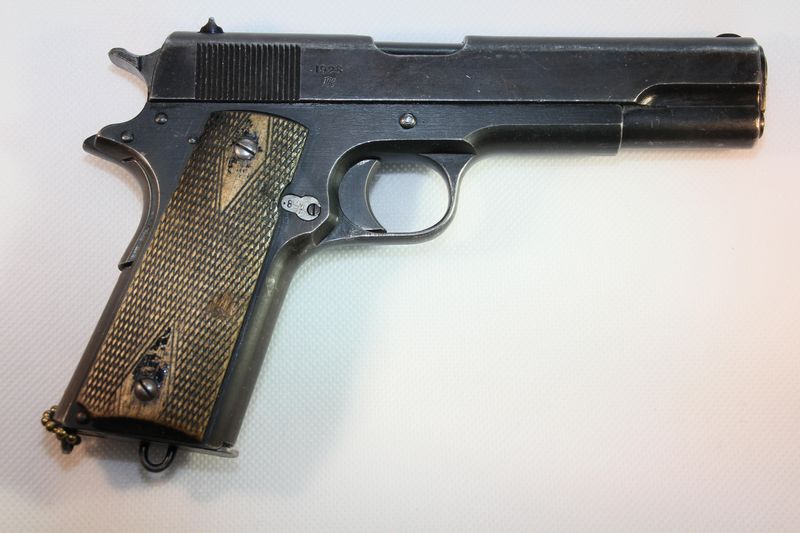
From the outside, the Norwegian product is almost indistinguishable from the American (or Belgian) M1911. That . The 45 ACP chamber was retained, although in Norway it was considered the 11.43x23mm ACP - an effective deterrent cartridge whose large size limited the pistol's magazine capacity. The appearance of this pistol is clearly Browning's Colt design, with its smooth, clean rectangular slide with the necessary knurling at the rear. Sights are mounted on the rear and front of the slide in the usual way for accurate shooting.
The hammer is exposed on the back and can be operated with a thumb or swipe operation. The angled grips are covered by a checkerboard grip pattern that sits on an exposed metal base. The trigger is solid and the ring is stretched. A loop has been added to the bottom of the handle for use with a lanyard. There is a noticeable overhang on the back of the grip, which provides some ergonomics and a more secure grip when shooting.
Both the slide removal and magazine release controls are located near the trigger group and within easy reach of the main hand. The Kongsberg Colt operates through recoil induced action using a closed bolt internal arrangement.
A recoil spring is mounted under the barrel to guide the slider into action. The spring-loaded detachable magazine holds seven ready-to-fire cartridges, and the spent magazines are ejected from the opening on the right side of the frame. The initial velocity is 800 feet per second.
Local mass production of the Kongsberg Colt was initially limited due to Norway's official neutrality, even when Europe was involved in the First World War (1914-1918). The Norwegian Navy became the first user of Colt guns in 1915 when the first 400 guns from Colt USA arrived. In 1916, local production in Norway increased in number, followed in 1917 by another group of Colt companies. Production increased in 1918 (with some minor changes).
It's worth noting that the early production form was erroneously labelled as the 1912 model, which was resolved in the 1918 production. The previous model was then rounded and corrected to follow.
The Kongsberg Colt continued to serve between the two world wars. However, when Germany invaded Norway during World War II (1939-1945), only about 22,000 were in circulation. The invasion began on April 9, 1940, leading to the official German occupation of the country.
The country was not liberated until May 8, 1945.
Like other useful weapons (and their manufacturing facilities) that fell into German hands during European campaigns, the Kongsberg Colt was put into service by its conquerors. This practice resulted in a fairly efficient use of local manufacturing and existing stockpiles of materials, which served the occupying Powers well - liberating much-needed front-line war supplies for Germany and the Axis Powers fighting on the active front. Kongsberg Colt thus became "Pistole 657(n)" in German nomenclature - the "n" stands for its Norwegian origin. All other aspects of the design were largely preserved, although later versions appeared with German checkmarks, and total wartime production brought an additional 8,200 guns to the line.
Due to increased investment in the Cragg-Jorgensen rifle over a period of time, no Kongsberg Colts were produced from 1943 to 1944.
Only 32,874 Kongsberg Colts are said to have been produced in total, making the series extremely rare in todays collectible market.
Specification
Roles
- Close Combat (CQB) / Personal Protection
- Sidearms
Dimensions
Front and rear iron
Performance
Recoil Operation; Closing Bolt
800 feet per second (244 meters per second)
Changes
11. 25m/m AUT. PISTOLE M/1914 - Basic serial number from 1914.
"Kongsberg Colt" - alternative name
Pistol 657(n) - Designation of captured units/productions by the German Army during World War II.
 Argentina
 Armenia
 Australia
 Austria
 Austria-Hungary
 Belgium
 Brazil
 United Kingdom
 United States
 Brunei
 Bulgaria
 Canada
 Chile
Chile China
China Colonial America
 Colombia
 Confederate States
 Croatia
 Czech
Czech Denmark
 Egypt
Egypt Finland
 France
 Georgia
 Germany
 German Imperial
 Greece
 Holland
 Hungary
 India
India Indonesia
 Iran
Iran Iraq
Iraq Ireland
 Israel
 Italy
Italy Japan
Japan Japan (1940)
 Jordan
 Kingdom of Italy
 Malaysia
 Mexico
 Myanmar
 Nazi Germany
 Netherlands
 New Zealand
 North Korea
 Pakistan
 Peru
Peru Philippines
 Poland
 Portugal
 Prussia
 Romania
 Russia
 Saudi Arabia
 Serbia
 Singapore
 Slovakia
 Slovenia
 South Africa
 South Korea
 Soviet Union
 Spain
Spain Sweden
 Switzerland
 Syria
Syria Taiwan
 Thailand
 Turkey
 UAE
UAE Ukraine
 Vietnam
 Yugoslavia