




History of the Lindsay Model 1863 American Double Rifle
Since the advent of firearms, gun manufacturers have taken various paths to provide operators with multiple-shot solutions. In the age of arquebuses, wheel locks, shotguns and flintlocks, this proved to be a formidable challenge, but with the adoption of strike-based action, the possibility of creating multiple-shot weapons increased - "revolvers" were A key solution and has been popularized by Colt and Remington. However, during the American Civil War (1861-1865), several multi-shot long guns proved to gain viable production runs, one of which developed into the Lindsay Model 1863 double-shot rifle in 1863. The design originated at the J.P. (John Parker) Lindsay Manufacturing Company in New Haven, Connecticut, in an attempt to fire two bullets (balls) in a row through a single-barrel arrangement (Lindsay lost his brother in the Indian attack and subsequent scalping, with only one shot at a time).
As such, Lindsay devoted considerable resources to developing double-barreled pistols and pistols for such encounters.
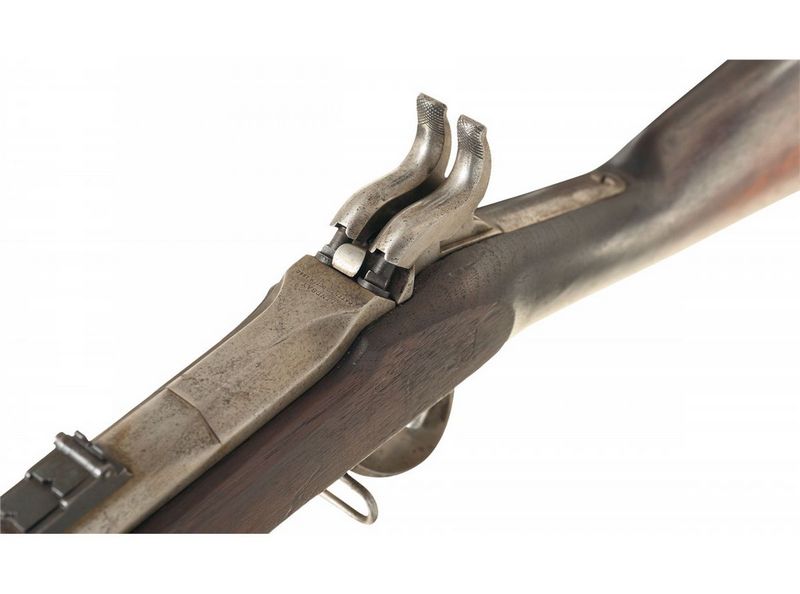
Lindsay was able to devise a new way to keep two rounds on a single chamber and barrel arrangement, the general idea is to fire each round in sequence at the operator's discretion by using two separate hammers (placed side by side) bullet arrangement). Each load is loaded into the muzzle of the barrel in the usual manner, struck home by the pushrod provided, and the bullets are placed in the chamber in the order of loading. After installing the two hammers, two primers are required, which are placed on the two designated nipples.
The design allows only one hammer to fall, even when both are ready, with the right side dominating. The danger, however, is that pulling the trigger, first igniting the breech charge and setting both the charge and the bullet into action, the left hammer will be cocked and dropped. The resulting recoil could be detrimental to the operator, or it could cause a severe breech failure, resulting in the complete loss of the rifle and, most likely, injury to the user. This method proved to be unique enough to be patented by the U.S. government and, if translated into a viable, .58-ball long-bore firearm, was known as the Lindsay "Two-Shot" or "Double" Model 1863.
When she was assessed in combat conditions in the U.S. Army, she saw limited service in the Civil War.
The Lindsay Double Rifle Musket features a one-piece wooden frame with an integrated grip and additional shoulder rest. The barrel is attached to the body using three ties, with only a small portion of the 41" long barrel assembly protruding forward. A pushrod was encased in a channel under the barrel, as the weapon was still a muzzle-loaded weapon at its core, requiring a separate charge and ball (ball) to be rammed into the barrel. In action, the percussion cap is then attached to a metal nipple and struck by a pair of cocked hammers operated by a trigger.
As usual, the trigger hangs in a thin protective ring under the body. The hammer on the right is designed to always fall first and is easy to operate with the shooter's thumb. Movement is controlled by metalwork on the back of the body. Iron sights are provided in two places - just before the action and at the muzzle, both of which are used to ensure accuracy during remote work.
The second barrel strap and the hoist ring on the trigger ring made it possible to carry the weapon over the shoulder while on the march.
The 1863 Lindsay Double was made at a time when the American Civil War was in full swing and all kinds of guns were needed. The U.S. government actually commissioned 1,000 examples of this type under an order of December 17, 1863. However, this appears to be the only arrangement to be aware of, as the Lindsay Double's range was extremely limited during the Civil War (the 16th Michigan Infantry was the only recorded user of this weapon at Peebles Farm). In practice, it has been found that underloaded guns and those operators who mistakenly use the left hammer in the heat of battle tend to release both chambers at the same time, with dire consequences. As a result, this particular bolt-action lance had little following during Union service proving to be more of a flawed novelty attempt than anything the infantry might find useful in combat.
This gun ended up falling into a chapter of Civil War history while more traditional long guns were sought and eventually procured.
Lindsay Model 1863 U. S. Double Rifle Specification
ROLES
- Frontline Infantry/Rifleman
STRUCTURAL
1,300 mm (51. 18 in)
1,041 mm (40. 98 in)
Iron Front and Rear
PERFORMANCE
Percussion Cap; Twin-Shot
6 rounds-per-minute
VARIANTS
Model 1863 - Base Series Designation
US Model 1863 Double Rifle Musket - US Army Designation.
 Argentina
 Armenia
 Australia
 Austria
 Austria-Hungary
 Belgium
 Brazil
 United Kingdom
 Brunei
 Bulgaria
 Canada
 Chile
Chile China
China Colonial America
 Colombia
 Confederate States
 Croatia
 Czech
Czech Denmark
 Egypt
Egypt Finland
 France
 Georgia
 Germany
 German Imperial
 Greece
 Holland
 Hungary
 India
India Indonesia
 Iran
Iran Iraq
Iraq Ireland
 Israel
 Italy
Italy Japan
Japan Japan (1940)
 Jordan
 Kingdom of Italy
 Malaysia
 Mexico
 Myanmar
 Nazi Germany
 Netherlands
 New Zealand
 North Korea
 Norway
 Pakistan
 Peru
Peru Philippines
 Poland
 Portugal
 Prussia
 Romania
 Russia
 Saudi Arabia
 Serbia
 Singapore
 Slovakia
 Slovenia
 South Africa
 South Korea
 Soviet Union
 Spain
Spain Sweden
 Switzerland
 Syria
Syria Taiwan
 Thailand
 Turkey
 UAE
UAE Ukraine
 Vietnam
 Yugoslavia