
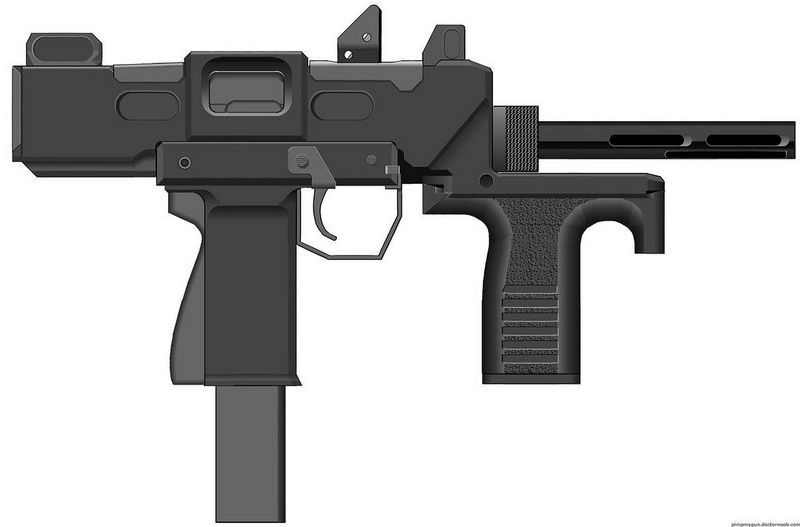
History of Minebea PM-9
The Israeli UZI became one of the most famous submachine guns of the time after its introduction in the mid-1950s. Its popularity has ensured its presence in nearly every major global inventory, and several countries have begun producing this classic firearm locally (licensed and unlicensed).
Over time, other more compact forms appeared in the family series, including the "Mini-UZI" and "Micro-UZI".
When the Japan Self-Defense Forces (JSDF) chose compact automatic weapons for their various services in the 1980s, the choice fell on the tried and true UZI. Local manufacture is produced by Minebea (formerly Southern Arms Manufacturing Company), which gave rise to the "PM-9" designation. It should be noted that the company already produces the SIG-Sauer P220 semi-automatic service pistol from Switzerland, and this new weapon can be produced on the same existing machines.
The PM-9 was issued primarily for second- and third-line units such as artillery support personnel, logistics vehicle drivers, combat vehicle crews, and security personnel. The Japanese special forces also counted some, who more than most appreciate close-range firepower in a compact package.
The service was launched in 1990. The only notable Japanese post-WWII submachine gun designed by the locals is the Nambu M66 (or SCK model 65/66), but this weapon is only a prototype/experimental product.
The weapon was influenced by foreign designs such as the Carl Gustav submachine gun and the American M3 "Grease Gun".
Many features of the original UZI (i.e. the mini-UZI form) have been carried over into the PM-9. It is loaded with the ubiquitous 9x19mm pistol cartridge, fired via a recoil system, while being fed from a 25-round detachable magazine.
The form and function of the weapon is faithful to the UZI, the rectangular receiver is balanced on the pistol grip. The magazine is inserted into the bottom of the pistol grip, with a small section of the barrel protruding out of the front of the frame.
Iron sights were placed on the receiver in the usual way.
Overall weight is 6.2 lbs and overall length is 399 mm. The barrel assembly is 120mm long. The rate of fire is 1100 rounds per minute, and the effective range is reduced to 100 meters.
Compared to the Israeli design, the PM-9's foregrip was lengthened and placed in front of the trigger group for better two-handed shooting in fully automatic mode. These originally appeared in wood finishes, but have since been modernized to plastic finishes.
The PM-9 is still used on a limited basis by various branches of the Japanese military. It is divided into submachine guns and submachine guns.
Specification
Roles
- Stealth
- Close Combat (CQB) / Personal Protection
- Sidearms
Dimensions
400 mm (15.75 in)
120 mm (4.72 in)
2.80 kg
Front and rear irons; optional reflex sight.
Performance
Recoil operation; fully automatic
1,100 rounds per minute
330 ft (101 m; 110 yd)
Changes
PM-9 - Base Series Name
 Argentina
 Armenia
 Australia
 Austria
 Austria-Hungary
 Belgium
 Brazil
 United Kingdom
 United States
 Brunei
 Bulgaria
 Canada
 Chile
Chile China
China Colonial America
 Colombia
 Confederate States
 Croatia
 Czech
Czech Denmark
 Egypt
Egypt Finland
 France
 Georgia
 Germany
 German Imperial
 Greece
 Holland
 Hungary
 India
India Indonesia
 Iran
Iran Iraq
Iraq Ireland
 Israel
 Italy
Italy Japan (1940)
 Jordan
 Kingdom of Italy
 Malaysia
 Mexico
 Myanmar
 Nazi Germany
 Netherlands
 New Zealand
 North Korea
 Norway
 Pakistan
 Peru
Peru Philippines
 Poland
 Portugal
 Prussia
 Romania
 Russia
 Saudi Arabia
 Serbia
 Singapore
 Slovakia
 Slovenia
 South Africa
 South Korea
 Soviet Union
 Spain
Spain Sweden
 Switzerland
 Syria
Syria Taiwan
 Thailand
 Turkey
 UAE
UAE Ukraine
 Vietnam
 Yugoslavia