




History
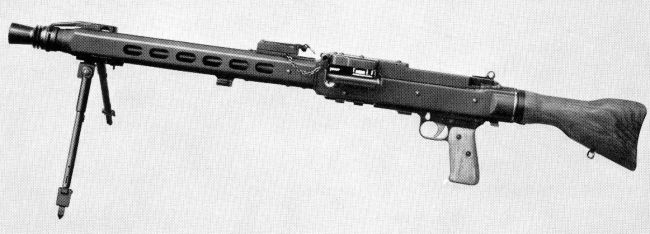
The MG 710 was offered by Schweizerische Industrie Gesellschaft (known by the initials 'SIG') in the post-World War II reconstruction decade for future export sales. Since the Swiss Army has already worked on the MG 51 series in previous years, the success of the MG 710 will largely depend on future export markets.
While it proved to be a high-quality machine gun, the MG 710 itself was expensive, never found an intended buyer, and its operators were limited to Bolivia, Brunei, Chile, Liberia, and Liechtenstein.
The MG 710 is classified as a "General Purpose Machine Gun" (GPMG), which describes its multi-faceted performance on the battlefield. It is a belted felt weapon with a rifle caliber cartridge that can act in a fire support role (via a bipod) or in a stationary defensive role through the use of a heavy tripod attachment.
In addition, this weapon can be easily mounted on a vehicle with only minor modifications and can operate normally.
Inspired by the post-war German MG45 (an improved, simplified version of the classic MG42 machine gun line, which itself was inspired by the MG34 predecessor), the MG 710 started in 1955 as the "Type 55" and was built in the 1960s. During this period, it appeared in three different forms before the standardized, accepted production model. The MG 710-1 is a version that holds a 6.5x55mm rifle cartridge with a perforated barrel jacket and muzzle flash suppressor.
The bipod was also attached to the muzzle. The successor MG 710-2 holds the 7.92x57mm Mauser rifle cartridge, has no barrel sheath, and has a carrying handle that doubles as a handle for barrel removal. The bipod is attached to the extension tube of the receiver. Three cooling vents are provided for the barrel. The SG 710-3 became the final form of the 7.62x51mm NATO standard rifle cartridge, complete with a perforated (solid square) barrel jacket, stamped steel construction (which reduced weight somewhat) and a simpler manufacturing process.
It was this version that ended up being sold in bulk by the SIG.
Externally, the MG 710 bears some clear resemblance to the German wartime MG42, with its slotted barrel jacket, belt feed system and elevated receiver. Actions are controlled according to the barrel and stock, providing a more stable firing platform. Its operating system is based on the delayed recoil of the barrel. The gun weighs 20.4 pounds and is 45 inches long with the 22-inch barrel assembly installed. The rate of fire was reported to be 875 rounds per minute (average) and the muzzle velocity was 2,560 feet per second.
Under ideal conditions and the correct sight (aided by optics on the supplied iron sight), the effective range is up to 1,200 meters. Weapons are attached via either a non-decomposable DM1 belt or a disassembled connected M13 belt assembly (they are housed in a 50-round metal box on the left side of the receiver). The barrel is air-cooled, which means that changing the barrel is a necessary feature of the system. The stock is solid, made of wood or metal, and fastened for convenience.
Overall, the quality of the MG 710 is considered excellent, and its rather sophisticated mechanics have proven to be absolutely reliable under the given load.
Specification
Roles
- Fire Support/Suppression/Defense
Dimensions
1,146 mm (45.12 in)
560 mm (22.05 in)
9.65 kg
Rear sliding tangent; open front; optional optics
Performance
Delayed recoil; recoil operation; belt feeding
2,592 feet per second (790 meters per second)
875 rounds per minute
3,280 ft (1,000 m; 1,093 yd)
VARIANTS
MG-55/Model 55 - Original Series Designation
MG 710 - Family Series Designation
MG 710-1 (MG-55-1) - MG42-style full length barrel jacket; muzzle-mounted bipod; detachable barrel.
MG 710-2 (MG-55-2) - Bipod on tube extension from receiver; three cooling vents on sides.
MG 710-3 (MG-55-3) - Similar to MG 710-1 model; chambered for 7. 62x51mm NATO standard cartridge; slotted square casing; bipod or tripod use optional.
 Argentina
 Armenia
 Australia
 Austria
 Austria-Hungary
 Belgium
 Brazil
 United Kingdom
 United States
 Brunei
 Bulgaria
 Canada
 Chile
Chile China
China Colonial America
 Colombia
 Confederate States
 Croatia
 Czech
Czech Denmark
 Egypt
Egypt Finland
 France
 Georgia
 Germany
 German Imperial
 Greece
 Holland
 Hungary
 India
India Indonesia
 Iran
Iran Iraq
Iraq Ireland
 Israel
 Italy
Italy Japan
Japan Japan (1940)
 Jordan
 Kingdom of Italy
 Malaysia
 Mexico
 Myanmar
 Nazi Germany
 Netherlands
 New Zealand
 North Korea
 Norway
 Pakistan
 Peru
Peru Philippines
 Poland
 Portugal
 Prussia
 Romania
 Russia
 Saudi Arabia
 Serbia
 Singapore
 Slovakia
 Slovenia
 South Africa
 South Korea
 Soviet Union
 Spain
Spain Sweden
 Syria
Syria Taiwan
 Thailand
 Turkey
 UAE
UAE Ukraine
 Vietnam
 Yugoslavia