

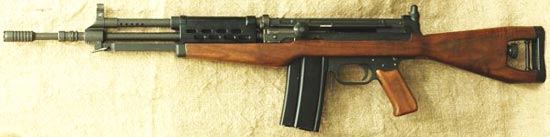
History of the Madsen m/62 LAR
Dansk Industri Syndikat (Madsen) developed a new, state-of-the-art "battle rifle" between 1957 and 1962 to meet the growing global The need calls for a reliable rifle automatic weapon firing the 7.62x51mm NATO cartridge. World War II (1939-1945) saw a coordinated shift from older manual bolt-action rifles to self-loading rifles (SLRs) and similar types that provided individual infantrymen with greater firepower on the move.
The Danish rifle is largely of traditional design, relying on a pneumatic system, fed from a detachable 20-round magazine, and aimed through iron sights set above the receiver and barrel.
The layout of the weapon was traditional, with a wooden stock (a tubular form was later used), a wooden front end and a fixed pistol grip. The trigger assembly is integrated into the grip, and the magazine feed is located directly in front, within reach below the receiver. The charging handle is located on the left side of the receiver, and the gas cylinder is located above the barrel assembly (as on the AK-47).
This assembly is covered by a flash suppressor.
This rifle is partly influenced by the tried and very popular post-war Soviet AK-47 Kalashnikov assault rifle, and is in line with Belgian FN FAL and West German Heckler & Koch G3 line . The Soviet incarnation was known for its reliability and simplicity, which made it commonplace in many parts of the world and featured in many global, regional and local conflicts. However, the Danish approach takes a lighter approach, using lighter alloys in its construction to create a more manageable weapon than the Soviet AK-47.
Despite the work, this battle rifle was not adopted. The version for the Finnish army originated from a 7.62x39mm M43 magazine, fed by a 30-round AK-style curved magazine, but eventually moved to a homegrown design, the Valmet M62.
Finally, as more countries embraced "assault rifles" - focusing on intermediate cartridges, battle rifles - with full-powered rifle cartridges - eventually fell out of favor in the West as standard long guns. A typical example of this period is the American M-16.
However, battle rifles continued to play a secondary role and became the weapon of choice for snipers and marksmen because of their ability to stop people at a distance.
Specification
Basics
Years of Service
1962
Origins
Denmark
Categories
Battle Rifle Prototype
Manufacturer
Dansk Industri Syndikat AS Madsen - Denmark
Operator
Denmark (intended); Finland (intended)
Roles
Auto function
Has mechanical features to automate the firing process.
Dimensions and Weight
Overall Length
1,080 mm
42. 52 inches
Barrel length
533mm
20. 98 inches
Cured weight
10.58 lbs
4.80 kg
Attractions
Before and after ironing.
Action
Gas Power
Gas Power
proposes a pneumatic system that typically consists of a cylinder and a rear drive piston that directs power to the bolt assembly.
Cartridges and Paper Feeds
Caliber*
7x62x51mm NATO; 7. 62x39mm M43
Circle/Feed
20 or 30 rounds detachable magazine.
Performance
Rate of Fire
600
Number of revolutions
Mile speed
2,650 ft/s
(808 m/s)
Variation
m/62 - Expected company name.
 Argentina
 Armenia
 Australia
 Austria
 Austria-Hungary
 Belgium
 Brazil
 United Kingdom
 United States
 Brunei
 Bulgaria
 Canada
 Chile
Chile China
China Colonial America
 Colombia
 Confederate States
 Croatia
 Czech
Czech Egypt
Egypt Finland
 France
 Georgia
 Germany
 German Imperial
 Greece
 Holland
 Hungary
 India
India Indonesia
 Iran
Iran Iraq
Iraq Ireland
 Israel
 Italy
Italy Japan
Japan Japan (1940)
 Jordan
 Kingdom of Italy
 Malaysia
 Mexico
 Myanmar
 Nazi Germany
 Netherlands
 New Zealand
 North Korea
 Norway
 Pakistan
 Peru
Peru Philippines
 Poland
 Portugal
 Prussia
 Romania
 Russia
 Saudi Arabia
 Serbia
 Singapore
 Slovakia
 Slovenia
 South Africa
 South Korea
 Soviet Union
 Spain
Spain Sweden
 Switzerland
 Syria
Syria Taiwan
 Thailand
 Turkey
 UAE
UAE Ukraine
 Vietnam
 Yugoslavia