

History
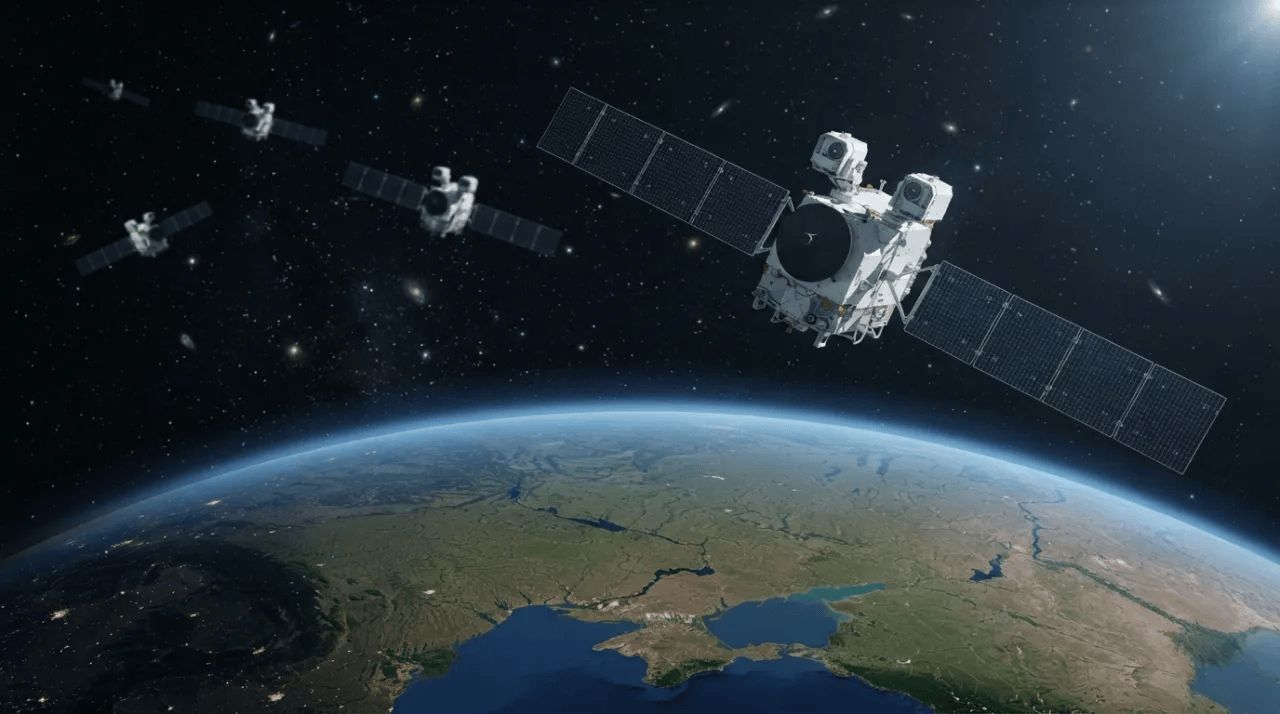
Bureau 1440 Rassvet is a Russian low-Earth-orbit satellite constellation intended to provide high-speed broadband communications. The system combines satellites, ground infrastructure, fixed and mobile subscriber terminals, and inter-satellite communication links.
Experimental spacecraft were launched in 2023 and 2024. Deployment of the first operational satellites began in March 2026, while commercial service remained planned for 2027.
The project originated in November 2020 as MegaFon 1440, an office established to study the technical and commercial potential of low-orbit broadband systems. Its name referred to the approximately 1,440 orbits completed by Sputnik 1. The organization began developing prototype spacecraft, subscriber equipment, and the supporting ground network.
In November 2021, Russian authorities allocated Ku- and Ka-band frequencies to the project. Bureau 1440 subsequently became part of X Holding and adopted its present name in 2022. The company developed into a vertically integrated organization responsible for spacecraft, terminals, and ground infrastructure.
The first experimental mission, Rassvet-1, placed three spacecraft into orbit on 27 June 2023. The satellites were launched by a Soyuz-2.1b vehicle from Vostochny Cosmodrome. Each spacecraft had a reported mass of approximately 80 kg. The mission tested satellite control, orbital adjustment, and broadband communication with ground subscribers.
Tests conducted with Rassvet-1 reportedly demonstrated download speeds of 48 Mbit/s with 38 ms latency and upload speeds of 12 Mbit/s with 42 ms latency. In August 2023, the system supported a demonstration video call between Moscow and a location outside terrestrial mobile-network coverage.
Three larger Rassvet-2 prototypes were launched from Plesetsk Cosmodrome during the night of 16–17 May 2024. These satellites introduced updated communications equipment, support for the 5G non-terrestrial network protocol, and two laser terminals per spacecraft for links between satellites. A technical summary of the mission is available from Gunter's Space Page.
During Rassvet-2 testing, Bureau 1440 reported 14 laser-link experiments over distances from 30 to 220 km. The company stated that approximately 1.5 TB of data was transferred during the test campaign, including as much as 450 GB in one session without damaged packets.
On 24 March 2026, Bureau 1440 announced the orbital deployment of the first 16 production satellites. The company described this launch as the transition from experiments to construction of a commercial communications service. One spacecraft was subsequently lost, leaving 15 satellites from this batch in orbit alongside the six earlier prototypes. The loss and the remaining orbital inventory were reported by Meduza and The Kyiv Independent.
By 31 July 2026, 12 satellites from the March group had reportedly reached an operational altitude of 550 km, while three were still raising their orbits. A second group of 16 communications satellites was placed into orbit at the end of July 2026.
Design
Constellation architecture
Rassvet is designed as a low-Earth-orbit broadband network. International Telecommunication Union filings described planned inclined and polar orbital groups. The filings listed an approximately 500 km altitude with inclinations of 60 degrees and 88 degrees. The architecture is intended to use Ku- and Ka-band radio links, ground stations, subscriber terminals, and links between spacecraft.
Later Rassvet prototypes carry laser communication terminals. These terminals allow data to pass between satellites rather than requiring every connection to be routed immediately through a ground station. Rassvet-2 also tested communications equipment based on the 5G non-terrestrial network protocol.
Subscriber terminals
Bureau 1440 is developing fixed and mobile subscriber terminals. The reported basic terminal measures no more than approximately 60 cm in length and width, weighs less than 15 kg, and supports throughput of up to 1 Gbit/s. Its stated operating-temperature range is −40 to +40 degrees Celsius.
The terminal uses an active electronically scanned phased-array antenna. Electronic beam steering allows it to locate and track moving satellites without mechanically pointing the antenna. Public reporting in 2026 indicated that development of the basic version had been completed and preparations for serial production were under way.
Program status
Commercial operation remained officially planned for 2027. Published constellation targets have changed over time. Earlier reports described goals of approximately 250 satellites in 2027, 730 by 2030, and more than 900 by 2035. Later reporting described 292 operational satellites by the end of 2030 and 383 spacecraft launched in total. These figures are plans rather than completed deployment numbers.
The project forms part of Russia's Data Economy program. Reporting in 2026 described planned financing of 102 billion rubles from the federal budget and 329 billion rubles from Bureau 1440.
An analysis published at the end of July 2026 concluded that the first operational chain already produced at least two stable communication windows over Ukraine per day. Each suitable passage reportedly lasted more than one hour, while the satellites entered the broader visibility area approximately four times daily. Only two or three passages placed them sufficiently high above the horizon for a stable terminal link. A summary of this analysis is available from Mezha.
Analysts assessed that such coverage could eventually support communications with ground units, ships, maritime unmanned craft, and long-range unmanned aircraft. Possible use for command or weapon guidance remained an assessment of future military utility, not confirmation that these applications were operational.
Variants
- Rassvet-1: First experimental series. Three approximately 80 kg spacecraft were launched in June 2023 to test the satellite platform, orbital control, and broadband links with ground terminals.
- Rassvet-2: Second experimental series. Three approximately 120 kg spacecraft were launched in May 2024 with updated payloads, 5G non-terrestrial network equipment, and two laser communication terminals per satellite.
- Rassvet-3: Designation associated with the first operational-generation spacecraft. The first batch of 16 was launched in March 2026, followed by another group in July.
Operator
- Bureau 1440: Developer and operator of the experimental and operational Rassvet spacecraft, subscriber terminals, mission-control facilities, and supporting ground infrastructure.
Specifications (Rassvet-2)
General characteristics
- Type: Experimental low-Earth-orbit broadband communications satellite
- Operator: Bureau 1440
- Mass: Approximately 120 kg
- Electrical power: Solar arrays and batteries
Communications equipment
- Inter-satellite equipment: Two laser communication terminals
- Network technology: 5G non-terrestrial network communications equipment
- Reported laser-link test distance: 30–220 km
- Reported laser-test data volume: Approximately 1.5 TB across 14 tests
Launch
- Launch date: 16–17 May 2024
- Launch site: Plesetsk Cosmodrome
- Launch vehicle: Soyuz-2.1b with Fregat upper stage
- Number launched: Three
Related equipment
- Starlink: A larger low-Earth-orbit broadband constellation with a broadly comparable satellite-internet role. Rassvet is frequently described in reporting as Russia's proposed counterpart to Starlink.
 Argentina
 Armenia
 Australia
 Austria
 Austria-Hungary
 Belgium
 Brazil
 United Kingdom
 United States
 Brunei
 Bulgaria
 Canada
 Chile
Chile China
China Colonial America
 Colombia
 Confederate States
 Croatia
 Czech
Czech Denmark
 Egypt
Egypt Finland
 France
 Georgia
 Germany
 German Imperial
 Greece
 Holland
 Hungary
 India
India Indonesia
 Iran
Iran Iraq
Iraq Ireland
 Israel
 Italy
Italy Japan
Japan Japan (1940)
 Jordan
 Kingdom of Italy
 Malaysia
 Mexico
 Myanmar
 Nazi Germany
 Netherlands
 New Zealand
 North Korea
 Norway
 Pakistan
 Peru
Peru Philippines
 Poland
 Portugal
 Prussia
 Romania
 Saudi Arabia
 Serbia
 Singapore
 Slovakia
 Slovenia
 South Africa
 South Korea
 Soviet Union
 Spain
Spain Sweden
 Switzerland
 Syria
Syria Taiwan
 Thailand
 Turkey
 UAE
UAE Ukraine
 Vietnam
 Yugoslavia