
History
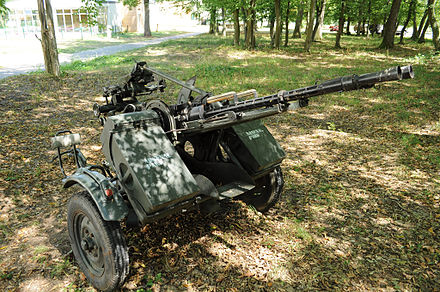
Development of the ZPU-1 began in 1947 after World War II. The ZPU-1 was nothing more than a single-barreled version of the successful ZPU anti-aircraft line, armed with a Soviet 14.5mm KPV machine gun. The weapon system is designed as a low-cost air defense system to repel low-altitude aircraft within the range of large-caliber 14.5mm systems.
This reliable and durable military hardware has proven to be a favorite of the world's cash-strapped and budget-conscious militaries, with around 50 countries using the ZPU series artillery for air defense. All versions of the ZPU entered service in 1949, and some are still widely used today, as evidenced by the aftermath of the 2003 US invasion of Iraq.
The design of the ZPU-1 is very functional and traditional. The system basically consists of three main components, including the barrel, the gun mount and the slide rails - which can be mounted to the vehicle if desired and used to temporarily move the weapons platform. The 14.5mm air-cooled machine gun is mounted on a semi-flexible mount and has an attack altitude of -8 to +88 degrees. Since the gun mount is fixed in the ZPU base slide, the entire ZPU-1 system must be rotated to achieve the traverse. However, this allows a full 360 degree traversal.
The artillery system has a maximum range of 8,749 yards and can reach aircraft at an altitude of 16,404 feet. However, the ZPU-1 is still most effective against aircraft below 5,000 feet. The actual rate of fire of the 14.5mm machine gun is about 150 rounds per minute. The weapon base is mounted on a two-wheeled, rubber tire, trailing arm sled system for ground transportation of light or heavy vehicles. A typical ZPU-1 crew consists of four people.
All ZPU-1's early optical sights were updated in the 1950s. The 14.5mm barrel can be replaced if it overheats.
The ZPU can fire a variety of ammunition types including API (Armor Piercing Incendiary), API-T (Armor Piercing Incendiary - Tracer) and I-T (Incendiary - Tracer) types of ammunition. API (also known as BS.41) uses full metal sheathed bullets with tungsten carbide cores.
The penetration of this cartridge is 547 yards. API-T (also known as BZT) is an all-metal jacketed cartridge with a steel core that contains a tracer cartridge during active fire to visually train the weapon system against targets. The I-T wheel is also called "ZP". The ZPU-1 crew is typically supplied with approximately 1,200 rounds of 14.5mm ammunition, although this may vary by operator and ammunition carrier. ZPU ammunition was produced in Soviet factories as well as in communist Bulgaria, China, Poland and Romania.
Egypt also took over the production of ZPU cartridges at one point.
Since the ZPU series originated purely from the Soviet Union, it is not surprising to find them in the list of supported countries and allies during the Cold War. The ZPU series was actively used by North Korean and Chinese troops against UN aircraft during the Korean War from 1950 to 1953.
Additionally, the NVA used the weapon as a low-altitude deterrent to U.S. Army helicopters during the upcoming Vietnam War of the 1960s to 1970s. Saddam Hussein's armed forces were equipped with ZPU types during the 1991 Gulf War.
More recently, examples of ZPU systems recovered by the coalition following the fall of Iraq in 2003 by the U.S. invasion show that they are still serving the country.
The main variants of the ZPU series include the single-tube ZPU-1, double-tube ZPU-2 and quad-tube ZPU-4. Each is easily identifiable, and their names clearly identify their respective versions based on the number of casks used.
ZPUs are also manufactured by the Chinese military under their own localized names (Type 58/ZPU-2 and Type 56/ZPU-4). Both the ZPU-1 and ZPU-2 are transported on their integrated two-wheel frame, while the ZPU-4 moves via its four-wheel frame system.
Additionally, the larger ZPU-2 and ZPU-4 systems require five standard operators.
In the Russian Army's inventory, the ZPU-1 has been replaced by the more powerful 23mm twin-barreled ZU-23 anti-aircraft gun system.
Specification
Basic
Roles
- Air Defense/Airspace Denial
- fire support/attack/damage
Dimensions
11.29 ft (3.44 m)
5.31 ft (1.62 m)
4.40 ft (1.34 m)
0t (413kg; 911lb)
Performance
Performance
5 miles (8 km)
Armor
1 x 14.5mm heavy machine gun
1,200 x 14.5mm Ammo
Changes
ZPU-1 - Single-barreled 14.5mm anti-aircraft machine gun; published 1949.
ZPU-2 - Double-barreled version; released in 1949.
ZPU-4 - Four-barreled version; released in 1949.
Type 58 - Chinese production version of the ZPU-2
Type 56 - Chinese production version of ZPU-4
 Argentina
 Armenia
 Australia
 Austria
 Austria-Hungary
 Belgium
 Brazil
 United Kingdom
 United States
 Brunei
 Bulgaria
 Canada
 Chile
Chile China
China Colonial America
 Colombia
 Confederate States
 Croatia
 Czech
Czech Denmark
 Egypt
Egypt Finland
 France
 Georgia
 Germany
 German Imperial
 Greece
 Holland
 Hungary
 India
India Indonesia
 Iran
Iran Iraq
Iraq Ireland
 Israel
 Italy
Italy Japan
Japan Japan (1940)
 Jordan
 Kingdom of Italy
 Malaysia
 Mexico
 Myanmar
 Nazi Germany
 Netherlands
 New Zealand
 North Korea
 Norway
 Pakistan
 Peru
Peru Philippines
 Poland
 Portugal
 Prussia
 Romania
 Russia
 Saudi Arabia
 Serbia
 Singapore
 Slovakia
 Slovenia
 South Africa
 South Korea
 Spain
Spain Sweden
 Switzerland
 Syria
Syria Taiwan
 Thailand
 Turkey
 UAE
UAE Ukraine
 Vietnam
 Yugoslavia