


History
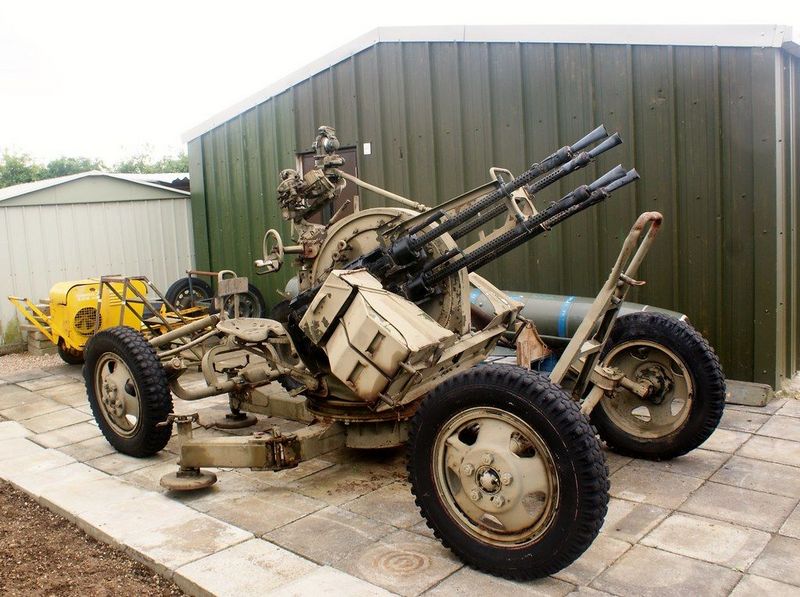
The ZPU-4 anti-aircraft gun was developed by the Soviet Union after the war and entered service in 1949. The towed artillery system consists of four air-cooled, quickly interchangeable 14.5mm heavy machine guns with a maximum range of 8,000 meters (about 5 miles) and an elevation range of 5,000 meters (3.1 miles), which has been proven at 1,400 meters /0.86 mile altitude range is more effective. Improved optical gun sights were added later in production life to improve battlefield efficiency. The system can be set up and launched in less than 30 seconds, making it a flexible mobile air defense system.
As a front-line weapon, it served the Soviet Union well and was exported to supply the stockpiles of many Soviet-facing customers.
The ZPU-4 air defense system received a baptism of firepower during the Korean War (1950-1953) serving Chinese and North Korean combat units. It was widely used against low-flying aircraft during the Vietnam War (1955-1975), and it became one of the most feared anti-aircraft components of U.S. helicopters because the four-tube arrangement could easily pierce key low-flying aircraft.
A slow machine. Iraq managed an inventory of these weapons during the 1991 Gulf War, many of which were scrapped after the 2003 U.S.-led invasion. The ZPU-4 was first used during the Syrian civil war (2011-present).
Since then, many countries have replaced their aging ZPU-4 weapons based on heavy machine guns in favor of ZU-23 air defense systems based on 23mm machine guns. However, the ZPU-4 is still used on the front line by a few countries, including North Korea, to this day (2011).
During the Cold War, the weapon was widely exported to countries allied with the Soviet Union, totaling more than 50 operators at its peak. Chinese factories also locally produce variants of the weapon system (licensed) such as the "Type 56" and "Type 58".
The ZPU-4 is typically in a towed/wheeled configuration, where weapons, crew seats, optics, and mounting hardware are integrated along a four-wheeled carriage that is towed by a moving vehicle. The weapon can also be removed for use as a stationary weapon, or placed in the rear of the vehicle to provide mobile firepower.
In addition to its intrinsic value in fighting low-flying targets, the system could prove just as effective against lightly armored vehicles, while also having a huge psychological impact on unprotected infantry.
The ZPU-4 belongs to the family of Soviet anti-aircraft guns, named after the number of barrels used. The ZPU-1 is equipped with one barrel, while the ZPU-2 is equipped with a pair of barrels. Appropriately, the ZPU-4 employs a four-gun arrangement.
Specification
Basic
Roles
- Air Defense/Airspace Denial
- fire support/attack/damage
Dimensions
14.86 ft (4.53 m)
5.64 ft (1.72 m)
6.99 ft (2.13 m)
2 tons (1,810 kg; 3,990 lb)
Performance
Performance
4,971 miles (8,000 km)
Armor
4 x 14.5mm heavy machine guns.
4,800 x 14.5mm ammo
Changes
ZPU-1 - Single-barreled 14.5mm anti-aircraft machine gun; issued in 1949.
ZPU-2 - Double-barreled version; released in 1949.
ZPU-4 - Four-barreled version; released in 1949.
Type 58 - Chinese production version of the ZPU-2
Type 56 - Chinese production version of ZPU-4
 Argentina
 Armenia
 Australia
 Austria
 Austria-Hungary
 Belgium
 Brazil
 United Kingdom
 United States
 Brunei
 Bulgaria
 Canada
 Chile
Chile China
China Colonial America
 Colombia
 Confederate States
 Croatia
 Czech
Czech Denmark
 Egypt
Egypt Finland
 France
 Georgia
 Germany
 German Imperial
 Greece
 Holland
 Hungary
 India
India Indonesia
 Iran
Iran Iraq
Iraq Ireland
 Israel
 Italy
Italy Japan
Japan Japan (1940)
 Jordan
 Kingdom of Italy
 Malaysia
 Mexico
 Myanmar
 Nazi Germany
 Netherlands
 New Zealand
 North Korea
 Norway
 Pakistan
 Peru
Peru Philippines
 Poland
 Portugal
 Prussia
 Romania
 Russia
 Saudi Arabia
 Serbia
 Singapore
 Slovakia
 Slovenia
 South Africa
 South Korea
 Spain
Spain Sweden
 Switzerland
 Syria
Syria Taiwan
 Thailand
 Turkey
 UAE
UAE Ukraine
 Vietnam
 Yugoslavia