


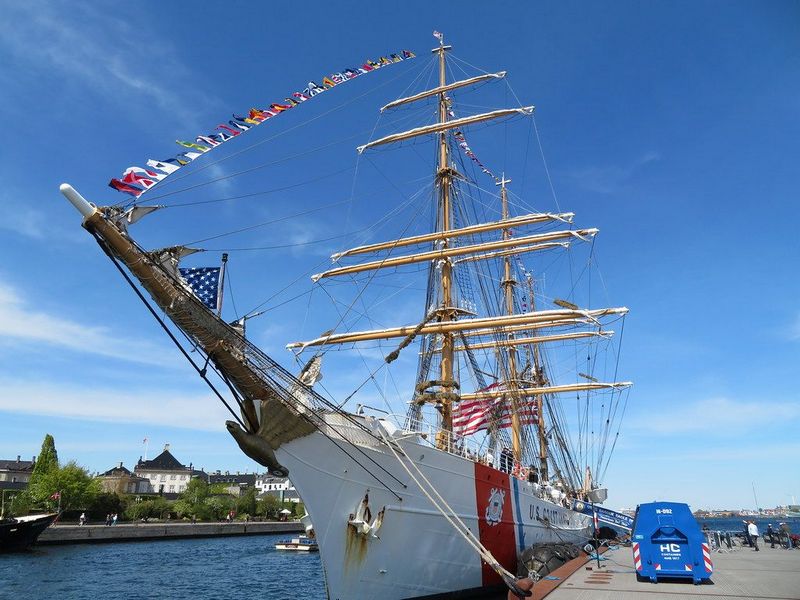
History
German Fuhrer Adolf Hitler urged the Kriegsmarine to increase the number of naval officers for the upcoming war plan, so an extra tall ship was needed to support the Bark sail training ship Gorch Foch Naval cadets became. The chosen shipyard was Blohm und Voss, and the ship was officially commissioned in the Port of Hamburg on September 17, 1936, under the name "Horst Wessel". Horst Wessel is named after an NSDAP member and SA stormtrooper who was killed in a street fight with communists in 1930.
Hitler and some of his personal bodyguards and staff were on board for the commissioning ceremony.
Horst Wessel is the flagship of the German Navy's Naval Training Fleet, ported over from Germany's Bluecher Piers Kiel. The fleet consisted of Gorch Fock, Albert Leo Schlageter and Horst Wessel. Horst Wessel combines a traditional three-masted barge with a modern steel hull instead of wood.
The foremast is 147.3 ft (44.9 m) high with square sail, the main mast is 147.3 ft (44.9 m) high (also square sail), and the mizzen is 132 ft (40.2 m) high, albeit with rigging. She carried a total of twenty-two sails on her three masts, plus the sails on her bowsprit, for a total sail area of ??2,070 square meters (22,300 square feet). During sailing, Horst Wessel runs the diesel engine at 17 knots (31 km/h) and about 7.5 knots. She measures 295 feet (89 meters) in length with a beam of 40 feet (12 meters) and a draft of 17 feet (5.2 meters).
All in all, when built, it displaces 1,750 tonnes under full load.
For defense, the ship deployed 8 x 20 mm anti-aircraft guns (AA), two on the bridge wings, two on the foredeck, and two quads mounted on the waist deck - the middle of the upper deck. The hull is four-tenths of an inch thick steel with a raised foredeck and aft deck. The open deck is three inches of teak on a steel deck. The entire vessel has two full-length steel decks with a platform deck below.
Below is the crew quarters for 300 people, as well as sufficient engine room for auxiliary diesel engines, fresh water supply and fuel storage. The full kitchen, sink, shower and waste disposal system was state of the art in 1936.
After being commissioned in 1936, Horstwiesel was used as a training ship for German naval non-commissioned officers in basic seamanship. Horst Wessel has travelled abroad to train trainees several times, visiting Edinburgh in the UK and Las Palmas in the Canary Islands.
Although in the North Sea, she also docked at the Norwegian port of Kristiansand, where the crew enjoyed cool breezes and warm nights in the Cuban port of Havana. When the war broke out in September 1939, Horstwiesel was assigned to the Naval Trainer Candidate Station in Stralsund in 1940. In 1941, she was placed alongside a tender boat as a stationary training vessel. However, in mid-May 1941, Horst Wessel was again tasked with training naval cadets. Some reports suggest that her crew shot down three Soviet aircraft during a training cruise after the declaration of war.
A German plane was also shot down by mistake because the German pilot used the wrong radio code indicating it was not a Luftwaffe aircraft. The pilot was rescued by the wind jammer crew.
Later in the war, she was placed in the reserve in Kiel. A small crew and Kapitanleutnant Berthold Schnibbe were ordered to remain on board, and in late 1945 British Allied forces entered Kiel and took place on the Allied-damaged Horst Wessel and her sister ship Albert Leo Schlageter. The German garrison was detained and drawn along with the United States, and Horstwesel ended up being a war prize.
In January 1946, the U.S. Coast Guard dispatched a small crew from the United States, including Commander Gordon P. McGowan, to Bremerhaven, Germany, to manage one of the tall German ships.
Commander McGowan would choose a ship held by the British that would be of no use to them, and told the US Navy that two tall ships were available. The Coast Guard tasked Captain McGowan with selecting the best ship available, finding local resources to overhaul her, and procuring the supplies needed to equip her for her voyage back to the United States.
Upon arriving in Bremerhaven, Captain McGowan contacted the British and went to the area designated by Allied Command. Two chief non-commissioned officers accompanied McGowan to inspect two ships docked at Bluecher Piers. The decision McGowan had to make on the advice of the Chiefs was between Horst Wessel and Albert Leoschlagert. Albert Leo Schlageter was the less seaworthy of the two boats. Her lower deck was damaged by water as the ship was struck by a mine.
McGowen chose Horst Wessel because she seemed to need less work to make her seaworthy. The British placed the German ship's crew in prisoner-of-war camps and offered McGowan to help them cross to America. Captain McGowan took over the ship, and on May 15, 1946, she was drafted into the U.S.
Coast Guard as the Cutting Eagle.
The decision on how to name the Coast Guard's newest knives dates back to the first days after the American Revolution. The War Department, under orders from George Washington, created a new service called the Marine Corps in 1790 to counter the lingering threat. Smugglers spend much-needed U.S. taxes on goods passing through rivers and ports on the East Coast and the Gulf of Mexico. New services require boats, and the USRC Eagle was one of the first 10 cutters built in the United States.
The Tax Marine Corps became the Tax Cutting Service, which later evolved into the U.S. Coast Guard, the oldest Navy service in the United States. The Coast Guard chose to honor the three-masted sailboat with a real American name, USCGC Eagle, IMO number: 6109973.
The figurehead on Horst Wessel is a German eagle with outstretched wings holding a disc in its talons with the swastika or swastika in relief. The puppet was replaced and remains to this day a flying golden eagle with five layers of feathers and an open beak under its outstretched wings, and a circular disc in its claws emblazoned with the Coast Guard's seal.
The difference between the two eagles is the German version, which appears to be standing with open wings, four layers of feathers under the wings, and a closed beak.
Coast Guard crews spend a lot of time cleaning the cabin. Nameplates for cabin functions are also in German and cannot be read by American crew members. Work was slow, and while working on the engine, they discovered that the block had broken. McGowan asked around, found engine parts in Hamburg, and sent a crew member to collect replacement parts.
A major problem slowing down the work is the lack of manuals on board about the ship's functions. Over time, however, with the help of translating the German on the pipes and dials into German, German citizens repaired the engine locally.
By the time Captain McGowen felt the ship was ready to go to sea, the Eagle had sunk into the mud, so the tide had to float her again. To transport the diesel engine out of the mine-ridden Bremerhaven, the British provided minesweeper escort. After leaving the port, her first stop was England. McGowan was in no hurry to get into porthis German and American crew took some time to get used to the ship and each other.
Arriving at the UK port of Falmouth, the German crew was supervised on board while they received supplies, fresh water and topped up fuel tanks. After a 48-hour layover in England, the Eagle lifted anchor and set sail for the port of Funical, Portugal. It was from this port that Captain McGowan decided to follow the route of Christopher Columbus to the New World. McGowan was unable to pay his crew for two months due to a lack of funds for the Coast Guard.
The American crew sold their surplus clothes to locals in Funichal in exchange for fake money ashore.
While crossing the Atlantic Ocean, the Eagle encountered a hurricane that lasted about 24 hours. The Eagle was diesel powered, and the Royal Set sails were deployed on all three masts. Rigging was in poor condition as wind and waves increased. The problem is turning the boat from the sea behind to the wind to weather the storm. Two-foot waves crashed across the deck.
Safety ropes are attached along the length of the boat to prevent people from being washed off the boat. The sail needs to be stowed from the contaminated rigging so that the boat does not heal and drown while turning. A German prisoner of war crew understands the dangers and volunteers to clear the rigging.
This brave act allowed McGowan to turn the Eagle into the sea, causing the ship to turn right.
With no major incidents for the remainder of the voyage, Eagle sailed into New York Harbor for Orangeburg, NY. Orangeburg is home to the largest military camp on the East Coast, Camp Shanks, which was once used to transport American soldiers to Britain.
The returning ship took the prisoners back to the United States, where they were detained at Camp Shanks. After the German crew left the Eagle, the German crew was handed over to MPs at the camp. Eagle then went to their new home in New London, Connecticut, where the Coast Guard Academy is located.
The Coast Guard Academy was established in 1876 with an initial class of 9 cadets, using the Income Cutter Dobbin as a training boat - accommodation and classrooms in one. The Dobbin is a sister ship to the eponymous cutter Eagle. Since 1946, the Eagle has been the only active sailing sailboat in service with the U.S. Navy. Eagle continues to serve as the sailing classroom for US Coast Guard Academy cadets.
Freshmen are seven weeks before classes begin in a classroom called "Swab Summer." 175 cadets and senior instructors board the tall ship Eagle for the final week of sailing. Young cadets and cadets get their first examples of life at sea. The week was hard work, learning what and what to do with 20,000 square feet of sail and 5 miles of rigging.
You steer the boat with a Sexton and a wooden steering wheel, learning the deck and rigging to hoist and unfold the sails. Students must know the names of the more than 200 ropes required to maneuver the ship.
Over the decades, Eagle has participated in OpSail events such as the 1964 World's Fair, the 1976 American Bicentennial, and the 1986 Statue of Liberty Centennial. Her most recent trip was to New York City in June 2012 for the Bicentennial of the War of 1812.
She also visited ports around the world, showing flags of the past and their sharp lines.
All photos courtesy of JR Potts, AUS 173d AB.
Specification
Basic
Roles
- Blue Water Operations
- Fleet Support
- Hunter
- direct attack
- Professional/Practical
Dimensions
295 feet (89.92 m)
39 feet (11.89 m)
17.5 ft (5.33 m)
Weight
1,800 tons
Performance
(1946): 1 x MAN diesel auxiliary engine, 550 hp, driven by 1 x axle; (1965): 1 x Maschinenfabrik-Augsburg-Nurnberg Diesel direct reversing engine, with reduction gear, 750 hp; (1980 ): 1 x Caterpillar D399 diesel engine with 1,200 hp on 1 x axle; 3 x masts for 23 x sails covering 22,300 square feet.
Performance
17 kn (20 mph)
essentially infinite
Armor
Built:
8 x 20mm anti-aircraft guns (AA)
After 1946:
No weapons installed.
Wing
No.
 Argentina
 Armenia
 Australia
 Austria
 Austria-Hungary
 Belgium
 Brazil
 United Kingdom
 Brunei
 Bulgaria
 Canada
 Chile
Chile China
China Colonial America
 Colombia
 Confederate States
 Croatia
 Czech
Czech Denmark
 Egypt
Egypt Finland
 France
 Georgia
 Germany
 German Imperial
 Greece
 Holland
 Hungary
 India
India Indonesia
 Iran
Iran Iraq
Iraq Ireland
 Israel
 Italy
Italy Japan
Japan Japan (1940)
 Jordan
 Kingdom of Italy
 Malaysia
 Mexico
 Myanmar
 Nazi Germany
 Netherlands
 New Zealand
 North Korea
 Norway
 Pakistan
 Peru
Peru Philippines
 Poland
 Portugal
 Prussia
 Romania
 Russia
 Saudi Arabia
 Serbia
 Singapore
 Slovakia
 Slovenia
 South Africa
 South Korea
 Soviet Union
 Spain
Spain Sweden
 Switzerland
 Syria
Syria Taiwan
 Thailand
 Turkey
 UAE
UAE Ukraine
 Vietnam
 Yugoslavia