
History
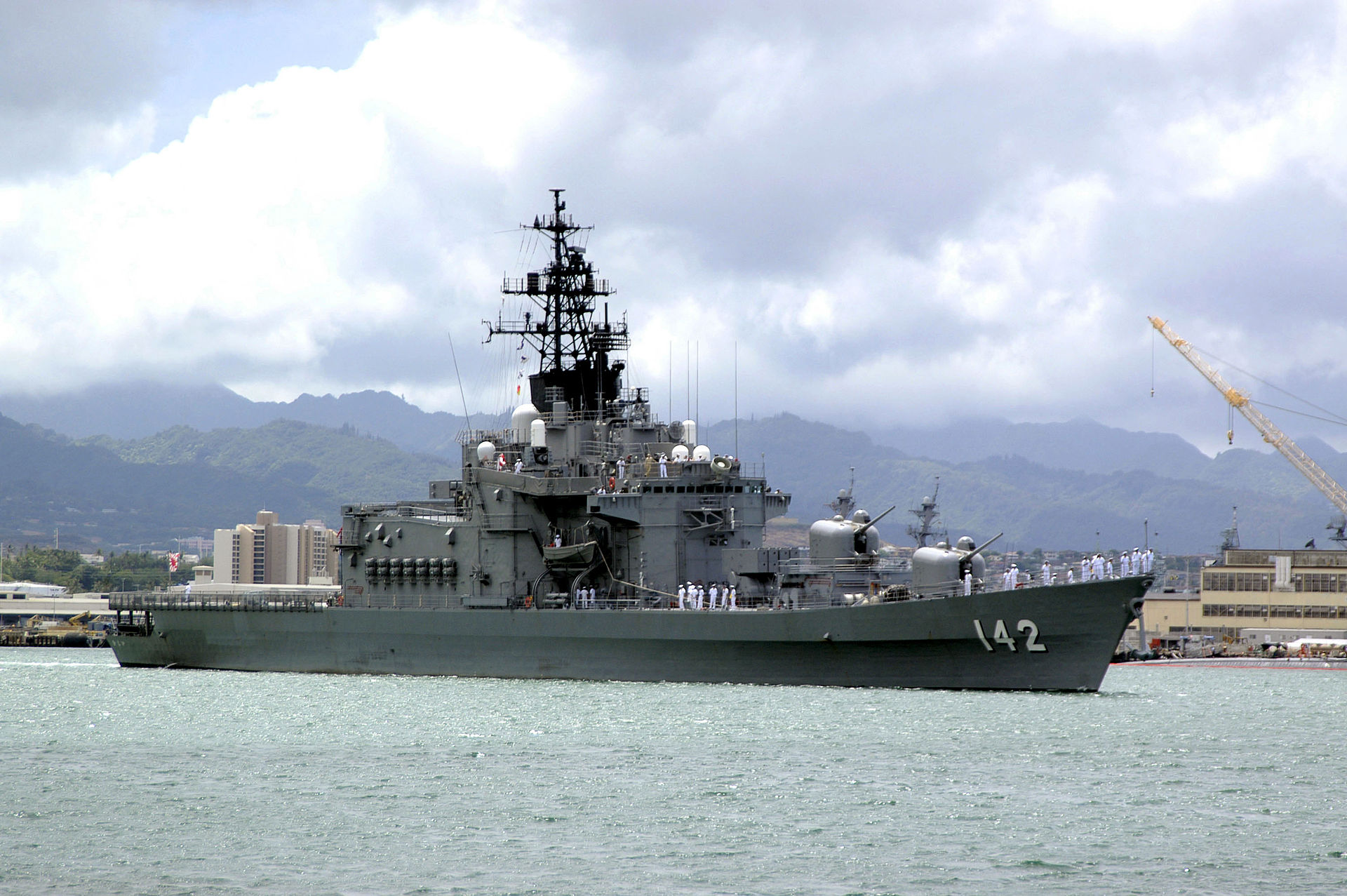
These ships were Japan's first helicopter-equipped destroyer (DDH), and their biggest feature was that they could carry three helicopters despite their 5,000-ton class , and can operate. Such ships, including the development of enhanced Shirane-class destroyers, can be regarded as the only ships in the world so far, which strongly reflect Japan's special military thinking. In terms of equipment, it is the first self-defense ship equipped with anti-sway fins to stabilize its flight attitude during helicopter operation.
In order to improve the safety and efficiency of flight work, a landing restraint device (beast trap) is installed to sway. ship.
Before the introduction of the Kongo-class destroyers (Aegis), this class (including the Shirane-class destroyers) was the largest support ship of the Japan Maritime Self-Defense Force.
Structure and Occupation
Hiei was laid on March 8, 1972 and launched on August 13, 1973 by the IHI Corporation Tokyo Shipyard. She was drafted into the 1st Convoy and deployed to Yokosuka on December 27, 1974.
From July 3 to August 17, 1978, she participated in the Hawaii dispatch training with sister ships JDS Haruna, JDS Kuroshio and eight P-2J aircraft.
JDS Hiei, JDS Amatsukaze, and eight P-2Js deployed to the United States beginning January 25, 1980, and participated in Exercise 1980 RIMPAC from February 26 to March 18. They were the first ships to join from Japan. Return to Japan on April 2.
On March 30, 1983, the 51st Escort Corps was withdrawn and became a ship directly controlled by the 1st Escort Corps.
On March 30, 1984, she was appointed flagship of the 4th Convoy.
The FRAM overhaul from August 31, 1987 to March 13, 1989 improved submarine search capabilities, single-ship air defense capabilities, warfare/information processing capabilities, and electronic warfare capabilities. However, the cost-effectiveness of FRAM refurbishment is not high, and similar large-scale refurbishments have only been carried out on two Haruna-class ships.
On March 2, 1995, the headquarters of the 4th Escort Brigade was moved to Wu, and the home port was moved to Wu.
In 1996, she participated in the 1996 RIMPAC exercise.
From May 11th to August 12th, 1999, she participated in US dispatch training with JDS Myoko and JDS Amagiri.
Participated in a joint Japanese-Russian search and rescue training with JDS Hamagiri off the coast of Petropavlovsk, Kamchatka, Russia, 1-11 September 2000.
Participated in US dispatch training with JDS Chokai and JDS Samidare, May 16-August 3, 2001.
Deployed to the Indian Ocean with JDS Samidare on 17 September 2002 under the Anti-Terrorism Special Measures Act. He served until December of the same year and returned to Japan on January 26, 2003.
On October 28, 2003, she was deployed to the Indian Ocean with JDS Akebono and JDS Tokiwa. Served until January 2004 and returned to Japan on March 3.
She visited Vladivostok, Russia from June 6 to 10, 2005, and participated in a joint Japanese-Russian search and rescue training off the coast of Vladivostok on June 10.
In 2006, she participated in the RIMPAC 2006 exercise.
On March 26, 2008, the escort corps was reorganized and merged into the fourth escort corps.
From July 23 to 27, 2010, he participated with JS Jintsu in the Japanese-Russian search and rescue training exercise SAREX off the coast of Vladivostok, Russia.
She retired on March 16, 2011. Her ultimate affiliation is the Fourth Guard and her home port is Wu. The service time is 36 years and 3 months. It is the longest ship in the history of the Maritime Self-Defense Force, with a sailing route of about 44 loops and a voyage of about 79,000 hours.
Specification
BASICS
Years of Service
1974
Origins
Japan
Status
stop service
Destroyed, scrapped.
supplement
360
staff
Class information
Class
Haruna Lesson
Class Size
2
ships
Class
JS Haruna (DDH-141); JS Hiei (DDH-142)
Carrier
Japan
Characters
Sea Bombing
Maritime bombardment/attack of surface targets/areas primarily through ship-based ballistic weapons.
Land Assault
Littoral attacks against surface targets primarily through ship-based missiles/missile weapons.
Sea Patrol
Active patrolling of critical waterways and sea areas; also serves as a local deterrent against air and maritime threats.
Airspace Denial/Deterrence
Neutralization or deterrence of flying elements by airborne missile weapon ballistics.
Fleet Support
Provide support (fire or materiel) to major surface fleets in blue water environments.
Dimensions and Weight
Length
502. 0 feet
153.01m
Ray
57. 4 feet
17.50m
Draft
17. 0 feet
5.18m
Shift
5,050 t
Power and Performance
Installed Power:
2 x boiler units power 2 x turbines producing 60,000 hp and drive 2 x axles in the stern.
Surface Velocity
31. 0 nodes
(35.7 km/h)
Weapons
2 x 5"/54 caliber Mk 42 (Type 73) deck guns with turret. 1 x Sea Sparrow Mk 29 Surface-to-Air Missile Launcher (SAM). 2 x 20mm Phalanx Closed - In Weapon Systems (CIWSs) 2 x Mark 32 triple torpedo tubes
Aircraft
3 x Sikorsky SH-60J(K) Seahawk naval helicopters equipped for anti-submarine warfare (ASW) missions.
 Argentina
 Armenia
 Australia
 Austria
 Austria-Hungary
 Belgium
 Brazil
 United Kingdom
 United States
 Brunei
 Bulgaria
 Canada
 Chile
Chile China
China Colonial America
 Colombia
 Confederate States
 Croatia
 Czech
Czech Denmark
 Egypt
Egypt Finland
 France
 Georgia
 Germany
 German Imperial
 Greece
 Holland
 Hungary
 India
India Indonesia
 Iran
Iran Iraq
Iraq Ireland
 Israel
 Italy
Italy Japan (1940)
 Jordan
 Kingdom of Italy
 Malaysia
 Mexico
 Myanmar
 Nazi Germany
 Netherlands
 New Zealand
 North Korea
 Norway
 Pakistan
 Peru
Peru Philippines
 Poland
 Portugal
 Prussia
 Romania
 Russia
 Saudi Arabia
 Serbia
 Singapore
 Slovakia
 Slovenia
 South Africa
 South Korea
 Soviet Union
 Spain
Spain Sweden
 Switzerland
 Syria
Syria Taiwan
 Thailand
 Turkey
 UAE
UAE Ukraine
 Vietnam
 Yugoslavia