


History
Unlike other global firepowers, the United States has never shied away from going to war with shotguns. This is testament to the situation in World War I (1914-1918) (even protests against Germany, which they ironically considered inhumane), when Remington Model 10 series pump-action shotguns were used to Provides weapons stockpiles to the U.S. military in Europe.
Some were even used on the eve of World War II (1939-1945) and after.
The design of the Model 10 is attributed to gunsmith John Pedersen (1881-1951), who John Moses Browning himself considered "the greatest gun designer in the world". Many of Remington's sporting rifle designs from this period can be traced back to Pederson's involvement, although his military-oriented efforts often failed through no fault of his own. John Pederson is the developer of the extraordinary "Pederson Mechanism" which was designed to be added to the M1903 Springfield Service Rifle to allow firing. 30 caliber short cartridge through a semi-automatic action that makes the M1903 bolt action The rifle is essentially a semi-automatic rifle.
Unfortunately, although the assembly line began to produce components, the Pederson installation was doomed to fail due to the cessation of hostilities in World War I - the armistice was signed in November 1918.
The Model 10 shotgun was introduced to the Remington line in 1910, initially as a movement system. Production would eventually span from 1908 to 1929 before the model was discontinued. All versions are 12 caliber and are available in a 32" long barrel and a shortened compact 20" version. The action is manual by operating a slider mounted under the barrel and around the cylindrical magazine.
The magazine is simple tubular and can hold up to five rounds. A button on the right side of the receiver is held down on each pump to accommodate a new shell and eject a spent shell. The loading port is located under the receiver, before the trigger, which doubles as the ejection port. Disassembly is relatively easy and only two parts are produced - the barrel/magazine tube with the slide and the receiver with the stock and trigger group. Each model has a fixed, ergonomic solid wood stock that is attached to the receiver's stock with a molded pistol grip.
Slides are also made of wood and are often ribbed for a firm grip. An iron sight is forged outside the muzzle. The right places for the Model 10 to function are the firing hands around the grips, the shoulder rests in the shoulder pockets, and the support hands on the pump slider.
Therefore, the rate of fire of the weapon is limited to the speed of action, and reloading is relatively easy.
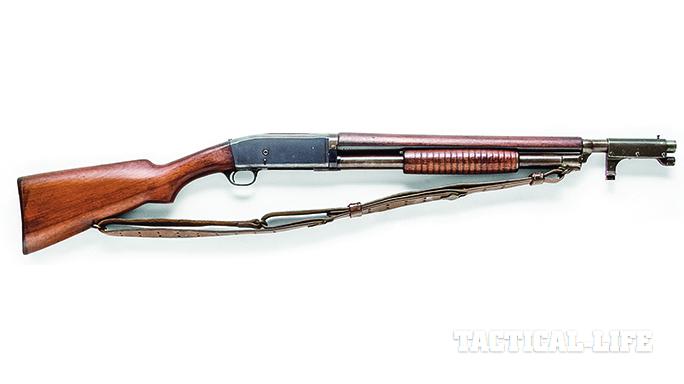
When the United States entered World War I in 1917, Remington contracted with Remington to supply it with a military version of the Model 10 (Type 10-A) (other gun manufacturers were also involved ). This spawned a range of weapons commonly referred to as "shotguns". The Model 10 trench shotgun is more or less faithful to its sports core, with a shortened 23" barrel for compactness, a wooden heat shield mounted on the barrel to protect the forehand, sling for the shoulder strap Cable swivel, and bayonet mount under the muzzle mount, US standard M1917 bayonet. These versions served on the front lines alongside the competing Winchester Model 1897 shotgun, the U.S. Army's primary shotgun in warfare.
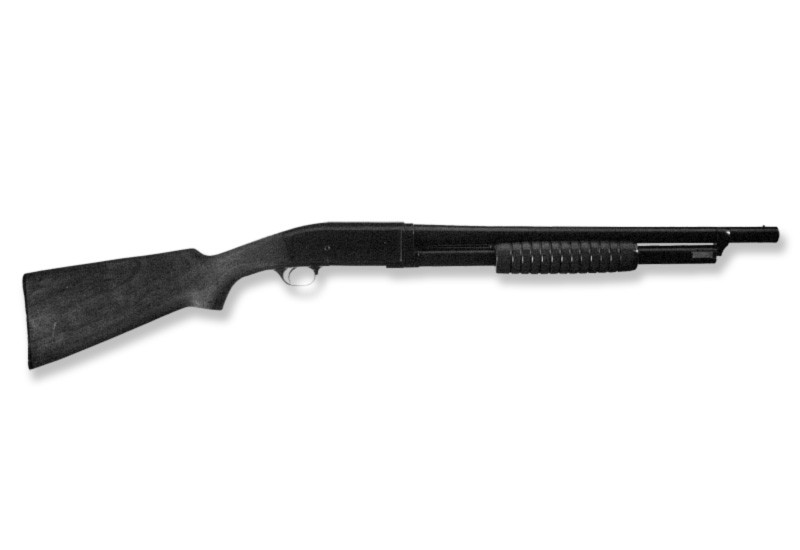
The Model 10 was also procured in a 20-inch barrel form (referred to as a "riot gun") to meet guard duty requirements. Like the Model 1897, the Remington Model 10 also purchased 26" and 30" barrel configurations for training aircraft gunners in the art of shooting moving targets from a distance. During World War I, approximately 3,500 to 5,000 Remington Model 10s were produced for the U.S.
Army.
Shotguns are certainly valuable in close combat - whether for urban combat or trenches. While machine guns and military rifles dominate the long-range aspects of warfare, weapons such as shotguns, pistols, grenades, and knives/bayonets are required to clear or eliminate remaining enemy forces in defensive positions.
The shotgun's repeat-firing nature and inherent firepower proved invaluable in trench warfare, and the Model 10 didn't disappoint in that regard (nor did any of the U.S. military's competing shotgun brands during the conflict). It was its lethality that led the Germans to protest the weapon in the final stages of the warand, of course, the Reich itself was guilty of using poison gas on the battlefield against the Allies.
Over 275,500 Remington Model 10s were eventually produced. In its militarized form, the shotgun remained in official combat service until the 1930s, especially for some members of the U.S. Marine Corps who knew it was a solid weapon as soon as they saw it.
The Model 10 series, discontinued by Remington in 1929, remains a rare collectible to this day. The Model 10 was in limited circulation during the Korean War (1950-1953) and Vietnam War (1955-1975).
Another shotgun design used by Remington in World War I was the Model 11, which was based on an unrelated design licensed by John Browning and had a markedly different appearance compared to the Model 10.
Specification
Roles
- Close Combat (CQB) / Personal Protection
Dimensions
584 mm (22.99 in)
3.60 kg
Steel Front.
Performance
Hand pump slides
10 rounds per minute
60 ft (18 m; 20 yd)
Changes
Model 10 - Basic Remington Model Name
Model 10-A - Basic Production Model
M10 - Abbreviation
Model 10 "Trench Gun" - militarized Model 10; 23" barrel; sling swivel for shoulder straps; eyelets for bayonet connection; wooden handguards on barrel; first time 3,500 were produced for the U.S.
Model 10 "Riot Gun" - Military Guard model; 20" barrel.
Model 10 completion level
 Argentina
 Armenia
 Australia
 Austria
 Austria-Hungary
 Belgium
 Brazil
 United Kingdom
 Brunei
 Bulgaria
 Canada
 Chile
Chile China
China Colonial America
 Colombia
 Confederate States
 Croatia
 Czech
Czech Denmark
 Egypt
Egypt Finland
 France
 Georgia
 Germany
 German Imperial
 Greece
 Holland
 Hungary
 India
India Indonesia
 Iran
Iran Iraq
Iraq Ireland
 Israel
 Italy
Italy Japan
Japan Japan (1940)
 Jordan
 Kingdom of Italy
 Malaysia
 Mexico
 Myanmar
 Nazi Germany
 Netherlands
 New Zealand
 North Korea
 Norway
 Pakistan
 Peru
Peru Philippines
 Poland
 Portugal
 Prussia
 Romania
 Russia
 Saudi Arabia
 Serbia
 Singapore
 Slovakia
 Slovenia
 South Africa
 South Korea
 Soviet Union
 Spain
Spain Sweden
 Switzerland
 Syria
Syria Taiwan
 Thailand
 Turkey
 UAE
UAE Ukraine
 Vietnam
 Yugoslavia